How I Found Metaliteracy

by Misha Robinson

My journey to metaliteracy has not been expected or exactly straightforward; I am an adjunct lecturer at a community college in Maryland and started out as a fierce advocate of media literacy and critical consumption in the age of social media. It was at the Maryland Consortium for Adjunct Faculty Professional Development in 2024 that I ran into the idea—and the woman—who lit the spark. Dr. Rhianna Rodgers was the keynote speaker that day, and she had a great deal to say about AI and its potential applications for the classroom. I was something of an AI skeptic—not closed, but definitely wary. At the Q&A, I asked her how I could integrate AI into the media literacy that I was teaching—less ‘how to use AI’ and more ‘how to identify AI-generated content’ and ‘how to defend yourself against doctored reality.’ Her response was immediate—she put me in touch with a colleague, Dr. Thomas Mackey, and told me to ask him about metaliteracy. She explained that metaliteracy asks learners to consume more critically but also to reflect on what they consume and to use that knowledge to make something new. I reached out and Dr. Mackey and I connected, and I have never looked back.

This summer, I learned that Dr. Mackey was giving a presentation with some colleagues about Metaliteracy and AI up at SUNY Stony Brook, so I figured what the heck, and I went up to attend the conference for a day. I came away practically vibrating with ideas and enthusiasm, and with a burning need to share metaliteracy with other faculty, not just with my students. There is so much that metaliterate class construction can do to facilitate deep learning, and metaliterate learning elegantly addresses student use of AI, which seems to be the digital elephant in the room these days.

Bringing Metaliteracy to Fellow Faculty

So, there I was: an adjunct instructor at the front of a room filled with part-time, full-time, and tenured faculty, thinking that I had something ground-breaking to share. To say that I was nervous would be an understatement. However, I have often referred to myself, somewhat jokingly, as a shameless evangelist for metaliteracy, and now I had my chance!

First, I wanted to illustrate the benefits to students of teaching from a metaliteracy framework—namely, that students become more reflective and engaged learners. They work in collaboration with others to synthesize and produce new knowledge and contribute that knowledge responsibly as civically minded people engaged in building the world they want to live in. Second, I had taken great pains to construct my presentation as one that was discipline-agnostic; I had no idea who would be in the room, either in terms of their department or discipline or how they might feel about integrating technology such as AI or podcasts into their classes. It was critical that the presentation feel relevant to everyone so that no one felt it was a waste of time or a poor fit. As it turns out, I had a handful of librarians and faculty from the departments of English, accelerated learning, math, philosophy, and academic development, among others. I seized the opportunity given to show everyone that metaliteracy unites strands of thought and learning from across disciplines.
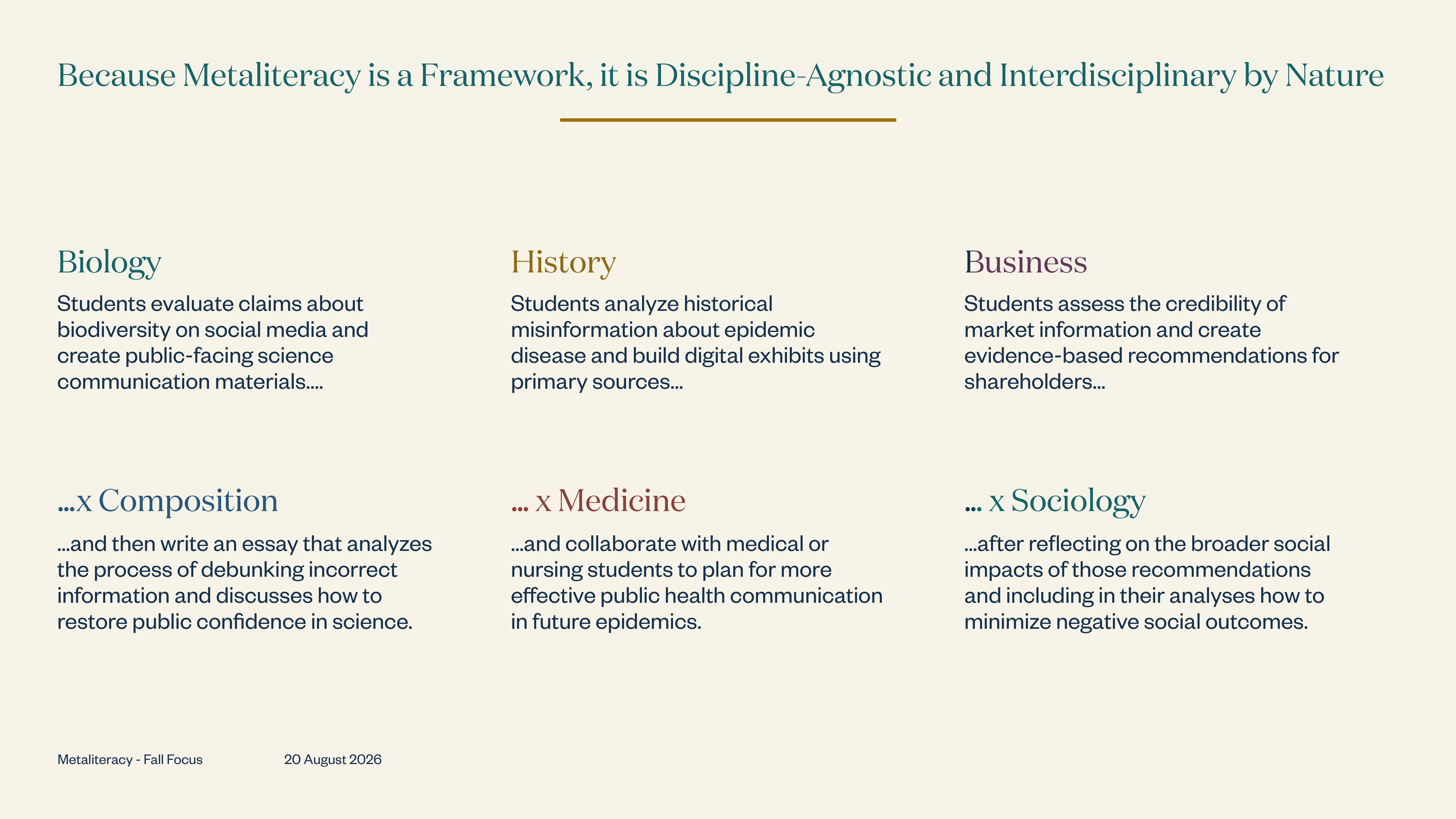
One of the early slides in the presentation by the author that provides examples of how students can use interdisciplinary approaches to enrich and enhance understanding of the world around us.
Figure 1: This is one of the early slides in the presentation, giving examples of how students can use interdisciplinary approaches to enrich and enhance understanding of the world around us.

I took the opportunity to explain how metaliteracy benefits their students by better preparing them for a world that is inundated with information and leaves them on their own to sort it out. I showed them what metaliteracy could do for their students—like history students analyzing historical misinformation about pandemics like the 1918 Influenza, building digital exhibits using primary sources, then collaborating with health science students on how to improve public health communication for future pandemics. Then, I showed my colleagues how to do it themselves: I provided basic guidelines for how to build metaliteracy into classroom assignments, from lab reports to literature reviews, using verbs like Find, Synthesize, and Reflect that map onto Bloom’s Taxonomy to keep it familiar.
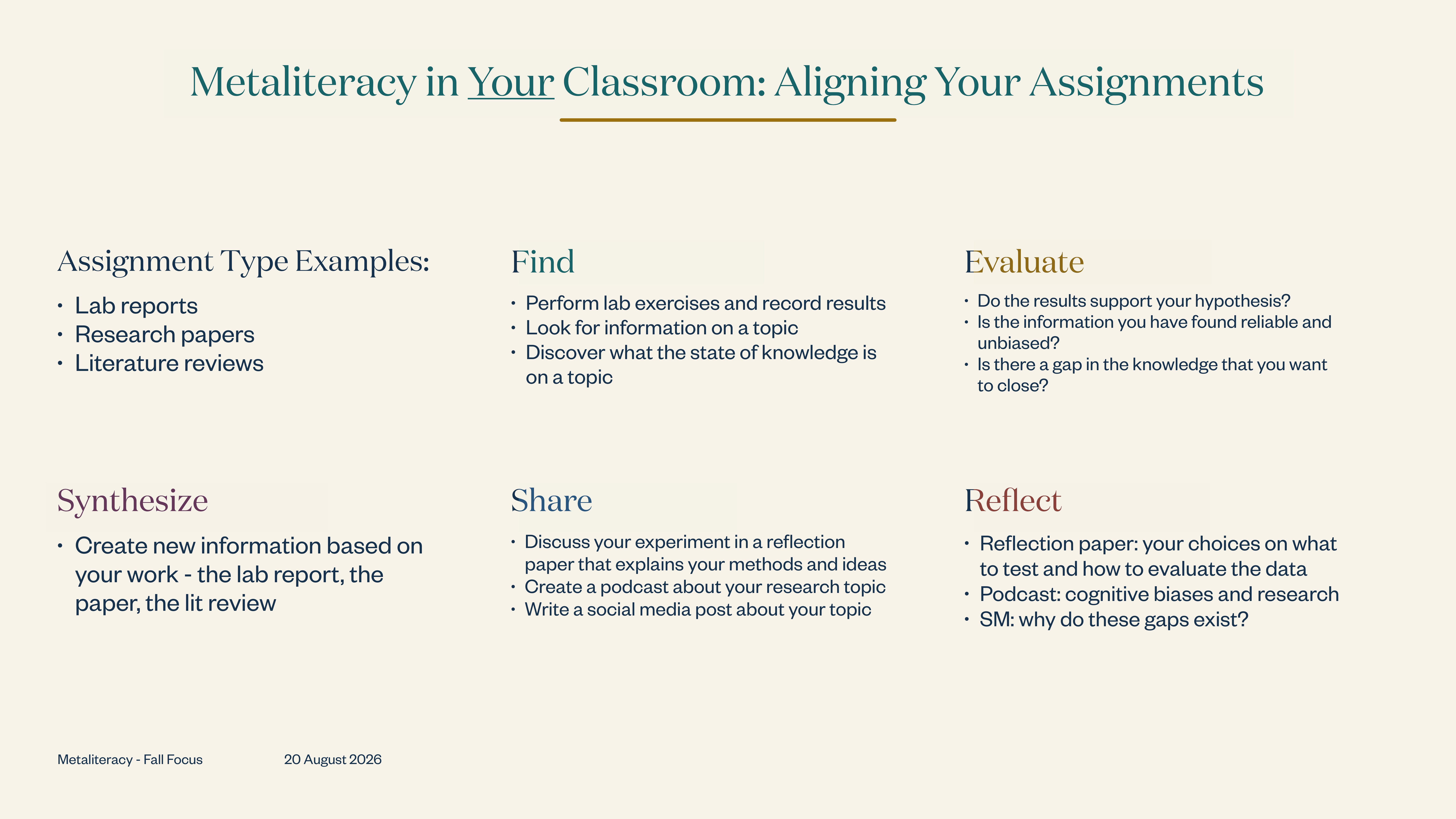
A slide from the author's presentation on how to integrate metaliteracy goals into assignment types that educators already use.
Figure 1: A slide from my presentation on how to integrate metaliteracy goals into assignment types that educators already use.

Okay, But… Why Metaliteracy?

Metaliteracy requires you to take the knowledge you have found and evaluated and do something with it. Share it, remix it, collaborate with others and turn it into something new. It is not enough to have the information; use it to the benefit of your fellow humans. It feels naïve to say this, but I see the benefits of metaliteracy so clearly that it honestly never occurred to me that others might not. So, I was surprised when one of the participants challenged me to really differentiate metaliteracy from information literacy. The answer was, to me, so simple that I struggled for several minutes to articulate it. However, this was the moment when I found that my presentation truly landed with some of the faculty, as one of them turned around to the questioner and gave his version of what the difference between them was—he homed in on the metacognitive domain and suggested that was where the difference lies.

Advice for Presenters

For those who have read the articles, or the books, or have read this website from start to finish, and are thinking about bringing metaliteracy to their institutions, I offer the following advice: first, keep it broad and interdisciplinary. On the first slide after my title, I offered a reassurance that if you’re not sure where or whether metaliteracy fits your discipline, there would be examples from many fields of academia. Building a coalition of faculty across disciplines leads by example and gets people out of their ‘silos.’ Second, make it low effort: giving educators a broad overview of how to incorporate metaliteracy into the assignments they already use lessens the barrier to entry. Finally, if there are specific concerns that the community has, such as AI, address them directly.

Metaliteracy has so much potential to help not just students but all of us to integrate our hard-won knowledge and wisdom that we gain across situations and subjects, and to shape the world we want to live in together. Come and be my neighbor!

References

Jacobson, T., & Mackey, T. (2025). 2025 metaliteracy goals and learning objectives. Metaliteracy. https://metaliteracy.org/learning-objectives/metaliteracy-goals-and-learning-objectives-updated-2025/

Thomas P. Mackey and Trudi E. Jacobson, “Reframing Information Literacy as a Metaliteracy.” College & Research Libraries 72, no. 1 (2011): 62–78. 

Photo of the author Misha Robinson.

Misha Robinson (she/they) holds a Masters in Liberal Studies from Indiana University. She teaches in the English department at The Community College of Baltimore County (CCBC). Their teaching and research foci are English composition, metaliteracy, and neurodiversity and accessibility in education. She presently serves on the CCBC School of World Languages and Literature’s AI Committee, the Neurodiversity Unbound Committee, and on the Textbook Affordability Committee.  When they are not teaching, Misha is an Emotional Support Human for a very spoiled Snowshoe cat named Selkie, collects fabric, and enjoys puzzles.  

This post was written in its entirety by Misha Robinson, and utilized generative AI to check accessibility and provide editing feedback.
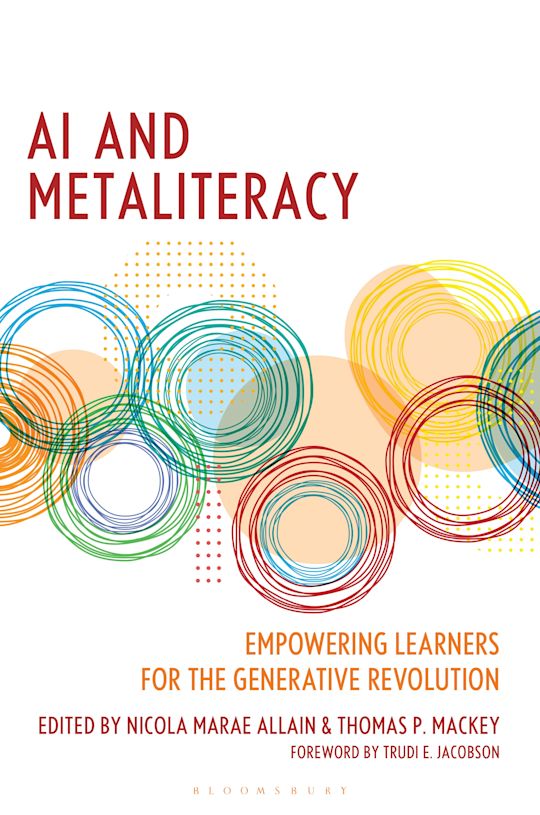
New AI and Metaliteracy Book to be Published in Early 2027

The manuscript for the new edited book by Drs. Nicola Marae Allain and Tom Mackey, AI and Metaliteracy: Empowering Learners for the Generative Revolution, has officially moved into the production phase at Bloomsbury Publishing. Scheduled for publication in early 2027, the volume features a Foreword by Distinguished Librarian Emerita Trudi E. Jacobson and appears in Bloomsbury’s Innovations in Information Literacy series, for which she serves as series editor. As generative AI continues to transform teaching and learning, the collection offers timely perspectives on empowering learners to engage critically and ethically with these technologies.

The new book includes a framing chapter by Allain and Mackey entitled, The Aura of the Image: Embedding AI and Metaliteracy in the Digital Media Arts. The chapter integrates media theory and metaliteracy with adaptable case studies, including examples from Empire State University’s Digital Media Arts program, to explore how metaliteracy can support creative inquiry, reflective learning, and ethical engagement with artificial intelligence.

Bringing together an international community of scholars and practitioners, the collection demonstrates how AI and metaliteracy can foster learner agency, strengthen visual and digital literacy, promote digital citizenship and social justice, and advance ethical engagement across educational and information contexts. Additional chapters examine applications in STEM education, financial literacy, digital workspaces, the metaverse, and library and information settings, while also addressing issues of accessibility and inclusive participation. Collectively, these contributions illustrate the broad applicability of AI and metaliteracy across disciplines and professional environments. The case studies offer innovative approaches that can be adapted and transferred across disciplines, institutions, and learning environments.

In addition, Mackey contributes a chapter co-authored with colleagues from the Intercultural Perspectives on Information Literacy and Metaliteracy (IPILM) virtual exchange team. The chapter examines how information literacy and metaliteracy can be combined with AI education to foster intercultural understanding and global engagement in team-based learning environments.

As publication approaches, we look forward to sharing additional details about the volume and to continuing the conversation about the evolving relationship between artificial intelligence, metaliteracy, and learner empowerment in digital environments.

Register for the AI & Metaliteracy Workshop at SUNY CIT 2026

Generative AI is reshaping how we design assignments, support student learning, and think about authorship and participation. The question is no longer whether to engage with AI in our teaching—but how to do so in ways that are ethical, reflective, and effective.

At the Conference on Instruction & Technology 2026, we invite you to register for a hands-on preconference workshop focused on applying the AI & Metaliteracy OER Toolkit in your own teaching.

Learn to Apply Ethical, Effective Learning with AI Using Metaliteracy
🗓 Tuesday, May 26, 2026
🕒 2:30–5:30 PM ET
📍 SAC 304, Stony Brook University

This interactive session will also mark the official launch of the AI & Metaliteracy OER Toolkit, developed through a SUNY Innovative Instruction Technology Grant by a collaborative team at Empire State University. The project is led by Principal Investigators Nicola Marae Allain and Thomas P. Mackey, with Alena Rodick serving as Project Manager and Eugenio Solis de Ovando leading digital video and AI avatar development. It also includes collaboration with Kathleen Olmstead and Logan Roth, Ph.D., both at SUNY Brockport.

This is a working session designed for direct application. Participants will explore the AI & Metaliteracy OER Toolkit, identify sample assignments and rubrics to adapt for their own courses, and revise those materials for their specific teaching context. Participants will also have the option to use AI as part of this process, modeling reflective and ethical engagement in their design choices. We encourage you to bring a learning activity you would like to develop or revise for your instructional setting.

Participants will leave with practical strategies for integrating AI through the metaliteracy framework, along with adapted assignments they have developed for their own course. They will also gain access to a wide range of resources from the AI & Metaliteracy OER Toolkit, including customizable assignment templates, guidelines, rubrics, learning modules, and implementation strategies. The workshop will also provide opportunities to connect with colleagues engaged in this work, with the potential to continue sharing ideas beyond the session.

AI is not just a new tool—it is reshaping how learners engage with information, create content, and participate in knowledge production. This workshop focuses on how metaliteracy can guide that work in practice, supporting learners as reflective, responsible, and active contributors in AI-mediated environments.

This work also reflects a broader commitment to open and collaborative dialogue about teaching and learning with AI, and we look forward to sharing additional updates as the toolkit becomes more widely available.

The session will be led by Dr. Nicola Marae Allain, Dr. Thomas P. Mackey, and Dr. Eugenio Solis de Ovando.

Please bring your own device and come ready to work with your own course materials.

Register today to join us at the workshop!

From Information Literacies to Metaliteracy: Learner Agency in an AI-Mediated World

The slide deck for this presentation is available as a resource for exploring the core components of metaliteracy and AI-related learning activities in greater detail.

As metaliteracy continues to evolve in response to AI and emerging technologies, this keynote invites further reflection and application. Readers are encouraged to consider how these ideas might inform their own teaching and learning contexts—whether by integrating metaliteracy principles into course design, developing new learning activities, or engaging students as active and ethical producers of knowledge. The embedded materials—including two Slido surveys, reflective prompts, and examples of assignments—offer opportunities to explore these concepts in practice and to extend the conversation across diverse educational settings.

We encourage readers to apply these ideas in their own contexts and to share examples of their work with us for possible feature on the Metaliteracy blog.

-Tom and Trudi

Metaliteracy Examined at the Faculty360.org Global Summit on AI

At the Faculty360.org 2025 Summit, hosted virtually by Zayed University in the United Arab Emirates, Tom Mackey delivered a presentation titled “Developing Metaliterate Learners for Generative AI.” The summit theme, Beyond the AI Hype: Faculty Futures in a Changing World, provided the context for a session that introduced metaliteracy as a holistic pedagogical framework for teaching and learning with generative AI. The presentation examined how the model supports critical thinking, knowledge production, and collaborative learning in AI environments.

The talk outlined the key elements of the metaliteracy framework and illustrated how its learner domains, roles, and characteristics guide effective engagement with generative AI. The 2025 revision of the Metaliteracy Goals and Learning Objectives was discussed as a transferable resource for educators seeking to support ethical, reflective, and empowered engagement with AI across disciplines.

Several examples of learning activities from the Digital Media Arts program at Empire State University illustrated how the integration of AI and metaliteracy can foster creativity, critical reflection, and informed decision-making. The session also introduced new versions of the metaliteracy diagrams, offering updated visualizations that show how the framework enhances multiple modality learning in a wide range of educational settings.

The slide deck from this presentation is now available and can be accessed below.

If you would like to contribute your own take on these ideas, particularly as they relate to the metaliteracy framework and the updated Metaliteracy Goals and Learning Objectives, we would be glad to work with you on a guest blog post.

Tom and Trudi

Reimagining Course Design with AI: Practical Strategies for Global Learning

As part of the SDL (Self-Directed Learning) Collaborative Corner on Multimodal Learning and Open Educational Resources (OER) at North-West University, Prof. Tom Mackey, Empire State University, presented an interactive session on Reimagining Course Design with AI: Practical Strategies for Global Learning. The virtual event brought together educators and researchers to explore innovative ways of redesigning courses with artificial intelligence (AI) to support OER and multimodal learning.

The presentation drew on examples from the Digital Media Arts program at Empire State University, highlighting practical strategies from courses such as Digital Storytelling, Information Design, and Ethics of Digital Art & Design. In doing so, it connected the application of AI in course design with a metaliteracy perspective, underscoring the importance of reflective, ethical, and collaborative learning.

Explore the Session

The full session recording is now available, offering an in-depth look at the key themes and interactive discussions (click on the image):

Key Takeaways

  • Revise course content and learning activities with AI to expand opportunities for reflection, collaboration, and creativity.
  • Create original images with AI to enhance open resources and support multimodal learning experiences.
  • Develop transparent and ethical AI use policies to ensure responsible student engagement with emerging tools.
  • Design rubrics for AI-assisted and multimodal projects to provide clear, equitable assessment frameworks.

These approaches demonstrate how AI can be integrated as an effective tool across disciplines and learning environments. Educators are encouraged to consider how such strategies can be adapted to their own teaching practices, fostering inclusive, innovative, and globally connected learning opportunities.

For a closer view of the concepts and examples shared, the slide deck provides a visual overview of the session. Respond to the workshop prompt on slide 26 to reimagine your own learning activity with AI:

This presentation contributes to the ongoing dialogue about the role of AI in education and its potential to empower learners and educators in designing flexible, reflective, and future-ready courses. It offers a metaliteracy perspective to further emphasize the importance of ethical engagement, critical reflection, and collaborative learning in applying AI to course design.

If you have ideas or case studies about integrating AI and metaliteracy into your own course design, we invite you to reach out. We would be glad to feature your approaches as a guest post on the Metaliteracy blog and share your insights with our global community.

Tom and Trudi

Digital Story: Embracing Metaliteracy in the Digital Age

We welcome this guest blog post from Riaz Laghari. He is an English language teacher, researcher, and writer from Pakistan. His work focuses on digital literacy, education, language, and critical thinking. As a passionate lifelong learner, he is dedicated to exploring how pedagogy and technology intersect to promote responsible digital citizenship.

I completed the Coursera MOOC Metaliteracy: Empowering Yourself in a Connected World offered by Empire State University. It was an incredibly enriching experience that broadened my understanding of how learners engage with information in today’s digital environment.

This story published in Medium entitled Embracing Metaliteracy in the Digital Age reflects my personal journey and learning process. It emphasizes the importance of being a responsible digital citizen in today’s interconnected world. Through the narrative, I explore how embracing metaliteracy has helped me understand the significance of critical thinking. It also highlights the importance of ethical information sharing. Collaboration in digital spaces is another key aspect I have come to appreciate. As I state in the article:

Metaliteracy has transformed my approach to digital engagement, equipping me with the tools to navigate the online world responsibly, ethically, and collaboratively.

In today’s fast-paced digital world, being an informed and ethical participant in online spaces is more important than ever. In this piece, I reflect on my personal journey as a digital citizen. I also consider my professional journey. My experiences are guided by the principles of metaliteracy. This article highlights how this model has influenced my way of learning. It details how I teach and share information. It shows how I evaluate online sources and engage responsibly in digital communities.

As I state in the article:

In my experience, embracing metaliteracy has meant developing a heightened awareness of my role in the digital ecosystem. It’s about recognizing that the content I create and share impacts others, and therefore, I must engage with this content thoughtfully and critically. This responsibility extends to both professional and personal digital spaces.

Besides my own journey, I also apply metaliteracy concepts in my teaching. I encouraged my students to reflect critically on the sources they use. I urged them to recognize their role as both consumers and producers of information. I also motivated them to collaborate more mindfully in digital spaces. For instance, I integrated reflective blog writing into the curriculum. I also added peer feedback activities. These methods helped promote metacognitive awareness. They fostered a more participatory learning environment. It was particularly effective in helping students become more responsible and confident digital citizens.

As I conclude in my Medium article:

As we continue to interact with the ever-expanding digital landscape, it is crucial for all of us to embrace metaliteracy. By doing so, we can foster a more informed, ethical, and connected world, where information flows freely and responsibly.

Riaz is an English teacher, and writes about language and political discourse in Pakistan. You can find his work on Medium and via his personal blog. If you would like to share your personal or professional experience with metaliteracy, feel free to reach out.