Metaliteracy Panel Explored Learner Agency and Ethical Engagement at the AAC&U AI in Higher Education Conference

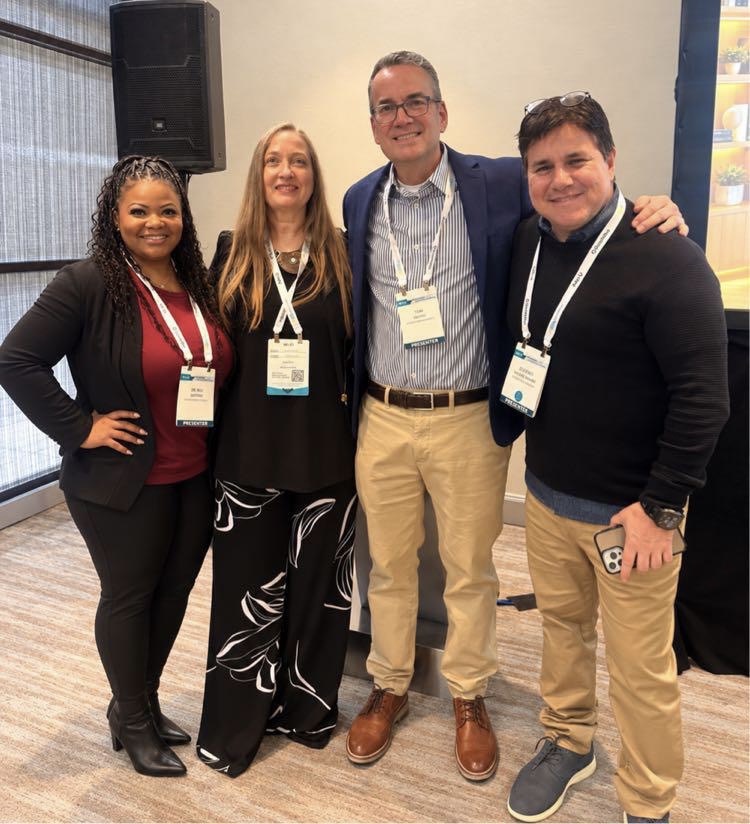
A collaborative panel featuring Drs. Nicola Marae Allain, Thomas P. Mackey, and Eugenio Solis d Ovando (pictured to the right with SUNY Empire colleague Dr. Rosilyn Sanders) presented at the AAC&U Conference on AI and Higher Education in Atlanta, Georgia. Their presentation, entitled “AI and Metaliteracy: A Framework for Ethical Engagement, Authorship, and Agency,” took place on October 29, 2026.
The panel highlighted two projects that apply metaliteracy to teaching and learning with generative AI. The AI & Metaliteracy Open Educational Resources (OER) Toolkit, supported by a SUNY Innovative Instruction Technology Grant (IITG), provides adaptable assignments, reflective learning activities, and rubrics.

AI avatar videos created by Eugenio Solis de Ovando opened and closed the session. Solis de Ovando also demonstrated how he creates an avatar, providing a practical example for the discussion of ethical engagement, authorship, and agency.

Later in the session, participants worked in small groups and were encouraged to consider how they might revise one of their own learning activities using metaliteracy. They explored how learner roles such as producer, collaborator, researcher, and teacher could inform what students create, how they work with others, and how they reflect on their decisions about AI use.

Viewers are welcome to use or adapt any part of the presentation for their own workshops and learning activities. To try the small-group exercise on your own, choose a learning activity you already use, select a metaliterate learner role, and consider how that role could guide one change to the activity.

The panel’s discussion drew on the forthcoming Bloomsbury volume AI and Metaliteracy: Empowering Learners for the Generative Revolution, edited by Nicola Marae Allain and Thomas P. Mackey, with a Foreword by Trudi E. Jacobson. The presenters also discussed the development of AI Learning with Metaliteracy, a forthcoming Coursera course to be launched in January 2027.
Introducing the AI & Metaliteracy OER Toolkit for Teaching and Learning

We are excited to introduce the AI & Metaliteracy OER Toolkit for Teaching and Learning, an openly licensed and adaptable resource that supports teaching and learning with generative AI through the framework of metaliteracy. The toolkit was developed by Empire State University professors Nicola Marae Allain, Tom Mackey, and Eugenio Solis de Ovando, in collaboration with Alena Rodick, Director of Learning Design and Solutions. This project was funded through a SUNY Innovative Instruction Technology Grant (IITG).

As generative AI redefines how we engage with and produce information, metaliteracy provides an essential framework for thinking critically about these technologies and reflecting on how we use them. By emphasizing learner agency and responsible participation, metaliteracy encourages us to consider our roles and responsibilities in AI-mediated environments.

The toolkit can be accessed through OER Commons, downloaded as a PDF, or imported into a learning management system using either the Common Cartridge or Brightspace Cartridge. Visit our new Access the AI & Metaliteracy OER Toolkit page for the available options and instructions

Apply It, Adapt It, Share It

Designed as an open educational resource (OER), the toolkit can be applied, adapted, and shared to fit your needs. Apply the toolkit’s learning activities and modules, which are informed by the Metaliteracy Goals and Learning Objectives; adapt the materials for your learners, teaching setting, or professional development needs; and share what you create.

Meet Our AI Avatars

To introduce the toolkit, Nicola Marae Allain, Tom Mackey, and Eugenio Solis de Ovando experimented with generative AI to create AI avatars of themselves. Eugenio led the AI production, while Nicola designed the environments in which the avatars appear. The videos reinforce the creative use of AI while raising questions about authorship, representation, and agency that are explored throughout the toolkit.

What’s in the Toolkit?

Five instructional modules explore metaliterate learner identity; ethical evaluation and production; collaborative and participatory engagement; development as a metaliterate learner; and next steps for continued learning. The modules include activities, assignments, reflections, rubrics, and supplemental resources, many adapted from our teaching in the Digital Media Arts program. Each module starts with a detailed description, suggestions for adapting the materials, and key takeaways informed by both the Metaliteracy Goals and Learning Objectives and Bloom’s Taxonomy.

We hope you will use the toolkit, make it your own, and share how you are applying and adapting it with your students, colleagues, and learning communities. We look forward to hearing about your experiences at Metaliteracy.org.

We thank Empire State University colleagues Susan Oaks and Cindy Conaway for contributing course-based materials and SUNY Brockport colleagues Kathleen Olmstead and Logan Rath for their additional support of the IITG project.

AI and Metaliteracy OER Toolkit by Nicola Marae Allain, Tom Mackey, Eugenio Solis de Ovando, and Alena Rodick, Empire State University, is licensed under a Creative Commons Attribution-ShareAlike 4.0 International License.