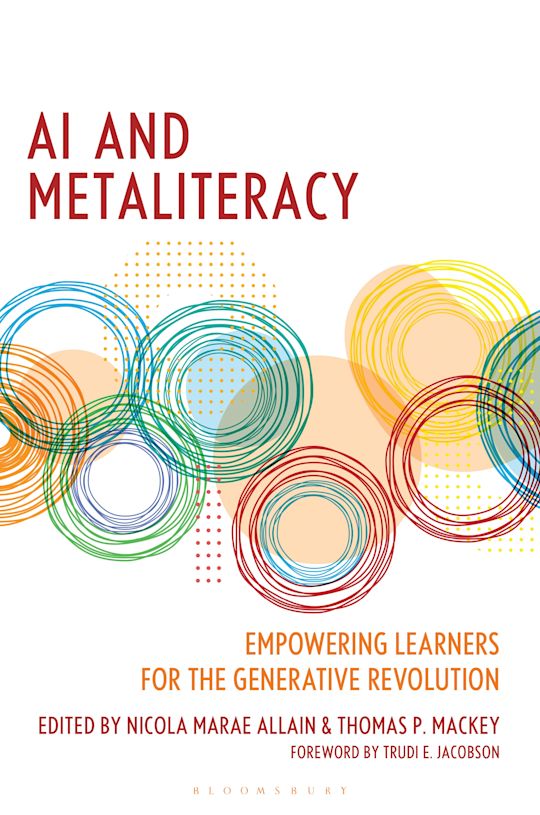
The manuscript for the new edited book by Drs. Nicola Marae Allain and Tom Mackey, AI and Metaliteracy: Empowering Learners for the Generative Revolution, has officially moved into the production phase at Bloomsbury Publishing. Scheduled for publication in early 2027, the volume features a Foreword by Distinguished Librarian Emerita Trudi E. Jacobson and appears in Bloomsbury’s Innovations in Information Literacy series, for which she serves as series editor. As generative AI continues to transform teaching and learning, the collection offers timely perspectives on empowering learners to engage critically and ethically with these technologies.
The new book includes a framing chapter by Allain and Mackey entitled, The Aura of the Image: Embedding AI and Metaliteracy in the Digital Media Arts. The chapter integrates media theory and metaliteracy with adaptable case studies, including examples from Empire State University’s Digital Media Arts program, to explore how metaliteracy can support creative inquiry, reflective learning, and ethical engagement with artificial intelligence.
Bringing together an international community of scholars and practitioners, the collection demonstrates how AI and metaliteracy can foster learner agency, strengthen visual and digital literacy, promote digital citizenship and social justice, and advance ethical engagement across educational and information contexts. Additional chapters examine applications in STEM education, financial literacy, digital workspaces, the metaverse, and library and information settings, while also addressing issues of accessibility and inclusive participation. Collectively, these contributions illustrate the broad applicability of AI and metaliteracy across disciplines and professional environments. The case studies offer innovative approaches that can be adapted and transferred across disciplines, institutions, and learning environments.
In addition, Mackey contributes a chapter co-authored with colleagues from the Intercultural Perspectives on Information Literacy and Metaliteracy (IPILM) virtual exchange team. The chapter examines how information literacy and metaliteracy can be combined with AI education to foster intercultural understanding and global engagement in team-based learning environments.
As publication approaches, we look forward to sharing additional details about the volume and to continuing the conversation about the evolving relationship between artificial intelligence, metaliteracy, and learner empowerment in digital environments.


I eagerly await this publication, which will undoubtedly be a milestone for the application of Metaliteracy supported by AI.
Helda Pinheiro
Helda,
Thank you so much for your interest in our forthcoming book AI & Metaliteracy!
Tom