CALL FOR PAPERS: Teaching and Learning with AI through Metaliteracy

The Independent Journal of Teaching and Learning is seeking submissions for a special issue on Teaching and Learning with AI through Metaliteracy.
Prof. Thomas P. Mackey and Prof. Nicola Marae Allain from Empire State University have been invited to serve as guest editors for this thematic collection, which celebrates the 21st anniversary of this peer-reviewed international journal from South Africa. The journal brings together researchers and educators from around the world to share scholarship that advances teaching, learning, and educational practice.

We invite submissions of original research and reflective scholarship that explore how metaliteracy can inform teaching and learning with artificial intelligence. Contributions may examine theory, pedagogy, classroom practice, assessment, learner engagement, ethics, creativity, self-directed learning, or interdisciplinary applications across multimodal contexts.

As artificial intelligence continues to influence teaching and learning, and the production and sharing of knowledge, metaliteracy prepares learners for evolving information environments, including those mediated by AI. The metaliteracy model emphasizes learner agency through interconnected learning domains, learner roles, and learner characteristics. We welcome submissions that explore how these core components of metaliteracy can inform teaching and learning with AI across a wide range of educational settings.

Please see the full Call for Papers for submission guidelines, important dates, and the complete list of suggested topics. A downloadable PDF of the call is also available for sharing with colleagues.

Nicola and I look forward to bringing together a diverse collection of scholarship that explores innovative approaches to AI and metaliteracy from international perspectives.
New AI and Metaliteracy Book to be Published in Early 2027

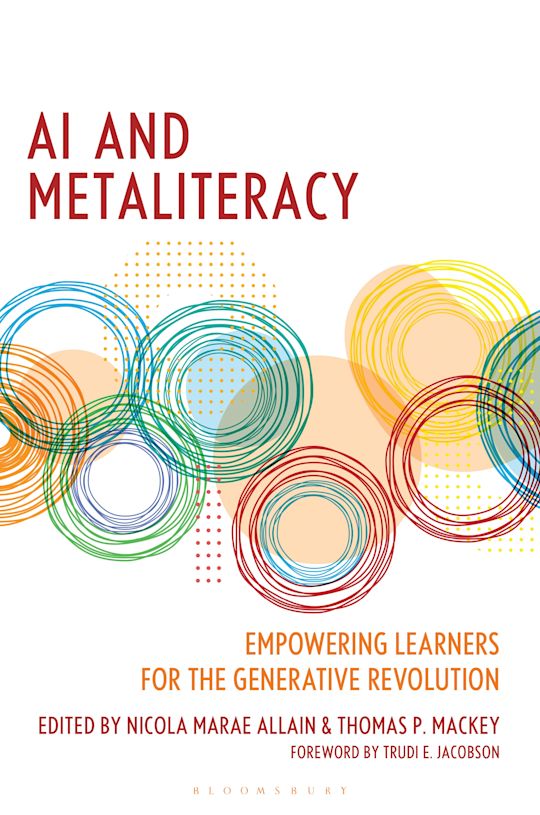
The manuscript for the new edited book by Drs. Nicola Marae Allain and Tom Mackey, AI and Metaliteracy: Empowering Learners for the Generative Revolution, has officially moved into the production phase at Bloomsbury Publishing. Scheduled for publication in early 2027, the volume features a Foreword by Distinguished Librarian Emerita Trudi E. Jacobson and appears in Bloomsbury’s Innovations in Information Literacy series, for which she serves as series editor. As generative AI continues to transform teaching and learning, the collection offers timely perspectives on empowering learners to engage critically and ethically with these technologies.

The new book includes a framing chapter by Allain and Mackey entitled, The Aura of the Image: Embedding AI and Metaliteracy in the Digital Media Arts. The chapter integrates media theory and metaliteracy with adaptable case studies, including examples from Empire State University’s Digital Media Arts program, to explore how metaliteracy can support creative inquiry, reflective learning, and ethical engagement with artificial intelligence.

Bringing together an international community of scholars and practitioners, the collection demonstrates how AI and metaliteracy can foster learner agency, strengthen visual and digital literacy, promote digital citizenship and social justice, and advance ethical engagement across educational and information contexts. Additional chapters examine applications in STEM education, financial literacy, digital workspaces, the metaverse, and library and information settings, while also addressing issues of accessibility and inclusive participation. Collectively, these contributions illustrate the broad applicability of AI and metaliteracy across disciplines and professional environments. The case studies offer innovative approaches that can be adapted and transferred across disciplines, institutions, and learning environments.

In addition, Mackey contributes a chapter co-authored with colleagues from the Intercultural Perspectives on Information Literacy and Metaliteracy (IPILM) virtual exchange team. The chapter examines how information literacy and metaliteracy can be combined with AI education to foster intercultural understanding and global engagement in team-based learning environments.

As publication approaches, we look forward to sharing additional details about the volume and to continuing the conversation about the evolving relationship between artificial intelligence, metaliteracy, and learner empowerment in digital environments.

AI and Metaliteracy to be Featured at ECIL 2025 in Bamberg, Germany

Two international panels on AI and Metaliteracy have been accepted for presentation at the 2025 European Conference on Information Literacy (ECIL). The aim and scope of this year’s conference are focused on Information Literacy in an AI-driven World. It will take place September 22–25 at the University of Bamberg in Germany.

The two metaliteracy panels are featured as part of the full conference agenda and include:

Panel Presentation: Humans in the Loop: Advancing Metaliteracy for Generative AI Learning Environments

This international panel on Tuesday, Sept. 23 2025 will explore the transformative potential of metaliteracy as a holistic framework for addressing the global challenges and opportunities presented by artificial intelligence (AI). The panelists will present descriptive case studies from around the world that demonstrate actionable strategies for empowering learners as humans in the loop through metaliteracy.

Panelists:

  • Thomas P. Mackey, Empire State University, USA
  • Brenda Van Wyk, University of Pretoria, South Africa
  • Megan Eberhardt-Alstot, Pepperdine Graduate School of Education and Psychology, USA
  • Kristine N. Stewart, Zayed University, United Arab Emirates
  • Kristen Schuster, University of Southampton, UK
  • Matt Moyo, North-West University, South Africa

Paper Presentation: Combining Information Literacy and Metaliteracy to Advance Transnational Group Learning about AI. Learning Process and Learning Outcomes, Results from a Case Study

The global panel on Thursday, September 25, 2025, will present findings from a co-authored transnational case study on learning about AI. The paper combines insights from information literacy and metaliteracy to highlight collaborative learning processes and outcomes across cultures. Panelists will discuss collaborative teaching and learning in the global virtual exchange Intercultural Perspectives on Information Literacy and Metaliteracy (IPILM).

Authors:

  • Joachim Griesbaum, University of Hildesheim, Germany
  • Stefan Dreisiebner, Carinthia University of Applied Sciences, Austria
  • Emina Adilović, University of Sarajevo, Bosnia and Herzegovina
  • Justyna Berniak-Woźny, SWPS University Kraków, Poland
  • Subarna Bhattacharya, Kalinga Institute of Industrial Technology, India
  • Jini Jacob, Symbiosis College of Arts & Commerce, India
  • Thomas P. Mackey, Empire State University, SUNY, USA
  • Tessy Thadathil, Symbiosis College of Arts & Commerce, India

These two sessions underscore the growing importance of metaliteracy in addressing the opportunities and challenges of AI in global education. They also highlight the collaborative work of international scholars who are shaping future directions for learning in the age of generative AI.

(AI-generated image “AI and Metaliteracy” created using ChatGPT)