Register for the AI & Metaliteracy Workshop at SUNY CIT 2026

Generative AI is reshaping how we design assignments, support student learning, and think about authorship and participation. The question is no longer whether to engage with AI in our teaching—but how to do so in ways that are ethical, reflective, and effective.

At the Conference on Instruction & Technology 2026, we invite you to register for a hands-on preconference workshop focused on applying the AI & Metaliteracy OER Toolkit in your own teaching.
Learn to Apply Ethical, Effective Learning with AI Using Metaliteracy
🗓 Tuesday, May 26, 2026
🕒 2:30–5:30 PM ET
📍 SAC 304, Stony Brook University

This interactive session will also mark the official launch of the AI & Metaliteracy OER Toolkit, developed through a SUNY Innovative Instruction Technology Grant by a collaborative team at Empire State University. The project is led by Principal Investigators Nicola Marae Allain and Thomas P. Mackey, with Alena Rodick serving as Project Manager and Eugenio Solis de Ovando leading digital video and AI avatar development. It also includes collaboration with Kathleen Olmstead and Logan Roth, Ph.D., both at SUNY Brockport.

This is a working session designed for direct application. Participants will explore the AI & Metaliteracy OER Toolkit, identify sample assignments and rubrics to adapt for their own courses, and revise those materials for their specific teaching context. Participants will also have the option to use AI as part of this process, modeling reflective and ethical engagement in their design choices. We encourage you to bring a learning activity you would like to develop or revise for your instructional setting.

Participants will leave with practical strategies for integrating AI through the metaliteracy framework, along with adapted assignments they have developed for their own course. They will also gain access to a wide range of resources from the AI & Metaliteracy OER Toolkit, including customizable assignment templates, guidelines, rubrics, learning modules, and implementation strategies. The workshop will also provide opportunities to connect with colleagues engaged in this work, with the potential to continue sharing ideas beyond the session.

AI is not just a new tool—it is reshaping how learners engage with information, create content, and participate in knowledge production. This workshop focuses on how metaliteracy can guide that work in practice, supporting learners as reflective, responsible, and active contributors in AI-mediated environments.

This work also reflects a broader commitment to open and collaborative dialogue about teaching and learning with AI, and we look forward to sharing additional updates as the toolkit becomes more widely available.

The session will be led by Dr. Nicola Marae Allain, Dr. Thomas P. Mackey, and Dr. Eugenio Solis de Ovando.

Please bring your own device and come ready to work with your own course materials.

Register today to join us at the workshop!

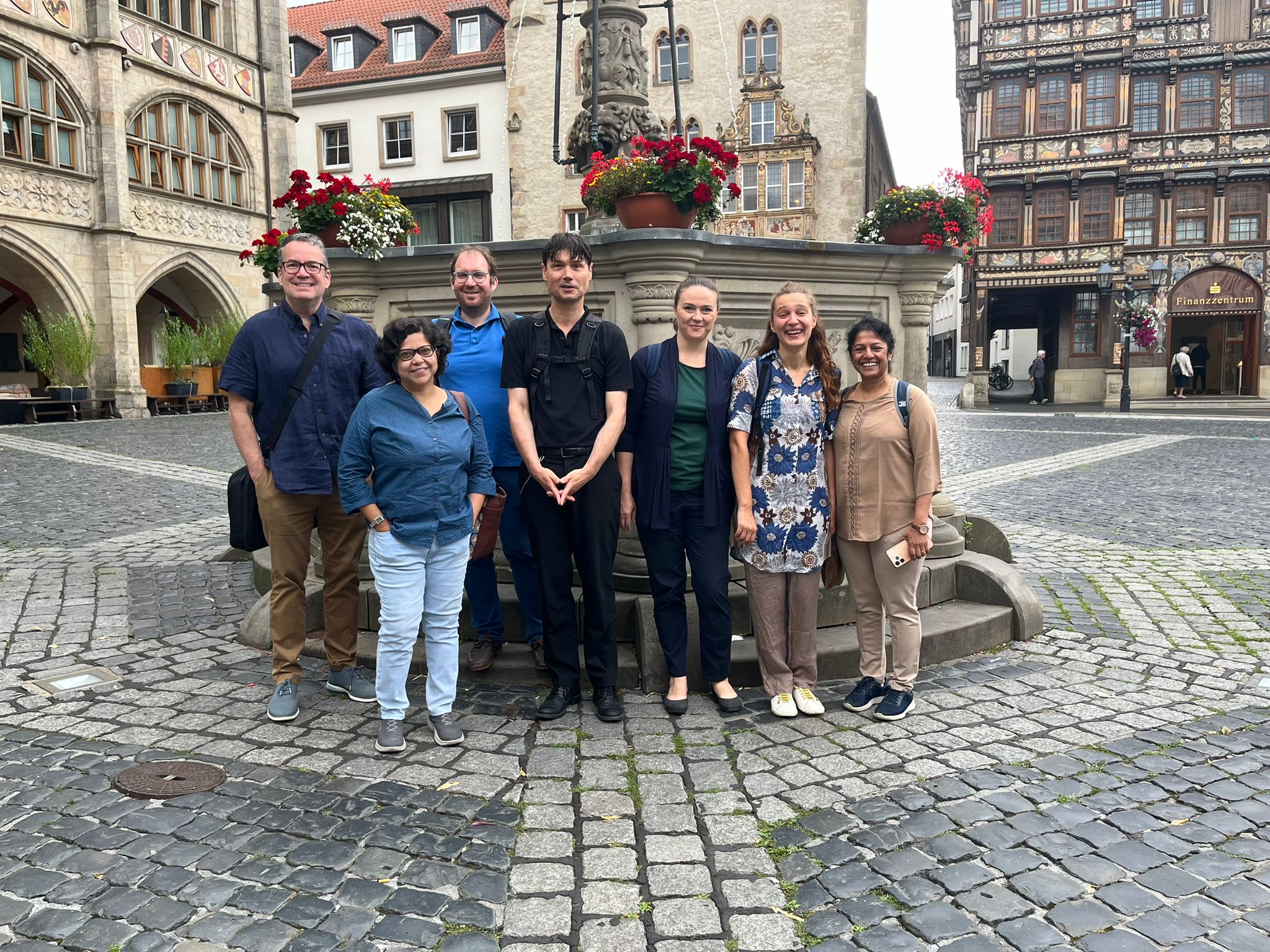
International Cooperation Workshop on Information Literacy and Metaliteracy at the University of Hildesheim

To learn more about this initiative, read the peer-reviewed article by members of the IPILM team:

Griesbaum, J., Dreisiebner, S., Mackey, T. P., Jacobson, T. E., Thadathil, T., Bhattacharya, S., & Adilović, E. (2023). Teaching Internationally, Learning Collaboratively: Intercultural Perspectives on Information Literacy and Metaliteracy (IPILM). Communications in Information Literacy, 17 (1), 260–278. https://doi.org/10.15760/comminfolit.2023.17.1.4

Collaborative Metaliteracy Article Published in Communications in Information Literacy (CIL)

The international project team that has been developing and teaching an innovative global course just published a peer-reviewed article entitled Teaching Internationally, Learning Collaboratively: Intercultural Perspectives on Information Literacy and Metaliteracy (IPILM) in Communications in Information Literacy (CIL). This teaching and research team includes Joachim Griesbaum, Stefan Dreisiebner, Tom Mackey, Trudi Jacobson, Tessy Thadathil, Subarna Bhattacharya and Emina Adilović.

According to the abstract for this new article:

Intercultural Perspectives on Information Literacy and Metaliteracy (IPILM) is a discourse- oriented learning environment that engages students from diverse cultural backgrounds to participate in collaborative knowledge construction. The objective is to evolve a thematic approach to course design that includes elements of open pedagogy, information literacy, and metaliteracy. IPILM invites participation from educators and learners from around the world and has witnessed an increase in participating countries. This paper describes the concept of IPILM and demonstrates the implementation of this approach in practice.

The next iteration of the IPILM concept will take place this summer and involve the exploration of artificial intelligence (AI) from an intercultural perspective and through the lens of information literacy and metaliteracy. The latest updates about the IPILM Project are available online: https://ipil.blog.uni-hildesheim.de/.

Griesbaum, J., Dreisiebner, S., Mackey, T. P., Jacobson, T. E., Thadathil, T., Bhattacharya, S., & Adilović, E. (2023). Teaching Internationally, Learning Collaboratively: Intercultural Perspectives on Information Literacy and Metaliteracy (IPILM). Communications in Information Literacy, 17 (1), 260–278. https://doi.org/10.15760/comminfolit.2023.17.1.4

Third Academic Minute Program about Metaliteracy

The June 27, 2022, Academic Minute program featured Trudi Jacobson, and, of course, metaliteracy. The episode is entitled, Students Reflect on their Roles and Responsibilities as Wikipedia Editors. It is the first in a week of episodes by professors and instructors who teach using the Wiki Education initiative. Although the program airs on a number of National Public Radio (NPR) stations, it is produced here in Albany, NY at WAMC. This makes Trudi’s affiliation, which is listed as North-West University (NWU) in South Africa rather than the University at Albany, seem a bit odd, but in order to appear on the program, one needs to be actively affiliated with an institution of higher learning. Trudi is Distinguished Librarian Emerita at The University at Albany, SUNY and both she and Tom Mackey were appointed Extraordinary Professors at North-West University (NWU) in South Africa, soon after presenting a metaliteracy Prestige Lecture as well as keynotes and workshops there in 2019. As part of their honorary appointments, their latest Prestige Lectures at NWU continue in a series this year and next.

This is the third Academic Minute episode that features metaliteracy. Tom Mackey recorded the first, Metaliterate Leaners, which aired on May 18, 2020. Trudi’s first was Renewable Assisgnments, Wikipedia, and Metaliteracy, from December 15, 2021. As indicated by the name of the series, these are quick listens. You might want to give them a try if you’ve not already heard them. This newest episode includes quotes from two students who made connections between their work as information producers on Wikipedia, metaliteracy and learning.

Feel free to use these short clips as part of your teaching practices related to metaliteracy!

-Trudi

You are invited to an online panel: The Wikipedia Assignment: Where Students’ Interests, Confidence, and Public Participation in Knowledge Production Intersect

If you are interested in implementing an exciting and innovative open pedagogical project in your teaching, you might be interested in attending a panel about the Wiki Education program. This program, available in the US and Canada, provides strong support to both students and instructors for Wikipedia assignments. Having students contribute to Wikipedia in an academic setting enhances the amount of content available through Wikipedia, a boon to those who rely upon this source for information. It also diversifies the editor pool and thus the content as well. The students are able to build upon their subject knowledge and information literacy abilities. Yet moving from a traditional assignment meant for the professor’s eyes only to one openly available can be somewhat intimidating at first. Metaliteracy’s emphasis on the metacognitive and affective learning domains provides scaffolding for students who may grapple with imposter syndrome and fear of visible failure.

The one-hour panel is sponsored by the Faculty Center for Teaching and Learning at Ferris State University and will take place on Monday, April 11 at 3:00 Eastern time. Besides Trudi Jacobson, panel members include Helaine Blumenthal, Senior Program Manager at Wiki Education, Mark Marinkovic, a former student of Trudi’s (pictured above), Naniette Coleman, Executive Director of the Interdisciplinary Research Group on Privacy and Ph.D. candidate in Sociology at UC Berkeley, and Ava Wu, a student of Naniette’s,

The registration page provides more information about the panel. We hope you can join us.

Open Pedagogy and Metaliteracy

As part of a second Prestige Lecture for North-West University (NWU) in South Africa, Profs. Trudi Jacobson and Tom Mackey presented Open Pedagogy and Metaliteracy to celebrate Open Education Week (OEWEEK 2022). This latest talk is based on a key theme from their new book for ALA Publishing Metaliteracy in a Connected World: Developing Learners as Producers. Trudi and Tom were invited to keynote on this topic as part of their honorary appointments as Extraordinary Professors in the Research Unit Self-Directed Learning, Faculty of Education, North-West University (NWU), South Africa. Thanks to Elsa Mentz, Director of the Research Focus Area Self-Directed Learning and Professor in Computer Science Education and Jako Olivier, UNESCO Chair on Multimodal Learning and OER and Professor in Multimodal Learning at NWU for making this opportunity possible. The entire presentation is now available online via YouTube. 

Prestige Lecture: Open Pedagogy and Metaliteracy

Metaliteracy Discussed on The Academic Minute—Again!

Trudi Jacobson is featured on a segment for NPR’s The Academic Minute that was first presented on December 15, 2021: Renewable Assignments, Wikipedia, and Metaliteracy.

In this new segment, Trudi discusses the value of renewable assignments, i.e., assignments in which students create content that is useful to others, not meant simply for their professors’ eyes alone. Such assignments help individuals to become metaliterate learners and responsible digital citizens. Her example involves editing content in Wikipedia and the important scaffolding that metaliteracy can provide. If you get a chance, listen (or read it, the text is provided). The Academic Minute is produced for NPR by our local WAMC public radio station.

This is the second time metaliteracy has been featured on the program. Tom Mackey’s segment, Metaliterate Learners, aired on May 18, 2020.

Metaliteracy Presentations at SUNY Virtual Conference on Instruction & Technology (CIT)

This year’s SUNY Virtual Conference on Instruction & Technology (CIT) 2021 featured two metaliteracy presentations. Prof. Trudi Jacobson presented Scaffolding Student Learning: The Role of Metaliteracy in Open Pedagogy. Trudi’s presentation examines the relationship between the core concepts of open pedagogy and metaliteracy with a focus on student creations that resulted from this approach.

In a second metaliteracy presentation, Prof. Tom Mackey collaborated with Prof. Sheila Marie Aird on Collaborating to Teach Global Digital Storytelling Online. Tom and Sheila’s presentation explores how they applied metaliteracy to the design of a Digital Storytelling course they co-teach at SUNY Empire State College as a fully online international experience. Their slideshow is available via their Global Digital Stories blog.

New Metaliteracy Book to be Published in Summer 2021

The new metaliteracy book written by Tom Mackey and Trudi Jacobson will be published by ALA/Neal Schuman in summer 2021!

The fourth metaliteracy book in a series is entitled Metaliteracy in a Connected World: Developing Learners as Producers and will focus specifically on the metaliterate learner as informed and ethical producer of information in collaborative social settings. The Foreword to this book will be written by Jako Olivier, UNESCO Chair on Multimodal Learning, and OER Professor in Multimodal Learning, North-West University, South Africa.

In this newest book in their series, the authors carefully examine the central role of learners as producers of information, a foundational idea for the metaliteracy framework and one that’s more important than ever in our current media and information environment. They emphasize the active role today’s learners play as individual and collaborative metaliterate producers of information in various forms, including writing, digital stories, digital artifacts, and multimedia productions. The authors explore a range of connected social settings from online courses to social media to open learning environments. 

(https://www.alastore.ala.org/mlitproducers)

We are excited to announce the forthcoming publication of our next book and will provide updates via Metaliteracy.org as we get closer to the publication date so stay tuned!

Best,

Tom and Trudi

Translation of Metaliteracy Interview for RSG Radio

An English translation of the metaliteracy interview for the RSG Radio Program has been prepared by Jako Olivier, UNESCO Chair on Multimodal Learning and OER at North West University (NWU), South Africa.

Trudi Jacobson Tom Mackey and Jako Olivier (pictured to the right in 2019 at NWU in South Africa) discuss metaliteracy on Sunday August 2, 2020 at 9:30am EST (15:30 South African time).

Download the English translation of the interview here:

The discussion is moderated by Johannes Van Lill, for the RSG radio show, Ons en die onderwys (‘We and Education’). While Tom’s and Trudi’s responses are in English, the program is in Afrikaans. Jako’s translation of the program will allow you to read along with the initial interview on Sunday at http://www.rsg.co.za/ or if you download the podcast after the event at https://lnkd.in/d-hCeDN.

Our first blog post about the interview featured two audio previews, and here are two additional responses from Tom and Trudi based on the questions posed by Johannes Van Lill:

Which characteristics should a metaliterate learner have?

“Metaliterate learners start to see themselves as producers of information as they strive toward the productive characteristic for creating content in a variety of media formats.” – Tom Mackey

What implications does metaliteracy have for teachers and parents in the school context?

“Promoting metaliteracy in students has the potential to empower them in their interactions with information and their engagement with others.” -Trudi Jacobson

We hope that you join us for this opportunity to engage with an international audience about metaliteracy and welcome any feedback and insights you have based on the conversation!