Metaliteracy Featured on The Academic Minute

The Academic Minute

How do we prepare learners to be informed consumers and ethical producers of information? This is the central question of Tom Mackey’s segment for the NPR/WAMC program The Academic Minute entitled Metaliterate Learners. The Academic Minute is a WAMC national production hosted by Dr. Lynn Pasquerella, President of the Association of American Colleges and Universities and features daily highlights from faculty about their research. The program is broadcast on 70 radio stations in the United States and Canada, including WAMC, and is featured on multiple social media platforms and Inside Higher Ed.

The metaliteracy segment explores why it is essential to apply metacognitive strategies to prepare learners for today’s challenging information environment. According to Mackey:

Metaliteracy prepares individuals to be informed consumers and ethical producers of information. This model is especially relevant today when misinformation circulates online, and personal beliefs or feelings displace objective reasoning. Metaliterate learners reexamine individual bias and rethink fixed mindsets to contribute in meaningful ways. They adapt to changing technologies and leverage these resources to create and share original content.

(https://academicminute.org/2020/05/thomas-mackey-suny-empire-metaliterate-learners/)

The learner as producer theme is core to the metaliteracy framework and is the topic of a new book project that Tom Mackey and Trudi Jacobson are currently working on for ALA Neal-Schuman Publishing.

The full script of the metaliteracy segment is available at The Academic Minute web site. The audio for this module was recorded at the WAMC studio in Albany, New York.

Let us know what you think about this brief metaliteracy piece and feel free to share it with your colleagues and students!
Metaliteracy Keynote Features Open Resources for Teaching and Learning at a Distance

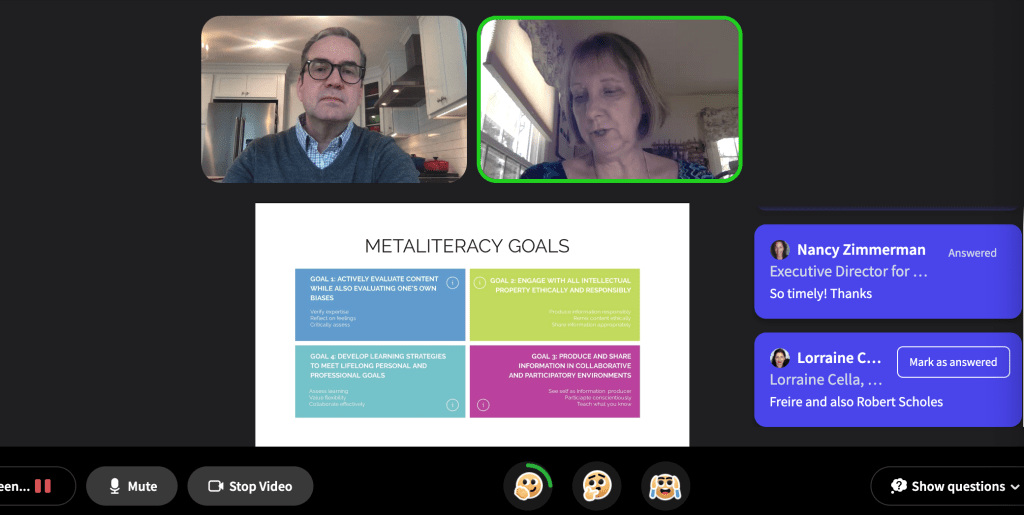
Tom and Trudi at Virtual Keynote

Trudi Jacobson and Tom Mackey keynoted on Teaching Metaliteracy as a Vital Literacy for Today’s Digital World at the Edge consortium’s Annual Teaching with Technology Showcase: Excellence in Action on April 24. This conference was transitioned to a virtual format as a result of the COVID-19 crisis and the presentation includes open resources that are available to faculty and librarians who have transitioned to online and remote teaching during this crisis. The keynote also features adaptable reflective questions about the information we consume, produce, and share at a time when accurate and reliable information is more important than ever. Trudi and Tom were invited to keynote by Nancy Zimmerman, Executive Director for EdgeEvents and Print Communications. Edge is the regional technology partner for colleges and universities in New Jersey. If you have any questions about the slides or would like to continue the conversation let us know!

Metaliteracy Resources for Online or Remote Teaching & Learning

As educators respond to the COVID-19 crisis and transition to online and remote learning, or expand what they are doing at a distance, consider several metaliteracy resources that are adaptable for these purposes. We’ve seen an increase in the use of our MOOCs during these unprecedented times and would like to highlight those resources and other OER that were designed for teaching and learning with metaliteracy:

iSucceed College Success – SUNY OER Services recently launched this expanded College Success course with a new metaliteracy module to prepare students for the college environment. The Metaliteracy Module is adaptable to K-12 and college environments and provides open content, learning objects, videos, and assignments that are adaptable to your educational setting.

Metaliteracy: Empowering Yourself in a Connected World – This was our first Coursera MOOC that introduces metaliteracy and was recently revised with updated content and streamlined to a four-module format.

Empowering Yourself in a Post-Truth World – This Coursera MOOC addresses the challenges of the post-truth world and is especially relevant now that accurate and reliable information is paramount during this global pandemic.

Metaliteracy Digital Badging – All of the content developed for our Metaliteracy Digital Badging system is openly available to apply online and through remote learning.

Metaliteracy Learning Goals and Objectives – This resource is at the heart of metaliteracy and has undergone revisions to address post-truth issues while expanding to include several new translations to address the international interest in metalieracy.

Metaliterate Learner Roles – This diagram features the essential metaliterate learner roles and associated questions that spark reflection and online discussion in multiple disciplines.

Metaliteracy and Your Role as a Metaliterate Learner – This resource also features the learner roles and the four domains of metaliteracy and features reflective questions written and shared by Professor Sally Friedman, University at Albany.

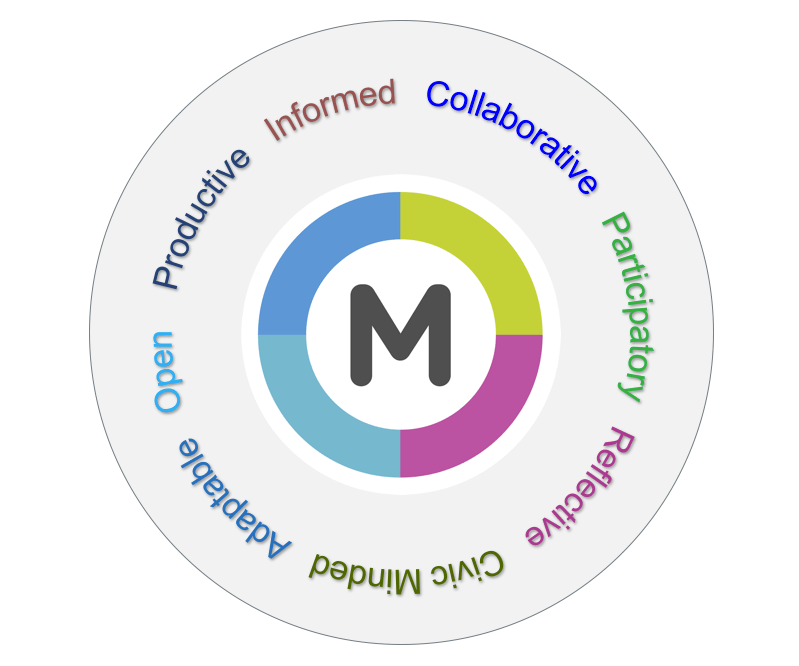
Metaliterate Learner Characteristics – This interactive learning object highlights the characteristics that individuals strive toward as they develop as metaliterate learners.

Metaliterate Learner Characteristics Aligned with the ACRL Framework Dispositions – This open model is ideal for faculty and librarians teaching information literacy with the ACRL Framework while incorporating key elements of metaliteracy.

Metaliteracy YouTube Channel– All of the videos we’ve created for our MOOC projects are openly available in one location via the Metaliteracy Learning Collaborative YouTube Channel.

Additional resources are available through this blog and if you would like to share any open metaliteracy resources that you have developed be sure to let us know.

Take care and be well during this challenging time.

Tom, Trudi, and Kelsey

Knowing Metaliteracy: A reflective digital story of my metaliteracy journey

We thank Mehreen Tahir, Information Commons Librarian at Forman Christian College, for providing this guest posting about Knowing Metaliteracy: A reflective digital story of my metaliteracy journey. Mehreen developed this final project as part of her participation in our Coursera MOOC, Metaliteracy: Empowering Yourself in a Connected World. We invite you to do the same!

Greetings Everyone,

I am excited to share that I have successfully completed the Coursera online course Metaliteracy: Empowering Yourself in a Connected World by The State University of New York (SUNY). Metaliteracy has always been my area of interest and thanks to the instructors Tom Mackey and Trudi Jacobson for developing this course with their colleagues at SUNY. This MOOC experience was an amazing learning opportunity for me to explore the concept of metaliteracy, its various learner roles, Creative Commons licensing, creating digital stories, and much more. 

My digital story is basically a reflective journey of my understanding of the different metaliteracy learner roles and the way I identified them during this course. It helped me in recognizing the roles I have been silently playing in my activities online through different social media platforms, such as Facebook and Instagram on a daily basis, but also urged me to build a creative thinking mechanism to incorporate these roles in the future as well. I feel like developing a sense of being a responsible digital citizen, reflecting upon my own experiences while navigating through these 21st century social media environments. Hoping to learn and explore more in this area.

Thanks,

Mehreen Tahir

SUNY Incorporates Metaliteracy Module into Lumen Learning’s College Success Online Learning Resource

Metaliteracy has joined ten other learning modules in SUNY’s iSucceed version of Lumen Learning’s online College Success course: 

College Success provides new students with an orientation to the college environment. It works to build more capable lifelong learners by combining conceptual knowledge with practical strategies and skills. With engaging content and a focus on applying course concepts to real-world situations, College Success is particularly helpful for first-generation students and those entering college underprepared, academically or otherwise. This course was developed by Lumen Learning with contributing work from Linda Bruce of Goucher College, Ronda Dorsey Neugebauer and Zack Varpness of Chadron State College, and others. (https://oer.suny.edu/courses/college-success/)

SUNY OER Services provides a variety of ready-to-adopt open courses and modules. They recently announced a version of Lumen’s College Success featuring additional modules and videos that is free for all in the SUNY system (and a text version that is free to everyone). iSucceed is also available to SUNY students and instructors in two other enhanced formats: the Waymaker version (“User-friendly digital courseware with data-driven learning design, personalization, and messaging tools that can increase student engagement, persistence, and passing rates”) or Candela (“curated and outcome-aligned open educational resources (OER) in a convenient e-book format”).

The Metaliteracy module includes a number of small sections that lead learners through the metaliteracy framework while they have the opportunity to explore how it impacts their learning and the roles in which they see themselves in relation to information. Some of these sections address:

  • What metaliteracy is
  • The roles, goals, and characteristics
  • Being a metaliterate:
  • Researcher;
  • Producer and collaborator;
  • Digital citizen;
  • Lifelong learner

Interspersed throughout the content are videos, assignments (optional unless assigned by an instructor), and, in the Waymaker version, self-check quizzes.

The Metaliteracy content was created by Trudi Jacobson, Tom Mackey and Kelsey O’Brien as part of our work together in the Metaliteracy Learning Collaborative. We thank Lisa Stephens of the University of Buffalo for inviting us to work on this project and Tony DeFranco of SUNY OER Services for working so closely with us. We also appreciate all the help that Diana Metcalf of Lumen Learning provided.

The other modules in the College Success course are:

  • Motivating Success
  • Goal Setting and Time Management
  • Career Exploration
  • Social Interaction and Diversity
  • Thinking and Analysis
  • Learning Styles and Strategies
  • Study Skills
  • Beyond the Classroom
  • Health Management
  • Financial Management

If you are new to open and online learning, or an experienced instructor, we encourage you to explore the Metaliteracy module and the course as a whole. These materials are adaptable to a range of settings and are also appropriate for lifelong learners seeking self-paced pathways for success!

Metaliteracy Post-Truth MOOC is Popular and Recommended

Characteristics of the Metaliterate Learner (Mackey & Jacobson, 2019)

According to Class Central, the Coursera version of our most recent metaliteracy MOOC Empowering Yourself in a Post-Truth World is one of 2019’s Most Popular Online Courses. The founder and CEO of Class Central, Dhawal Shah noted that his site aggregates MOOCs and collects course enrollment data from MOOC providers as well as data from learners at Class Central to arrive at the list of most popular online courses.

In another recent mention of our Metaliteracy MOOC, Jessica Stillman Contributor at Inc.com recommended Empowering Yourself in a Post-Truth World in her latest article “20 Online Courses That Will Make You More Successful in 2020.” According to Stillman, she selected “classes in everything from exercise to data analysis that will help you be more motivated, productive and successful this year.” Our MOOC was mentioned along with classes from around the world about such topics as Statistics, Artificial Intelligence (AI), Design, Writing and Public Speaking, Critical Thinking, and Ethical Hacking. We join Jessica Stillman in wishing everyone a productive and successful 2020!

Metaliteracy and Post-Truth Explored in Keynote at NWU in South Africa

Tom Mackey presented an international keynote entitled Building Communities of Trust: Metaliterate Learning for a Post-Truth Society at the International Conference on Information Literacy (ICIL) at North-West University (NWU) in Vanderbijlpark, South Africa. Tom was invited to keynote at the conference by Dr. Jako Olivier, UNESCO Chair on Multimodal Learning and OER and Professor in Multimodal Learning at NWU.

2bf4dc76-5e72-42c8-867d-74c108eaaf5f

Tom Mackey Keynoting at NWU (photo by Louise Olivier)

Tom’s keynote is based on the framing chapter he wrote “Empowering Metaliterate Learners for the Post-Truth World” for his latest metaliteracy book with Trudi Jacobson Metaliterate Learning for the Post-Truth World published by ALA/Neal-Schuman.

As noted in the abstract for this presentation: Metaliteracy is a reframing of information literacy to develop metaliterate learners as active producers of information in both local and global communities of trust. In today’s post-truth society, personal and political beliefs have diminished the meaning and impact of verifiable facts and truthful reasoning. Metaliterate learners are empowered through reflective practice to responsibly consume and creatively produce information in collaborative and participatory social spaces. Through informed civic engagement, individuals take control of their participation while working cooperatively with others to build responsible communities of trust. Visualizations have the power to enhance our understanding of and connections with the metaliteracy framework and several were shared as part of this presentation.

An analysis of the Open edX and Coursera versions of the Massive Open Online Course (MOOC), Empowering Yourself in a Post-Truth World, demonstrated how metaliteracy is applied as a pedagogical model to the challenges of a post-truth society.

Prestige Lecture at NWU in South Africa Features Metaliteracy

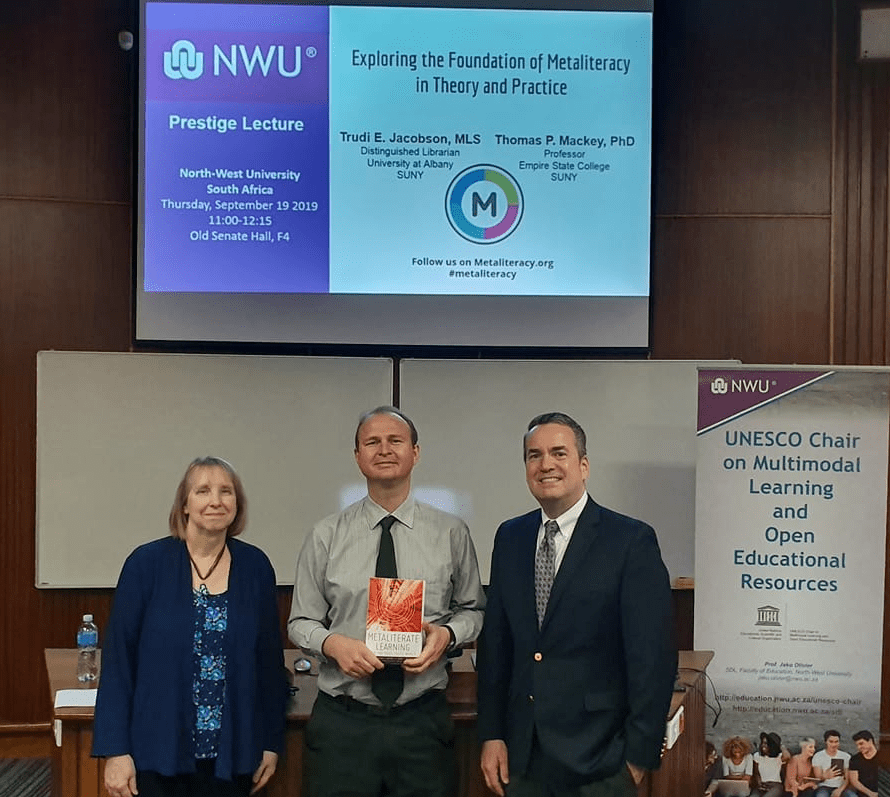
Trudi Jacobson, Jako Olivier, and Tom Mackey pictured at the Prestige lecture.
Trudi Jacobson, Jako Olivier, and Tom Mackey

At the invitation of Dr. Jako Olivier, UNESCO Chair on Multimodal Learning and OER and Professor in Multimodal Learning at North-West University in South Africa, Tom Mackey and Trudi Jacobson presented a Prestige Lecture entitled Exploring the Foundation of Metaliteracy in Theory and Practice at the Potchefstroom Campus on September 19, 2019. This collaborative lecture set the stage for two workshops with librarians, faculty and staff during the same week. All three events were presented in advance of the International Conference on Information Literacy (ICIL) at North-West University in Vanderbijlpark. Trudi and Tom both presented individual keynotes at ICIL as well as one additional collaborative presentation.

Metaliteracy Keynotes Featured at ICIL in South Africa

North-West University, South Africa, host of the 2019 ICIL

Tom Mackey and Trudi Jacobson have been invited to South Africa as keynote speakers at the International Conference on Information Literacy (ICIL), being held this year at North-West University in Vanderbijlpark. The conference theme is Information Literacy in All Spheres of Life, and will take place September 23-26. 

Tom’s keynote, to take place on September 24, is titled Building Communities of Trust: Metaliterate Learning for a Post-Truth Society. Trudi is presenting on September 26 on Creating Shareable Knowledge: Exploring the Synergy between Metaliteracy and Open Pedagogy. The other international and national keynote speakers at the conference include Serap Kurbanoglu of the Department of Information Management at Hacettepe University in Ankara, Turkey, Irina Zhilavskaya, Chair of Media Education, Moscow Pedagogical State University, Bosire Onyancha of the Department of Information Science at the University of South Africa, Karin de Jager, University of Cape Town, Ina Fourie, Department of Information Science at the University of Pretoria, and Jako Olivier, professor of Multimodal Learning in the School of Professional Studies in Education at North-West University.

Trudi and Tom have also been invited by Dr. Olivier to give a prestige lecture and two workshops at the Potchefstroom campus of North-West University the week prior to the conference. The collaborative lecture is Exploring the Foundation of Metaliteracy in Theory and Practice, and the workshops are Applying Open Educational Practices to Develop Active Metaliterate Learners and Integrating Metaliteracy and Information Literacy into Teaching and Learning.

Look to Metaliteracy.org for future posts that feature slides from both keynotes, the collaborative prestige lecture, and the shared workshops.

Two Revised Metaliteracy MOOCs Launch on Coursera

AI (Artificial Intelligence) concept. 3D illustration.Two Metaliteracy MOOCs are now available for registration via the Coursera platform. First, our original Coursera MOOC Metaliteracy: Empowering Yourself in a Connected World has been streamlined and enhanced with new video content, resources, and learning activities. Learners will be introduced to the metaliteracy model, learn about copyright, intellectual property, and open-licensing through the Creative Commons, and explore digital storytelling as a creative form of information production. By the end of this MOOC, learners will see themselves as content creators and develop a digital artifact or story of their own. Registration for this MOOC is open now for launch on October 14, 2019.

Second, the recently revised Empowering Yourself in a Post-Truth World MOOC is being offered on Coursera for the first time. Registration is open now for immediate launch. This course explores a wide range of issues related to the post-truth world and empowers learners to think about the role of experts in society, examine false representations in constructed media, reflect on their own biases, and explore ways to build collaborative communities of trust and reinvent a truthful world. Learners will be empowered to raise and share their own voice by creating a digital response to the post-truth world.

Both MOOCs provide dynamic video content, updated links to open readings and resources, discussions, and interactive learning activities. The MOOCs can be explored independently, or in sequence (if new to both MOOCs, you may want to start with the Connected World and move to Post-Truth World, but either sequence is fine). These updated resources are available to teachers, students, librarians, administrators, and lifelong learners interested in applying metaliteracy to a variety of teaching and learning situations and/or everyday life. Metaliteracy supports reflective learning and the active production of new knowledge in collaborative communities.