Metaliteracy Presentation Videos Now Available via ESC-TV

As part of our SUNY wide Conversations in the Disciplines event hosted at Empire State College, we recorded the keynote presentations and panels. These videos are now available via ESC-TV and include the morning keynote presentation by Tom Mackey and Trudi Jacobson, entitled Developing Metaliterate Learners: Transforming Literacy Across Disciplines.  We also feature the morning Reaction Panel with Richard Fogarty, Carleen Huxley, and Michael Youngs.  The afternoon sessions are also available, including the keynote presentation by Randy B. Hensley and Reaction Panel: Brian Morgan, Paige Jaeger, Tor Loney, Karen Mahar, Dave Brown, and Ashley Smolinski.  All of the videos are available at Metaliteracy Conference 2013.

New Issue of Communications in Information Literacy: A Refection on the Standards

Image

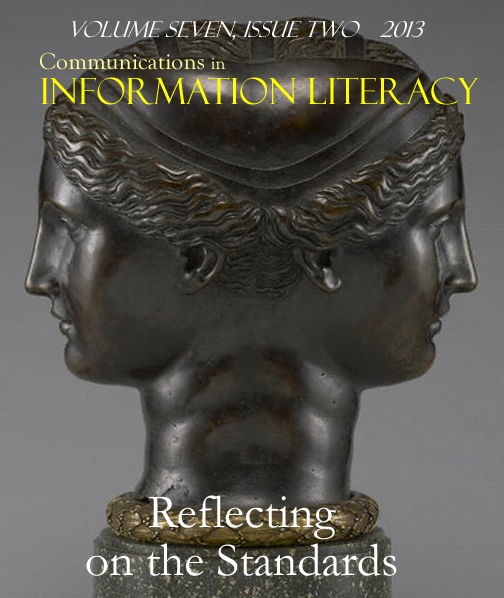
Cover image of CIL 7.2

Cover image of CIL 7.2

The new thematic issue of Communications in Information Literacy is out!  It is called Reflecting on the Standards, and the 15 articles that it contains reflect a range of viewpoints and focused interests. The image of Janus on the cover is particularly apt, as the pieces look back to the ACRL Information Literacy Competency Standards published in 2000, noting both the good and the not so good about those standards, and forward to the new model currently under development. The authors express hopes and potential concerns about the new framework. And some offer sage advice: the two introductory paragraphs in Benjamin Harris’s The New ACRL Information Literacy Competency Standards: Revising Reception are particularly thoughtful in this regard.

This issue contains articles by a number of well known individuals in the field. These include Carol Kuhlthau, Stanley Wilder, and Patricia Iannuzzi (who chaired the group that developed the 2000 Standards). Some of the 15 articles use the Prospectus for Revision that was issued by the current Task Force to try to determine what might or might not be included in the new version. This was an early document, and does not fully capture current discussions. The draft will be available for review in mid February.

We were delighted to find that our contribution, Proposing a Metaliteracy Model to Redefine Information Literacy, was selected as the lead article. We encourage you to read it, and all the articles in the issue. Speaking of which, let me get back to the few I’ve not yet read…

Conversations in the Disciplines

Last week we participated in a SUNY-wide “Conversations in the Disciplines” focused on metaliteracy.  This is a competitive program that provides funding for a one-day conference to promote interactivity and dialogue.  We experienced a full-day of activity that examined many dimensions of metaliteracy and covered a range of issues from K-12 to higher education to open learning.  This is the PowerPoint presentation from our morning keynote “Developing Metaliterate Learners: Transforming Literacy across Disciplines.”  

Metaliteracy MOOC Talk Plenary

We launched Metaliteracy MOOC on September 4 at the University at Albany with colleagues from SUNY Empire State College and the University Libraries. Our opening plenary was facilitated through Blackboard Collaborate and included Tom Mackey, Trudi Jacobson, Tor Loney, Jenna Hecker, Nicola Marae Allain, and our colleagues from the Metaliteracy Learning Collaborative Michele Forte, Kathleen Stone, Mike Daly, and Mark McBride. We were joined in person by three UAlbany students and online by one of our graduate students from Empire State College. The first MOOC Talk was developed in Prezi and provided an overview of key metaliteracy terms, updates on recent metaliteracy activity, and two figures from the Metaliteracy manuscript recently completed by Tom Mackey and Trudi Jacobson for ALA Books. A recording of our first interactive session via Blackboard Collaborate is available at our Topic 1 page at Metaliteracy MOOC. In the spirit of Open SUNY we coordinated shared press releases that have been published at the Empire State College web site and the UAlbany Web site. The live MOOC Talk session was fascinating for us as we facilitated the talk with several presenters, allowing us to look at metaliteracy from multiple perspectives. We were also inspired by the post-MOOC Talk (that we did not record) because it allowed us to talk through the MOOC format itself and it felt very much like a spontaneous seminar about MOOCs. We have also seen an asynchronous conversation unfold via Twitter at #metaliteracy in response to the talk. We look forward to our upcoming MOOC Talks. On September 18 Char Booth will examine “The Metacognitive Dimension of Metaliteracy,” a key aspect of the metaliteracy model.

Metaliteracy in the Disciplines

Michele Forte, Trudi Jacobson, and Emer O’Keefe were successful in applying for a State University of New York (SUNY) Conversations in the Disciplines about metaliteracy.  This intercampus one-day conference entitled “Developing Metaliterate Learners: Transforming Literacy Across Disciplines” will take place at the Center for Distance Learning (CDL) at Empire State College on Friday, December 13, 2013.

Learners – students and educators alike – are no longer simply information consumers but information producers in a participatory social media environment. Learners increasingly work collaboratively, creating and sharing digital information. We need to be adaptable within an information landscape that is complex and ever-changing. The metaliteracy model emphasizes these evolving literacy concepts, as well as the critical role played by metacognitive components, but many disciplines still view information creation as something done solely through traditional means, and solely by scholars in the field. How might disciplines benefit from new and collaborative modes of information creation? Can traditional models resist the changes wrought by Web 2.0? How might a conversation about expanding these conceptions bring new and fruitful ideas to these fields of study?

Librarians have ample opportunities to learn new theories and methods connected to information literacy in all its guises, but rarely have the chance to engage in macro discussion with disciplinary faculty members about the changes to the intersections of their fields. Usually conversations center around a specific class period, and what the librarian will teach to the professor’s students.

This day of conversation will allow members of both groups to engage together in learning and discussion about cutting-edge topics surrounding metaliteracy, the information literacy of today’s information and technology environment.

Tom Mackey and Trudi Jacobson will provide the keynote presentation to launch the event. Randy Hensley, Head of Information Services at Newman Library, Baruch College, CUNY, will be the afternoon keynote speaker, focusing on the student perspective. There will also be morning and afternoon reactions panels, with librarians and faculty members from community colleges, 4-year schools, a university, and a BOCES participating.

Registration will open shortly, and preference will be given to pairs made up of a librarian and a faculty member in a discipline who plan to attend together.
Meta or MEGA literacy!

Metaliteracy has been featured recently in two new publications.  A new UNESCO document entitled Media and Information Literacy for Knowledge Societies (2013) provides a brief definition of metaliteracy and makes it central to the conclusion.  According to this new publication:

As an umbrella term, it covers many of the other literacies. It also seems to overlap with new literacies such as multiliteracies and global literacy. It is a metaliteracy. It is transversal in its nature and can be seen as an iceberg concept which is much bigger than what it is seen at first sight. Information literacy can be easily called a megaliteracy which is composed of many other skills and literacies (p. 85).

As a comprehensive and unifying metaliteracy, the idea of a megaliteracy is not needed, since the the meta already encompasses this idea.  But this is an intriguing way to look at it and certainly addresses the interconnected nature of emerging literacies.  Great to see metaliteracy brought into the conversation.

We also note another new publication from Betty Hurley-Dasgupta, Carol Yeager, and Catherine Bliss from SUNY Empire State College about the first MOOC they offered in the SUNY System entitled Creativity and Multicultural Communication.  The authors make several references to metaliteracy in their article cMOOC and Global Learning: An Authentic Alternative in The Journal of Asynchronous Learning Networks (JALN).  According to the authors,

Clearly, we need to scaffold the development of metaliteracy skills for learning through cMOOCs. Some scaffolding could be accomplished by incorporating more self-assessment into the MOOC. For future MOOCs, we plan to incorporate shared rubrics to help participants assess their own metaliteracy skills, (Yeager, et.al, 2013, p. 144).

This is an important point that demonstrates the potential impact of a metaliteracy perspective on the cMOOC learning experience, and how learners could gain new insights and knowledge in these open and collaborative spaces.  We definitely need metaliteracy rubrics for MOOCs to enhance the experience for independent and collaborative learners.

Designing Learning Activities to Promote Metaliteracy

As part of Tom Mackey’s workshop at NELIG 2013, this short :30 video was created on the fly using the Animoto app on a smartphone. This was a quick and easy demo that showed the possibility of producing and sharing information in creative ways, either in the classroom or online. It is based on one of the tools used in the course Digital Storytelling at Empire State College. Workshop participants explored several questions in teams related to the challenges applying technology in Designing Learning Activities to Promote Metaliteracy.

Metaliteracy Presentation at Dartmouth College

Trudi Jacobson and Tom Mackey presented Reimagining Information Literacy as a Metaliteracy: Empowering Learners for Participation, Collaboration, and Reflection at the New England Library Instruction Group Annual Program at Dartmouth College, Hanover, NH.  Both presenters also conducted workshops: Trudi engaged participants in team-based learning with “What a Wonderful World: What Team-based Learning Brings to Metaliteracy Instruction” and Tom led a discussion on “Designing Learning Activities to Promote Metaliteracy” in blended and online learning environments.

Metaliteracy learning objectives inform UAlbany’s new general education learning objectives

The University at Albany recently made the decision to include four general education competencies within each major. This change, which will take effect for the fall 2014 semester, moves information literacy, critical thinking, oral discourse, and upper level writing (now called advanced writing in the major), from a course-based model to infusion within the major.

As would be expected, many, many task force, committee, and council meetings were part of the process, both leading up to this change in how these competencies are taught, and then developing the supporting structure, including the learning objectives for each. Because departments are mandated to do this but don’t necessarily feel prepared to do so, it has provided an excellent opportunity for information literacy librarians and bibliographers to have meaningful conversations with faculty members about what information literacy really is. And it also provided an opportunity to include elements of metaliteracy into these new learning objectives.

To see the result, take a look at the Campus Initiatives section under the ML in Practice tab.  We hope that this will be just the first of many entries in this section. We would very much like to hear from you if you have something to report. Leave us a comment and we will be in touch.

Keynote address at SOCHE in Dayton, Ohio

We are presenting the keynote address at this year’s Southwestern Ohio Conference for Higher Education (SOCHE) Library Conference.  The theme of the conference is  Transitions in Learning: Preparing Engaged Students for the E-Learning Environment.  Our collaborative keynote will examine  Reinventing Information Literacy as a Metaliteracy for E-Learning. We are also presenting two workshops: Trudi will conduct a workshop on team-based learning and Tom will facilitate a conversation about using emerging technologies in E-Learning.  The keynote address shows metaliteracy as an evolving concept.  We expand on previous talks with material from the new book we are working on and examples of student work that embody the metaliteracy concept of learner-centered production of information in participatory environments.