Collaborative Metaliteracy Article Published in Communications in Information Literacy (CIL)

The international project team that has been developing and teaching an innovative global course just published a peer-reviewed article entitled Teaching Internationally, Learning Collaboratively: Intercultural Perspectives on Information Literacy and Metaliteracy (IPILM) in Communications in Information Literacy (CIL). This teaching and research team includes Joachim Griesbaum, Stefan Dreisiebner, Tom Mackey, Trudi Jacobson, Tessy Thadathil, Subarna Bhattacharya and Emina Adilović.

According to the abstract for this new article:

Intercultural Perspectives on Information Literacy and Metaliteracy (IPILM) is a discourse- oriented learning environment that engages students from diverse cultural backgrounds to participate in collaborative knowledge construction. The objective is to evolve a thematic approach to course design that includes elements of open pedagogy, information literacy, and metaliteracy. IPILM invites participation from educators and learners from around the world and has witnessed an increase in participating countries. This paper describes the concept of IPILM and demonstrates the implementation of this approach in practice.

The next iteration of the IPILM concept will take place this summer and involve the exploration of artificial intelligence (AI) from an intercultural perspective and through the lens of information literacy and metaliteracy. The latest updates about the IPILM Project are available online: https://ipil.blog.uni-hildesheim.de/.

Griesbaum, J., Dreisiebner, S., Mackey, T. P., Jacobson, T. E., Thadathil, T., Bhattacharya, S., & Adilović, E. (2023). Teaching Internationally, Learning Collaboratively: Intercultural Perspectives on Information Literacy and Metaliteracy (IPILM). Communications in Information Literacy, 17 (1), 260–278. https://doi.org/10.15760/comminfolit.2023.17.1.4

Metaliteracy Book is the Recipient of a 2024 Divergent Publication Award for Excellence in Literacy in a Digital Age Research

Metaliteracy in a Connected World: Developing Learners as Producers by Tom Mackey and Trudi Jacobson has been selected for a 2024 Divergent Publication Award for Excellence in Literacy in a Digital Age Research by the Initiative for Literacy in a Digital Age.

This latest metaliteracy book published by ALA Neal-Schuman joins an impressive group of honorees that were announced in May. As part of this award, Trudi and Tom will participate in an online speaking engagement/conversation with the other honorees in early 2024 at a date to be announced.  

According to this initiative:

The Divergent Award for Excellence in Literacy in a Digital Age Research was established in 2016 by the Initiative for 21st Century Literacies Research to recognize the indelible contributions of educators and scholars who have dedicated their careers to the theoretical and practical study of 21st Century Literacies.

(HTTPS://WWW.INITIATIVEFOR21RESEARCH.ORG/THE-DIVERGENT-AWARD.HTML)

See the listing of all honorees as part of this YouTube video:

The Initiative for Literacy in a Digital Age is led by Shelbie Witte, Ph.D., School Head & Watson Endowed Chair, Senior Director of Teacher Education, Office of Educator Support, Adolescent Literacy & English Education, Director Emeritus, OSU Writing Project in the School of Teaching, Learning, & Educational Sciences, College of Education and Human Sciences at Oklahoma State University.

Thank you so much for this recognition of our fourth metaliteracy book!

Tom and Trudi

Open Pedagogy and Metaliteracy

As part of a second Prestige Lecture for North-West University (NWU) in South Africa, Profs. Trudi Jacobson and Tom Mackey presented Open Pedagogy and Metaliteracy to celebrate Open Education Week (OEWEEK 2022). This latest talk is based on a key theme from their new book for ALA Publishing Metaliteracy in a Connected World: Developing Learners as Producers. Trudi and Tom were invited to keynote on this topic as part of their honorary appointments as Extraordinary Professors in the Research Unit Self-Directed Learning, Faculty of Education, North-West University (NWU), South Africa. Thanks to Elsa Mentz, Director of the Research Focus Area Self-Directed Learning and Professor in Computer Science Education and Jako Olivier, UNESCO Chair on Multimodal Learning and OER and Professor in Multimodal Learning at NWU for making this opportunity possible. The entire presentation is now available online via YouTube. 

Prestige Lecture: Open Pedagogy and Metaliteracy

Metaliteracy Featured in ALA Neal-Schuman Interview

A new metaliteracy interview with Tom Mackey and Trudi Jacobson is featured in the ALAstore blog to coincide with the publication of their book Metaliteracy in a Connected World: Developing Learners as Producers. Rob Christopher, Marketing Coordinator at ALA Editions | ALA Neal-Schuman conducted the interview and asked questions related to the origins of the metaliteracy framework, the timeliness of metaliteracy, the “learner as producer” dimension of the model, and the relationship of a “growth mindset” to lifelong learning. Here’s one excerpt from the interview that addresses the importance of a “growth mindset” and the development of a metaliteracy mindset:

If you have a fixed mindset, you are much less likely to delve into new areas that require time and energy to succeed. Your lifelong learning would not be able to develop in creative and inventive ways. But with a growth mindset, the world’s your oyster! You just need to make a commitment and follow through on it when you are serious about learning or accomplishing something new. And you have to realize that there will be stumbles along the way–it is inevitable. Making mistakes is such an important part of the learning process, and the value of these experiences can be drawn out through the metacognitive dimension of metaliteracy.

(https://www.alastore.ala.org/MJconnectinterview)
Metaliteracy in a Connected World: Developing Learners as Producers (2022)

Metaliteracy Essay Published in SUNY Empire’s All About Mentoring 50th Anniversary Edition

A new metaliteracy essay by Tom Mackey entitled “Translating a Blended Cyprus Residency Study in the Digital Arts to Online” is featured in the latest edition of All About Mentoring (Issue 55 Autumn 2021, pp. 37-42) published by SUNY Empire State College.

The article explores how metaliteracy informed the design of a course entitled Ethics of Digital Art and Design for the international Cyprus Residency offered in the summer of 2019 (see class photo). The development of the residency study as an online course for the Digital Arts curriculum at SUNY Empire State College is explored as well.

A discussion of Linkr Education and how it is incorporated in the online version is provided. Metaliterate learners develop professional profiles and produce multimedia publications about course themes in the Linkr Education learning environment.

The application of metaliteracy in both learning experiences is central to the course description, learning outcomes, and learning activities. The relationship between each course is examined and practical insights are provided about how to embed metaliteracy into learning design in multimodal settings.

Zielsetzungen und Lernziele: German Translation of the Metaliteracy Goals and Learning Objectives

We are delighted to be able to offer the Metaliteracy goals and learning objectives in a German translation! Theresia Woltermann, who works for the Goethe-Institut, a German cultural association that promotes German language study abroad and encourages international cultural exchange, accomplished the translation in record time during the summer of 2021. Theresia has also been the 2021 research associate extraordinaire for the Intercultural Perspectives on Information Literacy project. Many thanks, Theresia!

This is the seventh translation of the Metaliteracy goals and learning objectives. We appreciate the previous translations in French, Afrikaans, Italian, Setswana, Spanish, and Portuguese. This work demonstrates the international interest in Metaliteracy and the transferability of these ideas to different educational settings.

Are you interested in translating the Metaliteracy goals and objectives in a language that has not been completed yet? Feel free to reach out to us!

Trudi and Tom

Metaliteracy Launches Reason & Respect Initiative at SUNY Empire

Tom Mackey’s presentation Advancing Metaliteracy to Rebuild Trust launched the Reason & Respect initiative at SUNY Empire State College. This series of online conversations “provides a forum for students, faculty, staff, and our broader communities to explore and discuss topics related to the election and learn about critical issues” (SUNY Empire). Tom’s presentation examines metaliteracy as a pedagogical strategy to address the challenges of misinformation and disinformation during this election cycle and a global pandemic. According to the World Health Organization, the COVID-19 pandemic is also an “infodemic” that is defined by the spread of false and misleading information. The sharing of deceptive and untruthful information during a global pandemic is especially problematic when accurate and reliable communication is essential for saving lives. Misinformation and disinformation are amplified by echo chambers, tribalism, and contentious partisan environments that reinforce mistrust and division. How do we rebuild trust based on reason and respect? How do we engage in difficult conversations about critical issues while reexamining fixed mindsets and understanding multiple perspectives?

During an age of misinformation and well-orchestrated disinformation campaigns, it is especially vital to make informed decisions based on accurate content from reliable and truthful sources. Metaliteracy is a comprehensive model that helps individuals to become both critical consumers and ethical producers of information in participatory environments (Mackey & Jacobson, 2011; Mackey & Jacobson, 2014). Metaliterate learners are reflective, well-informed, and civic-minded contributors to shared communities. They adapt to changing information technologies and work conscientiously to build communities of trust (Mackey, 2019). Metaliterate learners reflect on how they feel about information and the specific contexts of information environments (Jacobson, et. al., 2018). They develop a metaliteracy mindset and examine their own predispositions while consciously seeking information from multiple perspectives and sources (Jacobson, et. al., 2018). Metaliteracy has been applied in many different educational settings, from classrooms and libraries to online virtual environments, showing that it is possible to advance rational and reflective dialogue among engaged participants in shared spaces. This presentation explores how metaliteracy is a lifelong practice for building truthful and trusted communities based on a shared commitment to both empathy and understanding.

References

Jacobson, T., Mackey, T., O’Brien, K., Forte, M., & O’Keeffe, E. (2018).   “Goals and Learning Objectives.” Metaliteracy.org, Retrieved from https://metaliteracy.org/learning-objectives/

Mackey, T.P., “Empowering Metaliterate Learners for the Post-Truth World.” In Mackey and Jacobson (Eds.). Metaliterate Learning for the Post-Truth World. New York: ALA Publishing, Inc., (2019).

Mackey, T. P., & Jacobson, T. E.. (2011). Reframing Information Literacy as a Metaliteracy. College & Research Libraries, (January): 62-78.

Mackey, T. P., & Jacobson, T. E. (2014). Metaliteracy: Reinventing Information Literacy to Empower Learners. Chicago: ALA/Neal-Schuman Publishing.

Managing the COVID-19 infodemic: Promoting healthy behaviours and mitigating the harm from misinformation and disinformation. World Health Organization. (2020, September 23). https://www.who.int/news/item/23-09-2020-managing-the-covid-19-infodemic-promoting-healthy-behaviours-and-mitigating-the-harm-from-misinformation-and-disinformation.

Celebrating International Open Access Week 2020 with Metaliteracy

In celebration of International Open Access Week 2020 (October 19-25), we highlight several metaliteracy resources that are fully open for researchers, teachers, librarians, and lifelong learners! We published our first article that introduced the metaliteracy model, Reframing Information Literacy as a Metaliteracy, in the open access journal College & Research Libraries. Since that time we have been committed to open scholarship and developing open learning resources and open access environments (including this blog!) to support metaliterate learners in practice. This is an overview of several open access resources to advance teaching with and learning with metaliteracy:

Open Scholarship

Trudi E. Jacobson, Thomas P. Mackey, and Kelsey L. O’Brien, “Developing Metaliterate Citizens: Designing and Delivering Enhanced Global Learning Opportunities.” Conference on Learning Information Literacy Across the Globe. Frankfurt am Main, May 10, 2019.

Kelsey L. O’Brien, Michele Forte, Thomas P. Mackey, and Trudi E. Jacobson, “Metaliteracy as Pedagogical Framework for Learner-Centered Design in Three MOOC Platforms: Connectivist, Coursera and Canvas.” Open Praxis, v.9 no. 3, 2017, pp. 267-286.

Trudi E. Jacobson. and Thomas P. Mackey, (2017) “Advancing Metaliteracy: A Celebration of UNESCO’s Global Media and Information Literacy Week.” Facet Publishing, October 27, 2017.

Thomas P. Mackey and Trudi Jacobson. “How Can We Learn to Reject Fake News in the Digital World?” The Conversation, December 5, 2016.

Trudi Jacobson and Thomas P. Mackey, “Can’t Seem to Stop those Ads Following You Around? Why Not Become Metaliterate?” The Conversation, August 7, 2015.

Thomas P. Mackey, Trudi E. Jacobson, Jenna Pitera, Michelle Forte, and Nicola Allain, “MOOC Talk: A Connectivist Dialogue about our Metaliteracy MOOC Experience.” All About Mentoring Issue 46, Winter 2015. (34-40).

Trudi E. Jacobson and Thomas P. Mackey (2013) “Proposing a Metaliteracy Model to Redefine Information Literacy.” Communications in Information Literacy, Volume 7, Number 2. 84-91.

Thomas P. Mackey and Trudi E. Jacobson, “Reframing Information Literacy as a Metaliteracy.” College & Research Libraries, v. 72 no. 1, 2011, pp. 62-78. (Selected to be included in “LIRT’s Top Twenty” library instruction articles of 2011).

Additional Resources via our Publications page.

Open Learning Environments

MOOCs:

Metaliteracy: Empowering Yourself in a Connected World – This was our first Coursera MOOC that introduces metaliteracy and was recently revised with updated content and streamlined to a four-module format.

Empowering Yourself in a Post-Truth World – This Coursera MOOC addresses the challenges of the post-truth world and is especially relevant now that accurate and reliable information is paramount during this global pandemic.

Lumen Learning Module:

iSucceed College Success – SUNY OER Services recently launched this expanded College Success course with a new metaliteracy module to prepare students for the college environment. The Metaliteracy Module is adaptable to K-12 and college environments and provides open content, learning objects, videos, and assignments that are adaptable to your educational setting.

Digital Badging Content:

Metaliteracy Digital Badging – All of the content developed for our Metaliteracy Digital Badging system is openly available to apply online and through remote learning.

YouTube Channel:

Metaliteracy YouTube Channel– All of the videos we’ve created for our MOOC projects are openly available in one location via the Metaliteracy Learning Collaborative YouTube Channel.

Metaliteracy Goals and Learning Objectives:

Metaliteracy Learning Goals and Objectives – This resource is at the heart of metaliteracy and has undergone revisions to address post-truth issues while expanding to include several new translations to address the international interest in metalieracy.

Metaliteracy Diagrams and Interactive Learning Objects

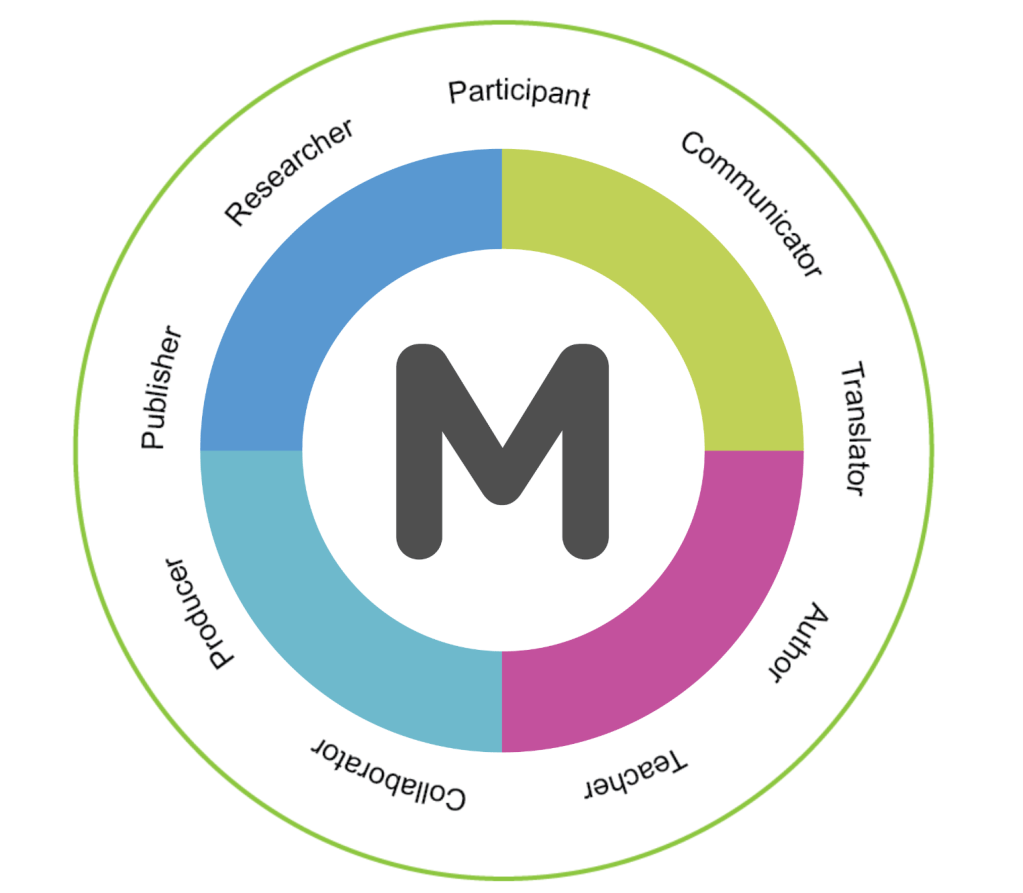
Metaliterate Learner Roles – This diagram features the essential metaliterate learner roles and associated questions that spark reflection and online discussion in multiple disciplines.

Metaliterate Learner Characteristics – This interactive learning object highlights the characteristics that individuals strive toward as they develop as metaliterate learners.

Metaliterate Learner Characteristics Aligned with the ACRL Framework Dispositions – This open model is ideal for faculty and librarians teaching information literacy with the ACRL Framework while incorporating key elements of metaliteracy.

We hope that you enjoy these resources and explore Metaliteracy.org for all current updates about metaliteracy and additional resources including recorded presentations, slideshows, interviews, and guest postings. Always feel free to provide us with feedback about these resources and if you would like to write a guest post based on your experience teaching and learning with metaliteracy just let us know!

Tom and Trudi
Metaliteracy Presentation at the Information Literacy & Democracy Conference

Tom Mackey and Trudi Jacobson will present Advancing democratic dialogue by applying metaliteracy in teaching praxis at the Information Literacy & Democracy Virtual Conference June 19-20. The video presentation is available in advance of the conference and their live session will take place on June 19 at 11:30 am Eastern Savings Time (5.30 p.m Central European Summer Time – CEST). To join the live session, register for free by sending an e-mail to infodem (at) uni-hildesheim.de. All of the conference presentations are available via the Information Literacy & Democracy conference web site and YouTube. The Information Literacy and Democracy (IDE) project is supported by the Ministry of Science and Culture of Lower Saxony, Germany.

Tom and Trudi’s presentation explores metaliteracy as a pedagogical model to develop a metaliteracy mindset for effectively consuming, producing, and sharing information. This comprehensive framework promotes democratic dialogue with learners to uphold democracy in a post-truth world of misinformation and disinformation. This presentation describes the four components of metaliteracy and offers ideas for advancing democratic dialogue with learners.

Metaliteracy Keynote at Virtual Teaching with Technology Showcase on April 24

The Annual Teaching with Technology Showcase: Excellence in Action, an entirely online event, will feature an invited keynote by Trudi Jacobson and Tom Mackey about metaliteracy on Friday, April 24. The keynote entitled Teaching Metaliteracy as a Vital Literacy for Today’s Digital World will explore metaliteracy and its relevance to educators and students, especially during this time of the COVID-19 crisis, when the ability to produce and share truthful and trusted information is essential. The keynote will examine metacognitive reflection and self-regulation as part of the scaffolding that metaliteracy provides for successful student participation in open pedagogical settings. Several open digital learning projects produced by the Metaliteracy Learning Collaborative will be introduced as part of this interactive presentation.

Roles of the Metaliterate Learner Figure (Mackey & Jacobson, 2014)

Registration is open for this virtual conference that is sponsored by Edge, the regional technology partner for colleges and universities in New Jersey. Edge responded quickly to the COVID-19 crisis and moved this conference to an entirely online format and will pilot the Run the World platform as part of this transition.

The conference starts at 9:30am with opening remarks by Nancy Zimmerman, Executive Director for EdgeEvents and Print Communications. Trudi and Tom’s keynote address is at 11:45 am. Throughout the day, presenters will address such relevant topics as: promoting the adoption of technology by faculty, video games for learning, technology preferences of Generation Z college students, virtual experiences in art and science, creating OER initiatives, interactive polling, using makerspaces in college, applying augmented reality and gamification to deepen learning, and much more!

We look forward to seeing you at the virtual conference and will share our slides after our keynote!

-Tom & Trudi