Metaliteracy and Me

During the Coursera MOOC, Metaliteracy: Empowering Yourself in a Connected World I realized that I have been a metaliterate citizen for a very long time. All the knowledge I’ve gained through this MOOC makes sense not only in the digital world but also within collaborative communities, where sharing, creating, and evaluating information are essential for collective growth and learning.

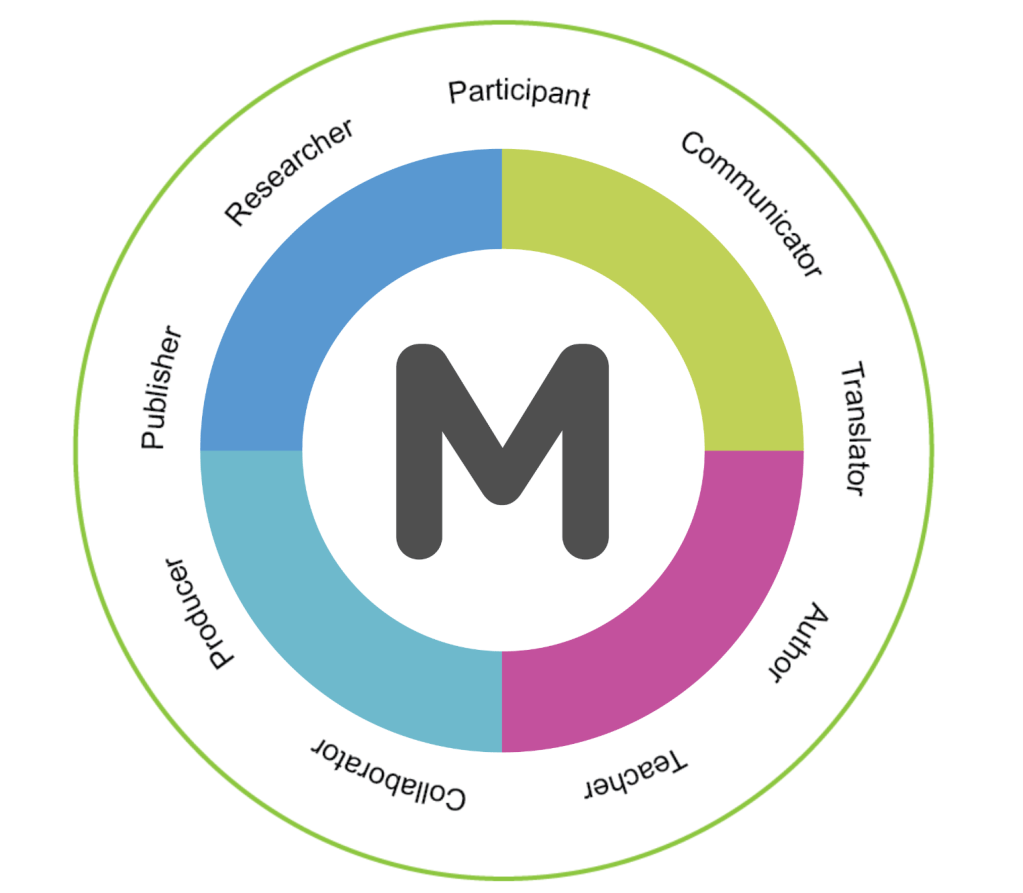
Circular figure of the Metaliteracy Model

References

Why Metaliteracy is Critical for People Over 55

Recently, Caitlin Manner, an author for the publication 55+ Life, interviewed Trudi Jacobson for her article, “Learning Curve,” on the value of MOOCs for those who fit the magazine’s age demographic. (The article is in the Fall 2023 issue, pages 38-39). During that interview, Trudi introduced Caitlin to the concept of metaliteracy. Caitlin included information on the Coursera MOOC Metaliteracy: Empowering Yourself in a Connected World in the “Learning Curve” article, but then delved more deeply into the meaning and value of metaliteracy. She went on to write an article on it for the 55+ Life website entitled The Importance of Metaliteracy for People 55+.

As she noted in the essay:

It is increasingly critical for everyone to assess their own metaliteracy and continuously work to improve it. This will not only prevent you from falling prey to “fake news,” but it can impact your hireability, your mindset, and your ability to navigate an increasingly online society. 

Caitlin Manner. (2023, September 25). The Importance of Metaliteracy for People 55+.55+ Life, https://55pluslifemag.com/the-importance-of-metaliteracy-for-people-55/

Caitlin wrote in an email to Trudi, “[O]ur conversation has made me tell just about everyone I know about the importance of metaliteracy…I’m fascinated by it.” We are delighted that this is the case, and that she wrote such an accessible article about metaliteracy for the magazine’s online readers. She highlights the evaluative, reflective, and societal benefits of metaliteracy, and notes the important factor that we are, each of us, creators of information. The article posits three main reasons that metaliteracy is critical for those 55 years old and older:

  • Protecting yourself and others from inaccurate information
  • Enhancing your employability in the gig economy
  • Providing a means for social justice

The article ends, “If you’re at all interested in maintaining your elasticity of thought and staying open-minded, metaliteracy is one way to do so.”

We would love to hear your feedback about the article and this application of the metaliteracy model. Feel free to reach out to us with your feedback.

Metaliteracy MOOCs Continue to Reach Learners Internationally


Since the launch of our two Coursera MOOCs, Metaliteracy: Empowering Yourself in a Connected World in 2016, and Empowering Yourself in a Post-Truth World in 2019, we have reached learners from around the world. So far, the first MOOC has enrolled 4,870 learners and the second has had 3,549 total learners worldwide. At times, we have been lucky enough to hear directly from the participants who successfully completed one or both of the MOOCs. Recently, Dr. Haleema Anwar from CMH Lahore Medical College and Institute of Dentistry in Lahore, Pakistan contacted us about her experience with the Coursera MOOC Empowering Yourself in a Post-Truth World. According to Haleema:

I am a final-year medical student, a researcher, and an author. I discovered the MOOC while going through the recommendation of courses for me on my app. This was a topic I wanted insight into. 

I learned that there is a diverse variety of roles that a person can take to create a community of trust in a Post truth world- leading to  prosperity.

Thank you!

Haleema Anwar

As part of the MOOC experience, participants apply the “learner as producer” role of metaliteracy to create a final digital media project. We share with permission, Haleema’s final project for the MOOC entitled “Metaliteracy in Action”:

Haleema describes this project in the following way:

This mind map is to walk us through the idea of meta-literacy and its practical implication.

The credit for the content is directed to a course by SUNY “Empowering yourself in a post-truth world”, a course I found on Coursera.

A central theme I learned is- “meta literacy is an integrated model for us to be a lifelong learner and to create a truthful community”

-Haleema Anwar

Thanks to Haleema for sharing such valuable insights about metaliteracy after completing our Coursera MOOC.

We always welcome this kind of feedback about our open metaliteracy projects! If you complete one of our MOOCs or any of our Metaliteracy Learning Resources, feel free to drop us a line and let us know if you would like to share your work via our blog.

To explore an analysis of the Post-Truth MOOC and how it was designed, read Embedding Metaliteracy in the Design of a Post-Truth MOOC: Building Communities of Trust (Mackey, 2020) in Communications in Information Literacy

Best,

Tom and Trudi

Embedding Metaliteracy in Learning Design to Advance Metacognitive Thinking: From OER to MOOCs

As part of this year’s European Conference on Information Literacy (ECIL 2021), Tom Mackey and Trudi Jacobson presented the paper “Embedding Metaliteracy in Learning Design to Advance Metacognitive Thinking: From OER to MOOCs.” The full-text version of the paper is available via ResearchGate. According to the abstract:

This paper describes several examples of how metaliteracy is embedded in teaching praxis through open educational resources (OER) that include interactive learning objects and digital badging content as well as fully developed Massive Open Online Courses (MOOCs). Specifically, these metaliteracy OER have been applied by the authors in an information literacy course at the University at Albany, SUNY, as well as online courses in the Digital Arts at SUNY Empire State College (Mackey & Jacobson, 2021).

This presentation follows an interactive workshop entitled “Teaching with Metaliteracy: Developing Informed, Reflective, and Participatory Citizens” that was provided at the conference earlier in the week. All of these ideas and resources are transferrable to a wide range of teaching and learning environments. If you would like to talk with us about ways to apply metaliteracy OER to your setting, feel free to reach out to us.

Tom and Trudi

Virtual Conference Features Metaliteracy Keynote

A new metaliteracy keynote entitled The Role of Metaliteracy in Designing Open Learning Initiatives was presented by Profs. Tom Mackey and Trudi Jacobson at the virtual conference Intercultural Perspectives on Information Literacy on January 30, 2021. This international event is an outcome of the “Intercultural perspectives on Information Literacy” project led by Prof. Dr. Joachim Griesbaum from Hildesheim University, Germany. This international collaboration connects the Department for Information Science and Natural Language Processing, Hildesheim University Germany and Symbiosis College of Arts and Commerce, Pune, India. The conference YouTube Channel features recorded sessions, including the keynote.

This new presentation addresses today’s fractured information environment and how metaliteracy can be applied in these challenging times. Trudi and Tom talk about ways to rebuild trust in these environments through metaliteracy and to share ideas about how to design open learning initiatives with this model.

Metaliteracy Keynote to be Featured at International Online Conference

Registration is now open for the online conference Intercultural Perspectives on Information Literacy that will feature a keynote presentation on metaliteracy by Profs. Tom Mackey and Trudi Jacobson on January 30, 2021. This first metaliteracy keynote of the new year will explore The Role of Metaliteracy in Designing Open Learning Initiatives.

This international conference is a part of the  “Intercultural perspectives on Information Literacy” project that “pursues the goal of establishing a common learning space in which students from different countries can learn together and thus fundamentally build up intercultural competence” (About the project). This project is a collaboration between the Department for Information Science and Natural Language Processing, Hildesheim University Germany and Symbiosis College of Arts and Commerce Pune, India. The project team is led by project manager Prof. Dr. Joachim Griesbaum, Hildesheim University.

As noted in the keynote description:

The metaliteracy model supports the design of open learning initiatives by reinforcing the value of ethical and responsible information production and sharing, and by scaffolding learners as they step into new roles that accompany open learning opportunities. These scenarios often include the opportunity to design and contribute to the communal learning environment. This presentation will describe the metaliteracy model and its intersections with open learning, and conclude by showcasing two initiatives that embody this approach.

As part of this presentation, Profs. Mackey and Jacobson will discuss the metaliteracy model within the context of today’s complex information environment. The presentation will reference the two recently published articles in Communications in Information Literacy, including Analyzing Information Sources Through the Lens of the ACRL Framework: A Case Study of Wikipedia by Prof. Jacobson and Embedding Metaliteracy in the Design of a Post-Truth MOOC: Building Communities of Trust by Prof. Mackey.

The full conference program is available here: https://ipil.blog.uni-hildesheim.de/conference-programme/.

We look forward to seeing you bright and early at 5:30am EST on January 30, 2021!

Tom and Trudi

Metaliteracy Featured in Two New Articles in Communications in Information Literacy

The latest issue of Communications in Information Literacy (CIL) features two new articles that focus on metaliteracy.

In the Perspectives section, Trudi E. Jacobson contributes her essay entitled Analyzing Information Sources Through the Lens of the ACRL Framework: A Case Study of Wikipedia. Trudi’s article starts a conversation about the six frames of the ACRL Framework for Information Literacy for Higher Education as explored in relation to Wikipedia and through the lens of metaliteracy. As Jacobson (2020) argues:

There are a number of components in Wikipedia that align with the Framework, suggesting that an analysis of Wikipedia might serve as a contained but rich case study of how the Framework can serve as a construct whose utility extends beyond individuals’ information literacy understanding and progress. Individual frames shed light on this resource, and metaliteracy, which influenced the Framework, highlights additional elements of Wikipedia, particularly as an immersive teaching tool.

(Jacobson, p. 374).

The Innovative Practices section of CIL features a new article by Tom Mackey entitled Embedding Metaliteracy in the Design of a Post-Truth MOOC: Building Communities of Trust. Tom’s contribution provides a descriptive analysis of the grant-funded Coursera MOOC Empowering Yourself in a Post-Truth World based on the metaliteracy framework and one of the key themes to emerge from the project related to building communities of trust. As Mackey (2020) argues:

This descriptive analysis of the Empowering Yourself in a Post-Truth World MOOC shows how metaliteracy is embedded in the course to prepare learners as informed consumers and ethical producers of information. Participants gain insights about their affective responses to information by reflecting on their preconceptions and conducting research to create a digital artifact. The course-specific learning outcomes in each module are based on the metaliteracy goals and learning objectives and associated components such as the learner roles, learning domains, and characteristics.

(Mackey, p. 357)

We welcome your feedback about these new metaliteracy articles and look forward to being in dialogue with you in 2021!

Happy Holidays and Happy New Year!

Tom and Trudi

Metaliteracy Presentation at the Information Literacy & Democracy Conference

Tom Mackey and Trudi Jacobson will present Advancing democratic dialogue by applying metaliteracy in teaching praxis at the Information Literacy & Democracy Virtual Conference June 19-20. The video presentation is available in advance of the conference and their live session will take place on June 19 at 11:30 am Eastern Savings Time (5.30 p.m Central European Summer Time – CEST). To join the live session, register for free by sending an e-mail to infodem (at) uni-hildesheim.de. All of the conference presentations are available via the Information Literacy & Democracy conference web site and YouTube. The Information Literacy and Democracy (IDE) project is supported by the Ministry of Science and Culture of Lower Saxony, Germany.

Tom and Trudi’s presentation explores metaliteracy as a pedagogical model to develop a metaliteracy mindset for effectively consuming, producing, and sharing information. This comprehensive framework promotes democratic dialogue with learners to uphold democracy in a post-truth world of misinformation and disinformation. This presentation describes the four components of metaliteracy and offers ideas for advancing democratic dialogue with learners.

Metaliteracy Keynote Features Open Resources for Teaching and Learning at a Distance

Tom and Trudi at Virtual Keynote

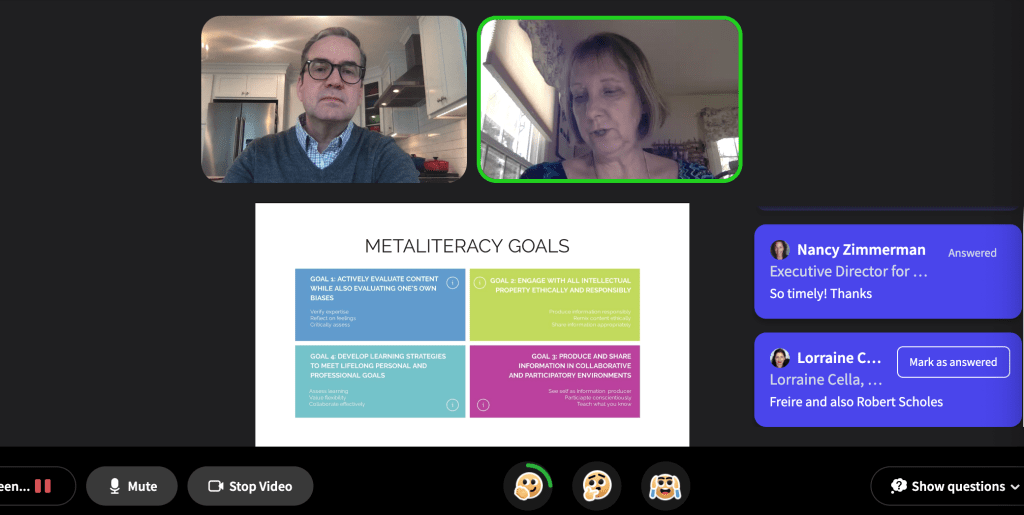
Trudi Jacobson and Tom Mackey keynoted on Teaching Metaliteracy as a Vital Literacy for Today’s Digital World at the Edge consortium’s Annual Teaching with Technology Showcase: Excellence in Action on April 24. This conference was transitioned to a virtual format as a result of the COVID-19 crisis and the presentation includes open resources that are available to faculty and librarians who have transitioned to online and remote teaching during this crisis. The keynote also features adaptable reflective questions about the information we consume, produce, and share at a time when accurate and reliable information is more important than ever. Trudi and Tom were invited to keynote by Nancy Zimmerman, Executive Director for EdgeEvents and Print Communications. Edge is the regional technology partner for colleges and universities in New Jersey. If you have any questions about the slides or would like to continue the conversation let us know!

Metaliteracy Resources for Online or Remote Teaching & Learning

As educators respond to the COVID-19 crisis and transition to online and remote learning, or expand what they are doing at a distance, consider several metaliteracy resources that are adaptable for these purposes. We’ve seen an increase in the use of our MOOCs during these unprecedented times and would like to highlight those resources and other OER that were designed for teaching and learning with metaliteracy:

iSucceed College Success – SUNY OER Services recently launched this expanded College Success course with a new metaliteracy module to prepare students for the college environment. The Metaliteracy Module is adaptable to K-12 and college environments and provides open content, learning objects, videos, and assignments that are adaptable to your educational setting.

Metaliteracy: Empowering Yourself in a Connected World – This was our first Coursera MOOC that introduces metaliteracy and was recently revised with updated content and streamlined to a four-module format.

Empowering Yourself in a Post-Truth World – This Coursera MOOC addresses the challenges of the post-truth world and is especially relevant now that accurate and reliable information is paramount during this global pandemic.

Metaliteracy Digital Badging – All of the content developed for our Metaliteracy Digital Badging system is openly available to apply online and through remote learning.

Metaliteracy Learning Goals and Objectives – This resource is at the heart of metaliteracy and has undergone revisions to address post-truth issues while expanding to include several new translations to address the international interest in metalieracy.

Metaliterate Learner Roles – This diagram features the essential metaliterate learner roles and associated questions that spark reflection and online discussion in multiple disciplines.

Metaliteracy and Your Role as a Metaliterate Learner – This resource also features the learner roles and the four domains of metaliteracy and features reflective questions written and shared by Professor Sally Friedman, University at Albany.

Metaliterate Learner Characteristics – This interactive learning object highlights the characteristics that individuals strive toward as they develop as metaliterate learners.

Metaliterate Learner Characteristics Aligned with the ACRL Framework Dispositions – This open model is ideal for faculty and librarians teaching information literacy with the ACRL Framework while incorporating key elements of metaliteracy.

Metaliteracy YouTube Channel– All of the videos we’ve created for our MOOC projects are openly available in one location via the Metaliteracy Learning Collaborative YouTube Channel.

Additional resources are available through this blog and if you would like to share any open metaliteracy resources that you have developed be sure to let us know.

Take care and be well during this challenging time.

Tom, Trudi, and Kelsey