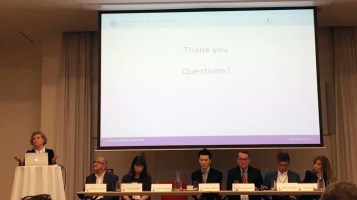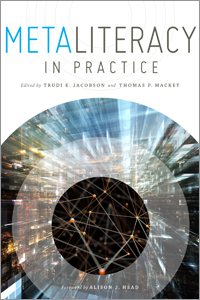
We were thrilled to present on the topic Expanding Metaliteracy Across the Curriculum to Advance Lifelong Civic Engagement at Cedar Crest College last week! The Cedar Crest Curriculum Committee invited us to present a summer workshop to build on the great work they are doing to map information literacy/metaliteracy across the curriculum. We were very impressed with the work they are doing and enjoyed our time with the faculty, librarians, and administrators very much. This is the slide deck for the facilitated presentation and it includes the world premiere of our new book cover for the forthcoming Metaliteracy in Practice! Be sure to check it out!
Category Archives: Metaliteracy
Metaliteracy featured at Cedar Crest College Summer Workshop
We are looking forward to presenting at Cedar Crest College in Allentown, Pennsylvania on Wednesday August 19. The topic of our collaborative workshop will be: Expanding Metaliteracy Across the Curriculum to Advance Lifelong Civic Engagement. Here’s the description for what we plan to do:
Metaliteracy is a reinvention of information literacy to promote reflective learning, active and critical participation in social settings, including social media, and the ability to adapt to emerging technologies. This is a dynamic reframing of information literacy with an expanded set of learning goals and objectives that could be applied across the curriculum to support metacognitive reflection, and learners as informed consumers and collaborative producers of information. Metaliteracy has influenced the development of the new Association of College and Research Libraries (ACRL) Framework for Information Literacy for Higher Education, signaling wider support for this model and increasing adoption in diverse educational settings. Metaliteracy has sparked the development of several collaborative projects initiated by Mackey and Jacobson and their colleagues in the Metaliteracy Learning Collaborative, including a digital badging system and three Massive Open Online Courses (MOOCs).
Metaliterate learners, who apply integrated competencies related to evaluating, consuming, and producing information in participatory environments, will be better prepared for college level learning and lifelong civic engagement. This workshop will define metaliteracy, discuss the four domains of metaliteracy and related learning goals and objectives, and examine how this approach has been applied in the curricular design of several innovative projects such as competency based digital badging and three MOOCs. Participants will have a chance during the workshop to envisage opportunities to enhance students’ metaliteracy abilities, and to share these ideas with other attendees.
One of the presenters for this workshop, Trudi E. Jacobson, was co-chair of the ACRL Task Force with Craig Gibson (The Ohio State University). She will describe the new metaliteracy-informed ACRL Framework and its definition of information literacy. This interactive portion of the workshop will be an opportunity to engage with the Framework and consider how it might inform collaborations between disciplinary faculty members and librarians. We will provide an opportunity for participants to grapple with more easily implemented changes and the metaliteracy underpinnings of the frame content to really build upon the content examined throughout the day.
Sneak Peak #2 into Metaliteracy in Practice
As promised, we are posting chapter previews, written by the authors, for the forthcoming book Metaliteracy in Practice, due out in late 2015 or early 2016 from ALA Neal-Schuman.
Chapter 2:
The Politics of Information: Students as Creators in a Metaliteracy Context
Lauren Wallis, Christopher Newport University
Andrew Battista, New York University
The recent revision of the Framework for Information Literacy in Higher Education opens a space for students to reflect on their position within an inherently political imbroglio of information, both in traditional scholarly formats and in open online spaces. When students visit the library, it is often at the behest of their professors, who expect that librarians will tell them how to find peer-reviewed journals. Meanwhile, the Framework, with its grounding in metaliteracy, encourages knowledge practices and dispositions in which students see their own encounters with information as opportunities to question authority, challenge expertise, and recognize the merit of nontraditional forms of evidence.
As the Framework was being revised, and as discussions of metaliteracy as a guiding principle for information literacy pedagogy emerged, we taught a one-credit class called The Politics of Information. In this class, we asked several questions: Who creates information? What information gets produced and circulated, and what information does not? Who has access to information, and how can the dissemination of information be an instrument of social control, inside and outside of the academy? As we taught, we realized that our core teaching moves—to destabilize authority and to encourage students to create digital products and reflect metacognitively on their learning experience—dovetail with the goals of metaliteracy.
We are excited that our chapter, “The Politics of Information: Students as Creators in a Metaliteracy Context,” is included in the forthcoming Metaliteracy in Practice volume. Our chapter makes the connections between the learning outcomes in The Politics of Information course and metaliteracy explicit. We began with the idea that information is a social construct, not a static, amorphous entity that reifies academic authority. We hope that this chapter, along with the others in the volume, offers concrete ways to adopt the goals of metaliteracy into the information literacy classroom.
Presentation on MOOCs and Badges at SUNY CIT
The Metaliteracy Learning Collaborative presented on the culmination of their work over the past year for an Innovative Instruction Technology Grant (IITG) at SUNY’s Conference on Instruction and Technology on May 28th. A panel composed of all eight members of the grant team, including PIs Tom Mackey and Trudi Jacobson and co-PIs Kathleen Stone, Michele Forte, Amy McQuigge, Kelsey O’Brien, Allison Hosier and Jenna Pitera, discussed the development of two MOOCs on two different platforms, both of which were supported by the metaliteracy learning objectives. Designing Innovative Online Learning: An Investigation of Digital Badges Integration with Two MOOC Platforms offered insights about the collaborative development and facilitation of both the Coursera and Canvas MOOCs and the extent to which we were able to integrate the Metaliteracy Badges.
Finished Manuscript of Metaliteracy in Practice
We have spent the last year editing a book that we just sent to our publishers, ALA Editions, at the beginning of July. Entitled Metaliteracy in Practice, the chapter authors explore a wide range of teaching situations and opportunities where metaliteracy provides a structural and pedagogical framework. It is highly exciting and inspirational to learn about the numerous ways the authors have found metaliteracy to be meaningful to them and their students.
The authors also examine issues relevant to the ACRL Framework in relation to metaliteracy. Both are having a transformative effect on the field of information literacy. The chapter authors show why we need to reframe and reinvent information literacy as a metaliteracy and why a new definition of information literacy was required at this pivotal time in higher education.
In addition to our wonderful chapter authors, we are thrilled that the book’s Foreword has been written by Alison J. Head, Ph.D., Executive Director, Project Information Literacy (PIL), Principal Research Scientist, The Information School, University of Washington, and Faculty Associate, Berkman Center for Internet & Society, Harvard University. Alison provides the ideal context for the book that connects to her innovative work with Project Information Literacy (PIL).
We expect the book will be published in late 2015 or early 2016. As soon as the publisher finalizes the copy for their catalog, we’ll add it here.
In the meantime, look for upcoming posts by chapter authors that provide a glimpse into the book’s contents!
Registration Now Open for New MOOC, Empowering Yourself as a Digital Citizen
Our Canvas MOOC, Empowering Yourself as a Digital Citizen, is set to begin on March 23. This MOOC is based on the Digital Citizen badge in the Metaliteracy Badging System. The course lasts 6 weeks, and at the end of it, participants who have completed their work will earn the Digital Citizen Badge. Registration is limited to 500 in this MOOC, so sign up soon if you are interested. Here’s a video to get a sneak peek.
Another Metaliteracy open learning opportunity is about to begin
In fall 2013 the Metaliteracy Learning Collaborative hosted a connectivist MOOC, Metaliteracy MOOC, which provided a collaborative learning environment to explore a range of aspects connected with metaliteracy. Over 500 people registered for the course, primarily professionals from information-related fields.
We are delighted to announce that this spring we will offer not one but two x-MOOCs, one on Coursera and one on Canvas. First up is the Coursera MOOC: Metaliteracy: Empowering Yourself in a Connected World. Registration for this first MOOC is now open at Coursera.org and the 10-week course will be begin on February 2, 2015. The second MOOC is being developed in Canvas Network with a particular emphasis on Digital Citizenship and additional details about registration will be forthcoming. These MOOCs are open to all, but we expect that many people who are not information professionals will engage in learning about their active roles in our information age, and how they can contribute to these social spaces as informed digital citizens. While our original connectivist MOOC was focused on exploring the theory of metaliteracy from multiple perspectives through our collaborative MOOC Talks, both X-MOOCs are designed for learners interested in putting theory into practice through an integrated and collaborative learning experience.
The two new metaliteracy MOOCs are being supported by an Innovative Instruction Technology Grant (IITG) Designing Innovative Online Learning: Integrating a Coursera MOOC with Open SUNY Badging. Both MOOCs integrate content from our Metaliteracy Digital Badging system and the Canvas Network version will provide opportunities for learners to earn a sharable Digital Citizen badge.
Register now for Empowering Yourself in a Connected World! Look forward to seeing you in the open course!
Second SUNY Innovative Instruction Technology Grant Supports Metaliteracy
A team from Empire State College, SUNY and the University at Albany was awarded a Tier 3 SUNY Innovative Instruction Technology Grant (IITG) for 2014-2015. This $60,000 grant, Designing Innovative Online Learning: Integrating a Coursera MOOC with Open SUNY Badging, is funding several initiatives focused on metaliteracy and badging.
As described in the grant proposal, “This project merges two innovative and flexible learning models: a metaliteracy Coursera MOOC open to all SUNY students, and its integration with competency-based badging. This unified approach to learning appeals to students and employers alike, and serves as a robust model to advance Open SUNY.” In addition, the funding will provide the means to develop a community of support for SUNY faculty interested in developing Open SUNY badging initiatives.
The team, led by Trudi Jacobson, Distinguished Librarian at the University at Albany, and Tom Mackey, Interim Vice Provost for Academic Programs at Empire State College, is building upon strengths developed from their 2012-2013 IITG-funded projects. They and members of the Metaliteracy Collaborative developed a connectivist MOOC that was offered in the fall of 2013, and they have created a very rich digital badging system based on the metaliteracy learning objectives.
Additional members of the grant team are Kelsey O’Brien (project director), Jenna Hecker, and Allison Hosier from the University at Albany, and Michele Forte, Kathleen Stone, Amy McQuigge, and Dana Longley from Empire State College.Three graduate students at the University at Albany’s School of Education,, Andrea Beukema, Brandon West, and Carmita Sanchez-Fong, will assist. Samuel Abramovich from the University at Buffalo’s Department of Learning and Instruction will oversee a MOOC-related research study.
Speaking of MOOCs, the team will offer not just one MOOC during spring 2015, but rather two! This came about because Coursera is currently unable to offer the functionality the team needed to integrate the badges with the MOOC. However, due to their high profile in the MOOC arena, and their selection as the platform of choice for SUNY, the team is adapting its original intentions in order to proceed with the planned course.The Coursera MOOC will feature a longer (10-week) learning opportunity that utilizes the high-end videos common to many of the company’s offerings, and will address a range of the metaliteracy learning objectives. Kathleen Stone is overseeing the Coursera component of the grant. This MOOC will begin in February 2015.
The Canvas MOOC will vary in several ways. It will be shorter, probably 5 weeks, and will start in March. It will focus on one of the four main areas of metaliteracy, Digital Citizen. Those who enroll in this MOOC will be working their way through a shareable badge, one that they can display via Credly.There is great interest in determining what impact the badging will have on student motivation, and what can be learned comparing the two different platforms and courses.
More details about the MOOCs and other grant-funded projects will be posted soon.
Metaliteracy Presentation Videos from CIT2014
The SUNY wide Conference on Instruction and Technology (CIT 2014) recently published the presentation videos from this year’s event at Cornell University. We developed a presentation with colleagues from the University at Albany and Empire State College based on last year’s Metaliteracy MOOC. This video features Michele Forte, Nicola Allain, Jenna Pitera and Tom Mackey (Trudi Jacobson was presenting a keynote at the Cornell University Library the same week). Here’s the link to the video now available via the CIT2014 site: Metaliteracy in Practice: Strengthening Learning Through a Connectivist MOOC. Tom Mackey was also part of a featured panel presentation about MOOCs with SUNY colleagues from Stony Brook who developed a Coursera MOOC. This was an excellent chance to discuss our connectivist MOOC in comparison with a Coursera MOOC. The video for this panel presentation is also available: Beyond the Front Row Experience: Blending a University Course with a MOOC. The keynote speaker for the conference was Daphe Koller from Coursera: The Online Revolution: Learning without Limits. Toward the end of Daphne Koller’s keynote, look for questions from Betty Hurley and Nicola Allain from Empire State College and Jenna Pitera from the University at Albany.
Video of 2014 CT IL Conference Keynote
This is the YouTube video of our metaliteracy keynote at the 2014 Connecticut Information Literacy Conference. All of the presentation videos are available via the conference web site. The metaliteracy keynote slides are also available on slideshare.