Are you interested in learning how to apply AI to create Open Educational Resources (OER)? Tom Mackey will explore this topic in an online presentation entitled “Advancing OER Through Metaliteracy and AI Integration” on November 12, 2025 at 8:00AM EST (New York) / 15:00 SAST (South Africa).
This virtual event is organized by the North-West University (NWU) UNESCO Chair and part of the NWU OER Fellows and the SADiLaR Digital Humanities OER Champions Project.
As noted in the event description:
The presentation introduces key concepts from metaliteracy and emerging AI literacy models, focusing on the updated metaliteracy goals and learning objectives, which have been revised to address the unique challenges and opportunities of AI-enhanced teaching and learning. Participants will engage in a practical workshop where they adapt and apply these themes to their own OER projects. Real-world examples from the Digital Media Arts program at Empire State University will illustrate how metaliteracy supports self-directed and multimodal learning in AI environments.
Session Takeaways:
Gain practical insights into how AI tools can be effectively applied to the development of Open Educational Resources (OER) through the lens of metaliteracy.
Participate in guided discussions and interactive learning activities that emphasize ethical, reflective, and collaborative engagement with AI in OER creation.
Explore strategies to empower educators and learners as metaliterate creators who design, share, and adapt OER for a global learning community.
Don’t miss this virtual event. Add it to your calendar and join via the Microsoft Teams link in the event announcement.
We welcome this guest essay by Dr. Melissa Atkinson, Director of Distance & Online Library Services at Abilene Christian University (ACU) Brown Library.
Metaliteracy, as introduced by Mackey and Jacobson in 2011, has been instrumental in developing metaliterate learners in a variety of contexts. The ACRL Framework for Information Literacy for Higher Education, published in 2016, transformed the previous InformationLiteracy Competency Standards for Higher Education (ACRL, 2000) into frames that build upon each other and were not prescriptive in how to assess students’ learning. Many librarians turn to the Framework as a guideline for developing information literacy courses, tutorials, guided studies, and assessments. Libraries and librarians create assessments of the Framework that are varied and individualized.
Using the Framework in conjunction with metaliteracy goals and learning objectives can enhance the student experience as well as give librarians a standard to follow that ensures development of skills needed in a participatory, connected environment (Mackey & Jacobson, 2011). Notes that reference metaliteracy and metacognition can be found in the Framework (2016). The Framework does have its strengths, but incorporating metaliteracy goals and learning objectives into the frames can aid in assessment and add to the knowledge and skills students should develop throughout their lifetime, not just when they are participating in higher education.
Using the original set of metaliteracy goals and learning objectives found on metaliteracy.org (Forte, et al, 2014), a metaliteracy course was developed in the Learning Management System (LMS) Canvas, specifically for fully online Ed.D. students, preparing them for research-related content encountered in their courses (Atkinson, 2019). The original course by Atkinson (2019) compared pretest, posttest, and metacognitive skills, using the Metacognitive Strategies for Library Research Skills Scale (MS-LRSS) developed by Catalano (2017).
The course was designed using backward design methods (Wiggins & McTighe, 2006) to introduce online doctoral students to common library terminology, metaliteracy, and metacognitive concepts. The metaliteracy course was not intended to take the place of library tutorials, individualized instruction, or research consultations–all of which are critical to meet the needs of doctoral students in an online environment.
The metaliteracy course consists of five modules, four of which are directly related to the metaliteracy goals and learning objectives from 2014 (Forte, et. al., 2014). The fifth module relates to specific skills students need to be successful, particularly in the Ed.D. program such as requesting materials through InterLibrary Loan, identifying research methods, and recognizing specific library databases. Each module consists of a pretest, an overview and videos (most of which are three minutes or less), and a posttest. Each module name, the video titles, and learning objectives are listed below.
Objective: Metaliterate learners evaluate information critically by determining authority, relevancy, accuracy, and validity of each source regardless of the information’s delivery method.
By the end of this module, learners will be able to:
1) Recognize the criteria for evaluating authority, relevancy, accuracy, and validity of information sources
2) Determine context of an information source by considering purpose and format
3) Distinguish between scholarly and non-scholarly sources
4) Understand the process of peer review and its purpose in scholarly research
Module 2: Information Ethics
Two Videos: Academic Integrity, Copyright, and Plagiarism; APA Style
Objective: Metaliterate learners understand and differentiate between their own intellectual property and others’ intellectual property, and give credit to others’ work using proper citation style methods.
By the end of this module, learners will be able to:
1) Understand the concepts of academic integrity, copyright, and plagiarism
2) Differentiate between various forms of attribution
3) Identify parts of a citation in APA style
4) Recognize elements of APA style in context
Module 3: Information Creation, Sharing, and Collaboration
Three videos: Social Media; Digital and Visual Literacy; Creating Original Content
Objective: Metaliterate learners are aware of their online environments, participate collaboratively, transfer information from one format to another, and produce and share original content.
By the end of this module, learners will be able to:
1) Understand the various ways of sharing original content
2) Consciously participate in social media environments
3) Describe digital and visual literacy and their importance to metaliterate learning
4) Identify digital and media formats and the uses and purposes of each
Module 4: Lifelong Learning Research Strategies
Two videos: Information Needs; Metacognition
Objective: Metaliterate learners connect learning with personal, professional, and lifelong goals using their experiences. Metaliterate learners recognize metacognitive principles of learning by acknowledging that learning is a process and can reflect on research difficulties to improve strategies.
By the end of this module, learners will be able to:
1) Know which search strategies are appropriate for the information needs
2) Determine tasks involved to develop research questions
3) Reflect on one’s own knowledge and determine ways to increase metacognition skills
4) Recognize the process of critical thinking that leads to metaliterate learning
Module 5: Research Skills Proficiency
Three videos: Types of Sources; Requesting Materials and ILL; Research Methods
Objective: Metaliterate learners are proficient in distinguishing between types of sources, describing research methods, and understanding how to request materials to find relevant, scholarly, and authoritative information sources.
By the end of this module, learners will be able to:
1) Describe research methods, including quantitative, qualitative, and mixed methods
2) Distinguish between primary, secondary, and tertiary sources
3) Recognize ACU library’s databases, authentication process, and InterLibrary Loan procedures
4) Understand how to request physical materials
The original course has been modified to reach other fully online student audiences such as undergraduate students and Doctor of Nursing Practice (DNP) students. The undergraduate metaliteracy course is embedded in a critical thinking course that is taken by all online undergraduates. The program directors for the Ed.D. and DNP programs encourage students to self-enroll in the Canvas metaliteracy course specifically designed for those students in each program. Currently, a LibGuide is being developed to bring the metaliteracy course to a wider audience than is currently reached in Canvas. The full metaliteracy course will be available at this link (forthcoming), https://guides.acu.edu/metaliteracy, and currently includes all of the learning objectives and videos for each module.
A mapping of the ACRL Framework to the metaliteracy course objectives can help expand the knowledge and skills students need to succeed in their courses and beyond. The concept of metaliteracy is important for either an introduction for undergraduate students to library and research terminology or for graduate and doctoral students who already have these concepts developed as well as students who have not been to school for a long time and need a refresher on these concepts. Future plans include updating the metaliteracy course to incorporate the updated metaliteracy goals and learning objectives from 2018 (Jacobson, et al, 2018) as well as an update to the mapping of the Framework.
References
Association of College and Research Libraries. (2000). Information literacy competency standards for higher education. Retrieved September 29, 2023, from https://alair.ala.org/handle/11213/7668
Association of College and Research Libraries. (2016). Framework for information literacy for higher education. Retrieved September 29, 2023, from https://www.ala.org/acrl/standards/ilframework
Atkinson, M. D. (2019). The relationship between metaliteracy pretest, posttest, and Metacognitive Strategies for Library Research Skills Scale: Creating a metaliteracy course for online Ed.D. students [Doctoral dissertation, Regent University]. https://digitalcommons.acu.edu/library_pub/32
Catalano, A. A. (2017). Development and validation of the Metacognitive Strategies for Library Research Skills Scale (MS-LRSS). Journal of Academic Librarianship, 43(3), 178–183. https://doi.org/10.1016/j.acalib.2017.02.017
Fulkerson, D. M., Ariew, S. A., & Jacobson, T. E. (2017). Revisiting metacognition and metaliteracy in the ACRL Framework. Communications in Information Literacy, 11(1), 21-41. https://doi.org/10.15760/comminfolit.2017.11.1.45
Mackey, T. P., & Jacobson, T. E. (2011). Reframing information literacy as a metaliteracy. College & Research Libraries, 72(1), 62–78. https://doi.org/10.5860/crl-76r1
Wiggins, G., & McTighe, J. (2006). Understanding by design (2nd ed.). Pearson.
Dr. Melissa Atkinson is the Director of Distance & Online Library Services at Abilene Christian University (ACU) Brown Library. In her 23-year career as a librarian at ACU, she has served as Online Learning Librarian, E-Collections & Web Services Librarian, Serials & Assessment Librarian, Electronic Services & Serials Librarian, and Reference Librarian. She is currently a dissertation chair for five dissertation students, one of whom recently successfully defended their prospectus. She earned a Ph.D. from Regent University in Education (Distance Education concentration) in May 2019. Her research interests include metaliteracy, information literacy, online pedagogy, andragogy, and instructional design methods for library instruction. Her dissertation titled, “The Relationship Between Metaliteracy Pretest, Posttest, and Metacognitive Strategies for Library Research Skills Scale: Creating a Metaliteracy Course for Online Ed.D. Students,” is available in Proquest and ACU’s institutional repository (Digital Commons). In 2020, an article based on her dissertation was published called, “To Frame or Not to Frame: Creating a Metaliteracy Course for Online Ed.D. Students” in Library Hi Tech News (https://digitalcommons.acu.edu/library_pub/41/).
If you are interested developing workshop ideas about metaliteracy or would like to participate in a metaliteracy workshop asynchronously, check out this latest presentation! On Tuesday, September 5, Trudi Jacobson and Tom Mackey facilitated an interactive workshop entitled Adapting Metaliteracy OER to Multimodal Teaching and Learning Practices as part of their honorary appointments as Extraordinary Professors at North-West University (NWU). This virtual event was recorded and is now available to watch at your own pace. The ideas presented in the slideshow are easily adaptable to different learning scenarios and it is fine to follow along with the video as an asynchronous workshop participant! Feel free to apply the slides to your own setting (as long as you cite the source) and be sure to let us know if you have any questions! We would love to hear your feedback! -Trudi and Tom
The application of metaliteracy in a Digital Arts course at SUNY Empire State College about Ethics of Digital Art & Design was featured at the 2022 Institute for Emerging Leadership in Online Learning (IELOL) Global program. IELOL Global is a leadership development program that is facilitated by the Online Learning Consortium (OLC) and features narratives about collaborative work in relation to both local and global digital learning initiatives. Tom Mackey was invited to share a story about his teaching of metaliteracy in relation to one of the the United Nations Sustainable Development Goals (SDGs). He presentedReflections on Quality Education: From Cyprus to Online to the 2022 cohort during the “Discovery Phase” of the program. The presentation explores the translation of a blended, international residency about Ethics of Digital Art and Design into a fully online course in the Digital Arts. He wrote about this course previously in an essay entitled “Translating a Blended Cyprus Residency Study in the Digital Arts to Online” forAll About Mentoring, a SUNY Empire State college publication.
Mackey, T. P., “Translating a Blended Cyprus Residency Study in the Digital Arts to Online”All About Mentoring Issue 55 Autumn 2021, (pp. 37-42).
According to Heap’s book review of Metaliteracy in a Connected World:
The flow of the text works well to introduce the reader to the concepts surrounding metaliteracy and then proceeds to provide evidence and a variety of examples of metaliteracy in action within Higher Education settings. The reader is supported in their understanding of how application of the metaliteracy framework and concepts could vary depending on the course. The activity section deserves particular appreciation —it provides various examples through which the framework could be applied, a useful scaffolding tool which not many texts offer.
(Heap, 2022, p. 131)
The reviewer provides an analysis of all six of the book’s chapters and argues that “It offers a useful jumping off point for both teachers and librarians in exploring the application of metaliteracy in the classroom” (Heap, 2022, p. 132).
We appreciate this review of our latest metaliteracy book published by ALA Neal-Schuman and look forward to seeing how it is received by authors and practitioners in the field and beyond. If you are aware of other reviews, feel free to send them our way!
Tom and Trudi
HEAP, Jodie R. Book review of Mackey, T., and Jacobson, T. 2022. Metaliteracy in a connected world: Developing learners as producers. Journal of Information Literacy, [S.l.], v. 16, n. 1, p. 131-132, june 2022. ISSN 1750-5968. Available at: <https://ojs.lboro.ac.uk/JIL/article/view/BR-V16-11-1>. Date accessed: 20 june 2022. doi: https://doi.org/10.11645/16.1.3217.
A new metaliteracy essay by Tom Mackey entitled “Translating a Blended Cyprus Residency Study in the Digital Arts to Online” is featured in the latest edition of All About Mentoring (Issue 55 Autumn 2021, pp. 37-42) published by SUNY Empire State College.
The article explores how metaliteracy informed the design of a course entitled Ethics of Digital Art and Design for the international Cyprus Residency offered in the summer of 2019 (see class photo). The development of the residency study as an online course for the Digital Arts curriculum at SUNY Empire State College is explored as well.
A discussion of Linkr Education and how it is incorporated in the online version is provided. Metaliterate learners develop professional profiles and produce multimedia publications about course themes in the Linkr Education learning environment.
The application of metaliteracy in both learning experiences is central to the course description, learning outcomes, and learning activities. The relationship between each course is examined and practical insights are provided about how to embed metaliteracy into learning design in multimodal settings.
This paper describes several examples of how metaliteracy is embedded in teaching praxis through open educational resources (OER) that include interactive learning objects and digital badging content as well as fully developed Massive Open Online Courses (MOOCs). Specifically, these metaliteracy OER have been applied by the authors in an information literacy course at the University at Albany, SUNY, as well as online courses in the Digital Arts at SUNY Empire State College (Mackey & Jacobson, 2021).
This presentation follows an interactive workshop entitled “Teaching with Metaliteracy: Developing Informed, Reflective, and Participatory Citizens” that was provided at the conference earlier in the week. All of these ideas and resources are transferrable to a wide range of teaching and learning environments. If you would like to talk with us about ways to apply metaliteracy OER to your setting, feel free to reach out to us.
SUNY’s Virtual Conference on Instruction & Technology (CIT) 2021 featured presentations related to metaliteracy by Prof. Trudi Jacobson and Drs. Sheila Aird and Tom Mackey. Both talks are now available via the CIT YouTube channel along with all of the other video recordings from the conference. Sheila and Tom spoke about their international collaboration to teach Digital Storytelling online while embedding the metaliteracy framework throughout the course. Their joint presentation entitled Collaborating to Teach Global Digital Storytelling Online is available via their Global Digital Stories blog. Trudi’s presentation, Scaffolding Student Learning The Role of Metaliteracy in Open Pedagogy, explores the connection between metaliteracy and open pedagogy in teaching and learning and is embedded as part of this posting.
Scaffolding Student Learning The Role of Metaliteracy in Open Pedagogy
The new metaliteracy book written by Tom Mackey and Trudi Jacobson will be published by ALA/Neal Schuman in summer 2021!
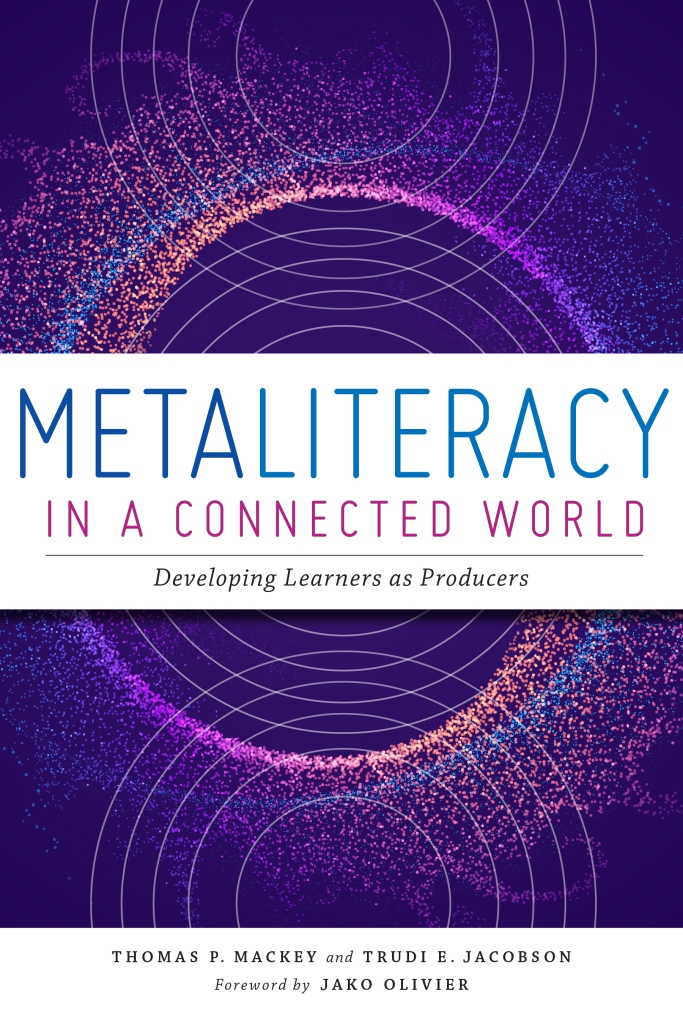
The fourth metaliteracy book in a series is entitled Metaliteracy in a Connected World: Developing Learners as Producers and will focus specifically on the metaliterate learner as informed and ethical producer of information in collaborative social settings. The Foreword to this book will be written by Jako Olivier, UNESCO Chair on Multimodal Learning, and OER Professor in Multimodal Learning, North-West University, South Africa.
In this newest book in their series, the authors carefully examine the central role of learners as producers of information, a foundational idea for the metaliteracy framework and one that’s more important than ever in our current media and information environment. They emphasize the active role today’s learners play as individual and collaborative metaliterate producers of information in various forms, including writing, digital stories, digital artifacts, and multimedia productions. The authors explore a range of connected social settings from online courses to social media to open learning environments.
We are excited to announce the forthcoming publication of our next book and will provide updates via Metaliteracy.org as we get closer to the publication date so stay tuned!
The metaliteracy model supports the design of open learning initiatives by reinforcing the value of ethical and responsible information production and sharing, and by scaffolding learners as they step into new roles that accompany open learning opportunities. These scenarios often include the opportunity to design and contribute to the communal learning environment. This presentation will describe the metaliteracy model and its intersections with open learning, and conclude by showcasing two initiatives that embody this approach.




 Metaliteracy.org