Plan to Attend an Online Workshop About Integrating AI and Metaliteracy to Develop OER

Are you interested in learning how to apply AI to create Open Educational Resources (OER)? Tom Mackey will explore this topic in an online presentation entitled “Advancing OER Through Metaliteracy and AI Integration” on November 12, 2025 at 8:00AM EST (New York) / 15:00 SAST (South Africa).

AI-generated image using ChatGPT 5 to show the integration of Metaliteracy, AI, and OER.

This virtual event is organized by the North-West University (NWU) UNESCO Chair and part of the NWU OER Fellows and the SADiLaR Digital Humanities OER Champions Project.

As noted in the event description:

The presentation introduces key concepts from metaliteracy and emerging AI literacy models, focusing on the updated metaliteracy goals and learning objectives, which have been revised to address the unique challenges and opportunities of AI-enhanced teaching and learning. Participants will engage in a practical workshop where they adapt and apply these themes to their own OER projects. Real-world examples from the Digital Media Arts program at Empire State University will illustrate how metaliteracy supports self-directed and multimodal learning in AI environments.

Session Takeaways:

  • Gain practical insights into how AI tools can be effectively applied to the development of Open Educational Resources (OER) through the lens of metaliteracy.
  • Participate in guided discussions and interactive learning activities that emphasize ethical, reflective, and collaborative engagement with AI in OER creation.
  • Explore strategies to empower educators and learners as metaliterate creators who design, share, and adapt OER for a global learning community.

Don’t miss this virtual event. Add it to your calendar and join via the Microsoft Teams link in the event announcement.

(Digital image generated in ChatGPT 5 for this post)

Looking for Workshop Ideas About Metaliteracy?

If you are interested developing workshop ideas about metaliteracy or would like to participate in a metaliteracy workshop asynchronously, check out this latest presentation! On Tuesday, September 5, Trudi Jacobson and Tom Mackey facilitated an interactive workshop entitled Adapting Metaliteracy OER to Multimodal Teaching and Learning Practices as part of their honorary appointments as Extraordinary Professors at North-West University (NWU). This virtual event was recorded and is now available to watch at your own pace. The ideas presented in the slideshow are easily adaptable to different learning scenarios and it is fine to follow along with the video as an asynchronous workshop participant! Feel free to apply the slides to your own setting (as long as you cite the source) and be sure to let us know if you have any questions! We would love to hear your feedback! -Trudi and Tom

Registration Open for Interactive Workshop about Metaliteracy and Multimodal Teaching and Learning

As a follow-up to their recent Prestige Lecture at North-West University (NWU), Prof. Trudi Jacobson and Prof. Tom Mackey will facilitate an interactive workshop entitled Adapting Metaliteracy OER to Multimodal Teaching and Learning Practices. This virtual event will take place on Tuesday, September 5 at 9am EDT and registration is now open: https://us02web.zoom.us/meeting/register/tZwudemqqD8vGtdb__JGCZUM5hP1GKECrIaN.

We look forward to seeing you there!

Trudi and Tom

Metaliteracy MOOCs Continue to Reach Learners Internationally


Since the launch of our two Coursera MOOCs, Metaliteracy: Empowering Yourself in a Connected World in 2016, and Empowering Yourself in a Post-Truth World in 2019, we have reached learners from around the world. So far, the first MOOC has enrolled 4,870 learners and the second has had 3,549 total learners worldwide. At times, we have been lucky enough to hear directly from the participants who successfully completed one or both of the MOOCs. Recently, Dr. Haleema Anwar from CMH Lahore Medical College and Institute of Dentistry in Lahore, Pakistan contacted us about her experience with the Coursera MOOC Empowering Yourself in a Post-Truth World. According to Haleema:

I am a final-year medical student, a researcher, and an author. I discovered the MOOC while going through the recommendation of courses for me on my app. This was a topic I wanted insight into. 

I learned that there is a diverse variety of roles that a person can take to create a community of trust in a Post truth world- leading to  prosperity.

Thank you!

Haleema Anwar

As part of the MOOC experience, participants apply the “learner as producer” role of metaliteracy to create a final digital media project. We share with permission, Haleema’s final project for the MOOC entitled “Metaliteracy in Action”:

Haleema describes this project in the following way:

This mind map is to walk us through the idea of meta-literacy and its practical implication.

The credit for the content is directed to a course by SUNY “Empowering yourself in a post-truth world”, a course I found on Coursera.

A central theme I learned is- “meta literacy is an integrated model for us to be a lifelong learner and to create a truthful community”

-Haleema Anwar

Thanks to Haleema for sharing such valuable insights about metaliteracy after completing our Coursera MOOC.

We always welcome this kind of feedback about our open metaliteracy projects! If you complete one of our MOOCs or any of our Metaliteracy Learning Resources, feel free to drop us a line and let us know if you would like to share your work via our blog.

To explore an analysis of the Post-Truth MOOC and how it was designed, read Embedding Metaliteracy in the Design of a Post-Truth MOOC: Building Communities of Trust (Mackey, 2020) in Communications in Information Literacy

Best,

Tom and Trudi

You are invited to an online panel: The Wikipedia Assignment: Where Students’ Interests, Confidence, and Public Participation in Knowledge Production Intersect

If you are interested in implementing an exciting and innovative open pedagogical project in your teaching, you might be interested in attending a panel about the Wiki Education program. This program, available in the US and Canada, provides strong support to both students and instructors for Wikipedia assignments. Having students contribute to Wikipedia in an academic setting enhances the amount of content available through Wikipedia, a boon to those who rely upon this source for information. It also diversifies the editor pool and thus the content as well. The students are able to build upon their subject knowledge and information literacy abilities. Yet moving from a traditional assignment meant for the professor’s eyes only to one openly available can be somewhat intimidating at first. Metaliteracy’s emphasis on the metacognitive and affective learning domains provides scaffolding for students who may grapple with imposter syndrome and fear of visible failure.

The one-hour panel is sponsored by the Faculty Center for Teaching and Learning at Ferris State University and will take place on Monday, April 11 at 3:00 Eastern time. Besides Trudi Jacobson, panel members include Helaine Blumenthal, Senior Program Manager at Wiki Education, Mark Marinkovic, a former student of Trudi’s (pictured above), Naniette Coleman, Executive Director of the Interdisciplinary Research Group on Privacy and Ph.D. candidate in Sociology at UC Berkeley, and Ava Wu, a student of Naniette’s,

The registration page provides more information about the panel. We hope you can join us.

Explore Open Pedagogy and Metaliteracy During Open Education Week March 7-11

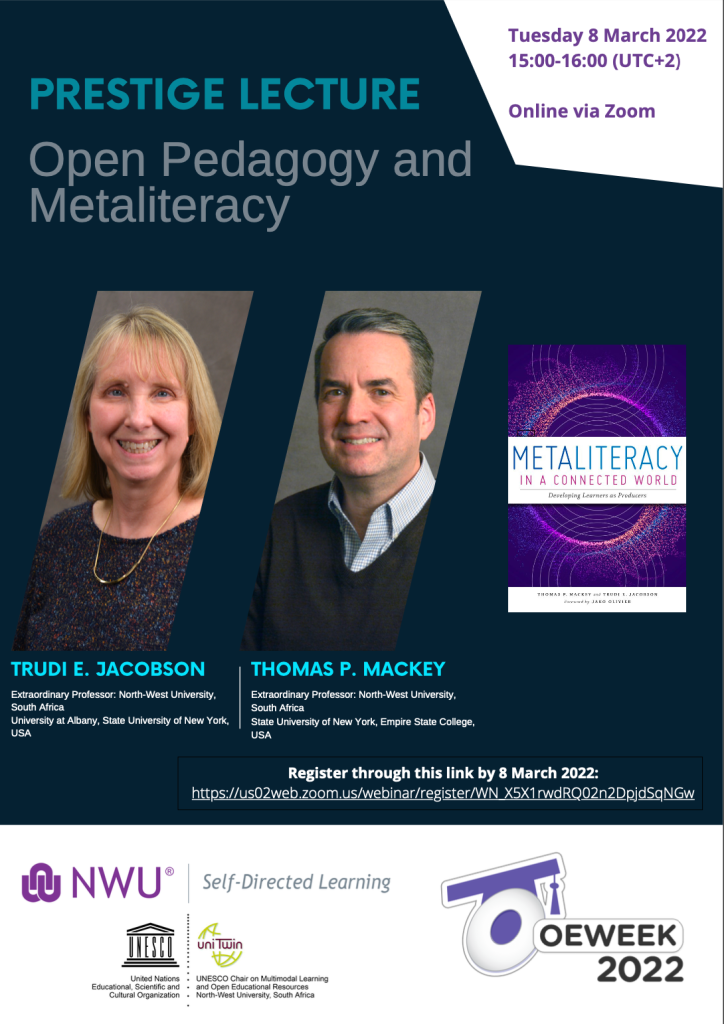
The week of March 7-11 is Open Education Week (OEWEEK 2022). There are many events happening around the world, live and virtually, that address Open Education. We hope that you might be able to attend Open Pedagogy and Metaliteracy, given by Trudi Jacobson and Tom Mackey. We will be delving into characteristics of pedagogy and exploring how metaliteracy can scaffold the opportunities and challenges that open pedagogical teaching and learning methods introduce. This is our second Prestige Lecture as honorary Extraordinary Professors in the Research Unit Self-Directed Learning, Faculty of Education, North-West University, South Africa.

The virtual lecture explores themes from our new book for ALA Publishing, Metaliteracy in a Connected World: Developing Learners as Producers. The event is open to anyone who would like to attend.

Register here:
https://us02web.zoom.us/webinar/register/WN_X5X1rwdRQ02n2DpjdSqNGw

Metaliteracy Discussed on The Academic Minute—Again!

Trudi Jacobson is featured on a segment for NPR’s The Academic Minute that was first presented on December 15, 2021: Renewable Assignments, Wikipedia, and Metaliteracy.

In this new segment, Trudi discusses the value of renewable assignments, i.e., assignments in which students create content that is useful to others, not meant simply for their professors’ eyes alone. Such assignments help individuals to become metaliterate learners and responsible digital citizens. Her example involves editing content in Wikipedia and the important scaffolding that metaliteracy can provide. If you get a chance, listen (or read it, the text is provided). The Academic Minute is produced for NPR by our local WAMC public radio station.

This is the second time metaliteracy has been featured on the program. Tom Mackey’s segment, Metaliterate Learners, aired on May 18, 2020.

Metaliteracy, Self-Directed Learning, and Assessment

Trudi Jacobson, Tom Mackey and Jako Olivier (UNESCO Chair on Multi-Modal Learning and Open Educational Resources, and Professor at North-West University) co-authored a chapter in a recent open-access volume, Learning Through Assessment: An Approach Towards Self-Directed Learning. The book was edited by Elsa Mentz and Anitia Lubbe, and is a part of the NWU Self-directed Learning Series.

Cover for Learning through assessment: An approach towards self-directed learning
Learning Through Assessment (2021)

The chapter by Trudi, Tom and Jako is entitled “Aligning Metaliteracy with Self-directed Learning to Expand Assessment Opportunities,”

The chapter’s abstract:

Metaliteracy is a holistic model that emphasises information-related knowledge attainment whilst challenging individuals to take charge of their learning strategies and goals. It prepares learners to become informed consumers and responsible producers of information. Metacognition is a core concept in metaliteracy, just as it is in self-directed learning (SDL) and in methods of assessment appropriate to SDL, such as Assessment as Learning (AaL) and Assessment for Learning (AfL). This congruence provides clear avenues for using metaliteracy’s framework in ways that support SDL. The first part of the chapter explores metaliteracy and its connections with SDL and assessment. The remainder of the chapter provides two examples of how the intersection of metaliteracy, SDL and assessment might be addressed in practice. These case studies provide additional and practical connections that might suggest applications in other settings. The first section explores a comprehensive metaliteracy digital badging system that is designed to advance SDL, with a focus on how the self-directed unit from this system was adapted for use in an open textbook. The final section of the chapter provides an example of how an online undergraduate course intertwines metaliteracy, information literacyand editing on Wikipedia, exemplifying principles of SDL and providingexamples of AaL and AfL. (p. 72)

We look forward to furthering our investigations into the connections between metaliteracy and self-directed learning.

Portuguese Translation of the First Metaliteracy Book is Published Online

Metaletramento (Metaliteracy) is available online! 

The full-text version of Metaletramento is presented as an open and fully online resource at: http://www.valentim.bsb.br/metaletramento/. This dynamic site features an interactive Table of Contents, annotation tools, QR code, and link to the virtual presentation entitled Metaliteracy and the Perspectives of Information Science in the Digital Age. This roundtable discussion celebrated the publication of book and took place at the XXI National Meeting of Research and Postgraduate Studies in Information Science (ENANCIB 2021) – Brazil  This Portuguese translation of the first metaliteracy book by Tom Mackey and Trudi Jacobson was supported by The Brazilian Institute of Information in Science and Technology (IBICT), Research Unit of the Ministry of Science, Technology and Innovation (MCTI) in partnership with UNESCO and ALA/Neal-Schuman Publishing. Thanks to Helda Pinheiro and Dr. Cecília Leite, Director of Ibict, and the Faculty of Information Science at the University of Brasília.

Embedding Metaliteracy in Learning Design to Advance Metacognitive Thinking: From OER to MOOCs

As part of this year’s European Conference on Information Literacy (ECIL 2021), Tom Mackey and Trudi Jacobson presented the paper “Embedding Metaliteracy in Learning Design to Advance Metacognitive Thinking: From OER to MOOCs.” The full-text version of the paper is available via ResearchGate. According to the abstract:

This paper describes several examples of how metaliteracy is embedded in teaching praxis through open educational resources (OER) that include interactive learning objects and digital badging content as well as fully developed Massive Open Online Courses (MOOCs). Specifically, these metaliteracy OER have been applied by the authors in an information literacy course at the University at Albany, SUNY, as well as online courses in the Digital Arts at SUNY Empire State College (Mackey & Jacobson, 2021).

This presentation follows an interactive workshop entitled “Teaching with Metaliteracy: Developing Informed, Reflective, and Participatory Citizens” that was provided at the conference earlier in the week. All of these ideas and resources are transferrable to a wide range of teaching and learning environments. If you would like to talk with us about ways to apply metaliteracy OER to your setting, feel free to reach out to us.

Tom and Trudi