Metaliteracy Takes On Fake News

In an essay for The Conversation, entitled How we can learn to reject fake news in the digital world? Tom Mackey and Trudi Jacobson describe ways to challenge fake news through metaliteracy. The spread of fake news across social media presents us all with a reality check about the danger of deception in these spaces. As the authors describe in the article, fake news stories that appear to be easily accepted by online users is a problem that warrants a strong educational response through focused metaliterate teaching and learning. The same approaches outlined in the article address concerns about misinformation that is created and shared online as well. Several of metaliteracy’s learning goals and objectives speak directly to the situation we find ourselves in with a proliferation of fake news and misinformation online.

The response to the essay has been tremendous, leading to an interview with Tom and Trudi by reporter Torie Wells from 6CBSNews for the TV news story Facebook preparing to flag fake news stories. According to stats provided by The Conversation, the article has had over 7,000 readers to date, with 796 Facebook shares, 115 tweets, and 143 shares via LinkedIn. The article has been published by the Associated Press, Government Technology, and newspapers across the country, including the Albany Times Union, Houston Chronicle, SFGate, and Seattle Post-Intelligencer, among others.

Last year, Jacobson and Mackey wrote an article for The Conversation about how to protect ourselves online from those annoying ads that follow us around while surfing the Web. The authors said that becoming meta-literate in today’s social media world prepares us to think critically about the sites we visit online and to develop smart search strategies that protect our identity. This latest piece about fake news is an extension of that work, applying metaliteracy to real world practice.
On-Demand Version of Coursera Metaliteracy MOOC Launches in December 2016!

We are set to launch an on-demand version of our Cousera Metaliteracy MOOC entitled Metaliteracy: Empowering Yourself in a Connected World in December 2016! If you missed this MOOC the first time around or would like to discover this course for your own learning or as a resource for instruction, register now for this on-demand version taught by  Tom Mackey, Trudi Jacobson, Kelsey O’Brien, Michele Forte, and Allyson Kaczmarek.  This course will provide a dynamic exploration of metaliteracy through videos, animations, interviews, readings, and digital images, all developed by members of the metaliteracy learning collaborative from two schools within the State University of New York (SUNY), The University at Albany and Empire State College. Learners will participate in peer assessments and contribute to online discussions related to such topics as the metaliteracy model, creating and sharing information, understanding intellectual property and the ethical use of information, understanding how information is packaged and shared, participating as a global contributor, creating and curating information, and developing metacognitive reflection.  While this course is focused primarily on metaliteracy, learners and teachers should also explore this MOOC as a way to support information literacy and related literacies such as digital literacy and media literacy.  Register now for our December launch. Special thanks to Kelsey O’Brien for working closely with Coursera and our UAlbany/ESC team to transition the first version of this course into the on-demand format!


Metaliteracy Discussed at ASIS&T 2016 in Copenhagen

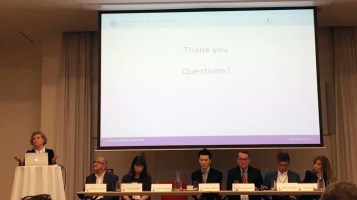
Picture of Metaliteracy panel at ASIS&T 2016 in Copenhagen

(L-R) Louise Limberg, Jamshid Beheshti, Joan Bartlett, Yusuke Ishimura, Thomas Mackey, Jacek Gwizdka, and Dania Bilal

At the invitation of Prof. Jamshid Beheshti from McGill University, an international team of researchers participated in a panel related to metaliteracy at the 2016 Annual Meeting of the Association for Information Science and Technology (ASIS&T) in Copenhagen, Denmark. The panel presentation entitled “Information Literacy: Bridging the Gap Between Theory and Practice” reflected this year’s conference theme Creating Knowledge, Enhancing Lives through Information & Technology. Tom Mackey’s part of the presentation and the accompanying conference proceedings, developed with Trudi Jacobson, explored “Metaliteracy and Inter-Generational Metacognitive Learning.” The panel of information science researchers (pictured above), featured: Jamshid Beheshti, and Joan Bartlett, McGill University, Canada, Louise Limberg, University of Borås, Sweden, Dania Bilal, University of Tennessee, Jacek Gwizdka, University of Texas at Austin, and Yusuke Ishimura, Tokyo University, Japan.

New Metaliteracy Keynotes in June 2016!

Tom Mackey and Trudi Jacobson both presented on metaliteracy in June at two separate keynote presentations during the same week! Tom presented Developing Metaliteracy to Engage Citizens in a Connected World at the University of Delaware Summer Faculty Institute 2016 and Trudi presented Envisioning the Possibilities: Educational Trends and Information Literacy in Academic Libraries at the 3er Congreso de Bibliotecas Universitarias y Especializadas in Santiago, Chile! Trudi’s presentation also considered new modes and methods of teaching (including digital badges and MOOCs) and the ACRL Framework. Trudi’s slides are available via SlideShare. Tom’s keynote is available online at the SFI 2016 Sessions Recording Page and his slides are available via SlideShare and this blog posting.

Metaliteracy in Practice Book Published!

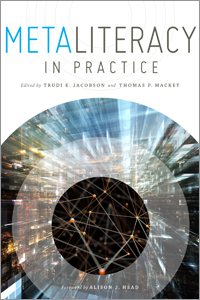
MackeyMIP_300We are thrilled that our new edited book Metaliteracy in Practice (right) was published this week by ALA Neal-Schuman! This book is the follow up to our co-authored book Metaliteracy: Reinventing Information Literacy to Empower Learners (2014).  The new book features 9 chapters from faculty and librarians who have been applying metaliteracy in their teaching practices.  We really enjoyed the chance to work with such outstanding chapter authors on this project, representing a variety of institutions, including: Keene State College, Washington College, University of South Africa, SUNY College at Brockport, and the University of Scranton. The authors explore metaliteracy practices related to social media pedagogy, the politics of information, nursing education, open and collaborative learning, student empowerment, and learner agency.  In addition, ACRL’s Framework for Information Literacy for Higher Education is examined in relation to metaliteracy in several of the chapters.  The book’s Foreword was written by Alison J. Head, Ph.D., Executive Director, Project Information Literacy (PIL), Principal Research Scientist, The Information School, University of Washington, and Faculty Associate, Berkman Center for Internet & Society, Harvard University. We appreciate all of the support we received from everyone at ALA Neal-Schuman and we must say that we absolutely love the cover!  -Trudi and Tom

Metaliteracy at the Course Level: A look at “Revising for Metaliteracy” from the forthcoming Metaliteracy in Practice book

Donna Witek and Teresa Grettano of The University of Scranton offer the following preview of their chapter, “Revising for Metaliteracy: Flexible Course Design to Support Social Media Pedagogy,” appearing in the forthcoming book Metaliteracy in Practice.

What does a course designed intentionally for metaliteracy—as both a pedagogical method as well as a learning outcome—look like? How can a course’s goals, assignments, and schedule be deliberately composed and structured to develop metaliteracy in both students and instructors? And why might instructors choose to use social media in their courses, not despite but because of the complexities that accompany these technologies when they are invited into the learning community of the classroom?

This chapter offers answers to these questions by describing, analyzing, and reflecting on a 200-level Writing course called Rhetoric & Social Media, in which students “investigate rhetoric through and the rhetoric of social media.” This course was co-designed and co-taught by the authors—an information literacy librarian and a rhetoric/composition professor—for the first time at their institution in spring 2011. At its inception the course focused on the social media platform Facebook as both the primary object of analysis and vehicle for learning in the course. By 2013, it became clear to the authors that a course intentionally designed to develop both information literacy and rhetorical and critical practice in students on social media needed to address more platforms than Facebook, and needed to be flexible in how it did so. To this end, the authors significantly revised the course in time for the spring 2013 semester to include Twitter, Instagram, and Pinterest, in addition to Facebook, with a restructured course schedule and new learning exercises (i.e., assignments) developed to take advantage of this expansion in scope.

This chapter shares with readers this revision process: what the revisions were, the authors’ pedagogical rationale for the revisions made, the outcomes of the revisions (i.e., how they played out in practice in the classroom), and the relationship between this revision process and the development of metaliteracy in all involved—students and instructors/authors alike. Like a companion chapter in this collection, this chapter models a metaliterate approach to course design through its method of analyzing elements of the syllabus over time, in order to build an argument for what metaliteracy at the course-level looks like. It also makes connections between the goals of rhetorical theory and the goals of metaliteracy, connections that can be leveraged by information literacy educators to further integrate these domains within and across the curriculum.

Metaliteracy Keynote at Cedar Crest College

We were thrilled to present on the topic Expanding Metaliteracy Across the Curriculum to Advance Lifelong Civic Engagement at Cedar Crest College last week! The Cedar Crest Curriculum Committee invited us to present a summer workshop to build on the great work they are doing to map information literacy/metaliteracy across the curriculum.  We were very impressed with the work they are doing and enjoyed our time with the faculty, librarians, and administrators very much.  This is the slide deck for the facilitated presentation and it includes the world premiere of our new book cover for the forthcoming Metaliteracy in Practice! Be sure to check it out!

Metaliteracy featured at Cedar Crest College Summer Workshop

We are looking forward to presenting at Cedar Crest College in Allentown, Pennsylvania on Wednesday August 19.  The topic of our collaborative workshop will be: Expanding Metaliteracy Across the Curriculum to Advance Lifelong Civic Engagement.  Here’s the description for what we plan to do:

Metaliteracy is a reinvention of information literacy to promote reflective learning, active and critical participation in social settings, including social media, and the ability to adapt to emerging technologies. This is a dynamic reframing of information literacy with an expanded set of learning goals and objectives that could be applied across the curriculum to support metacognitive reflection, and learners as informed consumers and collaborative producers of information. Metaliteracy has influenced the development of the new Association of College and Research Libraries (ACRL) Framework for Information Literacy for Higher Education, signaling wider support for this model and increasing adoption in diverse educational settings. Metaliteracy has sparked the development of several collaborative projects initiated by Mackey and Jacobson and their colleagues in the Metaliteracy Learning Collaborative, including a digital badging system and three Massive Open Online Courses (MOOCs).

Metaliterate learners, who apply integrated competencies related to evaluating, consuming, and producing information in participatory environments, will be better prepared for college level learning and lifelong civic engagement. This workshop will define metaliteracy, discuss the four domains of metaliteracy and related learning goals and objectives, and examine how this approach has been applied in the curricular design of several innovative projects such as competency based digital badging and three MOOCs. Participants will have a chance during the workshop to envisage opportunities to enhance students’ metaliteracy abilities, and to share these ideas with other attendees.

One of the presenters for this workshop, Trudi E. Jacobson, was co-chair of the ACRL Task Force with Craig Gibson (The Ohio State University). She will describe the new metaliteracy-informed ACRL Framework and its definition of information literacy. This interactive portion of the workshop will be an opportunity to engage with the Framework and consider how it might inform collaborations between disciplinary faculty members and librarians. We will provide an opportunity for participants to grapple with more easily implemented changes and the metaliteracy underpinnings of the frame content to really build upon the content examined throughout the day.

Sneak Peak #2 into Metaliteracy in Practice

As promised, we are posting chapter previews, written by the authors, for the forthcoming book Metaliteracy in Practice, due out in late 2015 or early 2016 from ALA Neal-Schuman.

Chapter 2:

The Politics of Information: Students as Creators in a Metaliteracy Context

Lauren Wallis, Christopher Newport University

Andrew Battista, New York University

The recent revision of the Framework for Information Literacy in Higher Education opens a space for students to reflect on their position within an inherently political imbroglio of information, both in traditional scholarly formats and in open online spaces. When students visit the library, it is often at the behest of their professors, who expect that librarians will tell them how to find peer-reviewed journals. Meanwhile, the Framework, with its grounding in metaliteracy, encourages knowledge practices and dispositions in which students see their own encounters with information as opportunities to question authority, challenge expertise, and recognize the merit of nontraditional forms of evidence.

As the Framework was being revised, and as discussions of metaliteracy as a guiding principle for information literacy pedagogy emerged, we taught a one-credit class called The Politics of Information. In this class, we asked several questions: Who creates information? What information gets produced and circulated, and what information does not?  Who has access to information, and how can the dissemination of information be an instrument of social control, inside and outside of the academy? As we taught, we realized that our core teaching moves—to destabilize authority and to encourage students to create digital products and reflect metacognitively on their learning experience—dovetail with the goals of metaliteracy.

We are excited that our chapter, “The Politics of Information: Students as Creators in a Metaliteracy Context,” is included in the forthcoming Metaliteracy in Practice volume. Our chapter makes the connections between the learning outcomes in The Politics of Information course and metaliteracy explicit. We began with the idea that information is a social construct, not a static, amorphous entity that reifies academic authority. We hope that this chapter, along with the others in the volume, offers concrete ways to adopt the goals of metaliteracy into the information literacy classroom.

Presentation on MOOCs and Badges at SUNY CIT

The Metaliteracy Learning Collaborative presented on the culmination of their work over the past year for an Innovative Instruction Technology Grant (IITG) at SUNY’s Conference on Instruction and Technology on May 28th. A panel composed of all eight members of the grant team, including PIs Tom Mackey and Trudi Jacobson and co-PIs Kathleen Stone, Michele Forte, Amy McQuigge, Kelsey O’Brien, Allison Hosier and Jenna Pitera, discussed the development of two MOOCs on two different platforms, both of which were supported by the metaliteracy learning objectives. Designing Innovative Online Learning: An Investigation of Digital Badges Integration with Two MOOC Platforms offered insights about the collaborative development and facilitation of both the Coursera and Canvas MOOCs and the extent to which we were able to integrate the Metaliteracy Badges.