The interactive workshop Advancing OER Through Metaliteracy and AI Integration, presented by Prof. Tom Mackey of Empire State University, explored the application of metaliteracy and artificial intelligence (AI) to enhance the design of Open Educational Resources (OER). This online session was organized by Prof. Dorothy Laubscher, UNESCO Chair at North-West University (NWU) in South Africa, and was featured as part of the NWU OER Fellows and the SADiLaR Digital Humanities OER Champions Project.
The workshop introduced key concepts from metaliteracy and emphasized the updated Metaliteracy Goals and Learning Objectives to address the challenges and opportunities of AI for teaching and learning. Participants engaged in several interactive surveys and two workshop activities that emphasized ethical, creative, and collaborative applications of AI in open learning environments. The session illustrated how careful planning and inclusive engagement reinforce the learning experience through the development of sustainable OER.
Real-world examples from the Digital Media Arts program at Empire State University illustrated how metaliteracy supports self-directed and multimodal learning in AI-driven environments.
The video recording from the session is now available:
Video recording of OER + Metaliteracy + AI Workshop
Watch the video to learn how to integrate AI and metaliteracy to support effective OER development. Try the workshop activities or adapt them to your OER projects. We invite you to share the outcome of your work via this blog, and we’ll gladly support you in doing so. If you have any questions, let us know!
At the Faculty360.org 2025 Summit, hosted virtually by Zayed University in the United Arab Emirates, Tom Mackey delivered a presentation titled “Developing Metaliterate Learners for Generative AI.” The summit theme, Beyond the AI Hype: Faculty Futures in a Changing World, provided the context for a session that introduced metaliteracy as a holistic pedagogical framework for teaching and learning with generative AI. The presentation examined how the model supports critical thinking, knowledge production, and collaborative learning in AI environments.
The talk outlined the key elements of the metaliteracy framework and illustrated how its learner domains, roles, and characteristics guide effective engagement with generative AI. The 2025 revision of the Metaliteracy Goals and Learning Objectives was discussed as a transferable resource for educators seeking to support ethical, reflective, and empowered engagement with AI across disciplines.
Several examples of learning activities from the Digital Media Arts program at Empire State University illustrated how the integration of AI and metaliteracy can foster creativity, critical reflection, and informed decision-making. The session also introduced new versions of the metaliteracy diagrams, offering updated visualizations that show how the framework enhances multiple modality learning in a wide range of educational settings.
The slide deck from this presentation is now available and can be accessed below.
If you would like to contribute your own take on these ideas, particularly as they relate to the metaliteracy framework and the updated Metaliteracy Goals and Learning Objectives, we would be glad to work with you on a guest blog post.
Are you interested in learning how to apply AI to create Open Educational Resources (OER)? Tom Mackey will explore this topic in an online presentation entitled “Advancing OER Through Metaliteracy and AI Integration” on November 12, 2025 at 8:00AM EST (New York) / 15:00 SAST (South Africa).
This virtual event is organized by the North-West University (NWU) UNESCO Chair and part of the NWU OER Fellows and the SADiLaR Digital Humanities OER Champions Project.
As noted in the event description:
The presentation introduces key concepts from metaliteracy and emerging AI literacy models, focusing on the updated metaliteracy goals and learning objectives, which have been revised to address the unique challenges and opportunities of AI-enhanced teaching and learning. Participants will engage in a practical workshop where they adapt and apply these themes to their own OER projects. Real-world examples from the Digital Media Arts program at Empire State University will illustrate how metaliteracy supports self-directed and multimodal learning in AI environments.
Session Takeaways:
Gain practical insights into how AI tools can be effectively applied to the development of Open Educational Resources (OER) through the lens of metaliteracy.
Participate in guided discussions and interactive learning activities that emphasize ethical, reflective, and collaborative engagement with AI in OER creation.
Explore strategies to empower educators and learners as metaliterate creators who design, share, and adapt OER for a global learning community.
Don’t miss this virtual event. Add it to your calendar and join via the Microsoft Teams link in the event announcement.
Framed around the idea of learners as “humans in the loop” (Wu, et. al., 2022), the session highlighted diverse case studies that offered practical strategies for empowering individuals to engage with AI critically, ethically, and collaboratively.
Representing the team in person were Matt Moyo (North-West University, South Africa), Kristine N. Stewart (Zayed University, United Arab Emirates), and Tom Mackey (Empire State University, USA), (all pictured above). The panel also drew on the important contributions of Brenda Van Wyk (University of Pretoria, South Africa), Megan Eberhardt-Alstot (Pepperdine Graduate School of Education and Psychology, USA), and Kristen Schuster (University of Southampton, UK).
The case studies showcased during the session reflected a wide range of perspectives and areas of inquiry, including Generative AI and the Metaliterate Learner, Responsible Use of AI in Postgraduate Research, Misrepresentation in AI, Inclusive Curriculum Design, and the Ethics of AI in Digital Media Arts. Together, these themes underscored the value of metaliteracy as a framework for engaging with AI while emphasizing the human capacity for metacognitive reflection, ethical responsibility, and collaborative knowledge construction.
If you would like to share your own explorations with AI and Metaliteracy, feel free to reach out to us and we would be happy to share via our Metaliteracy.org blog.
Tom and Trudi
Reference
Wu, X., Xiao, L., Sun, Y., Zhang, J., Ma, T., & He, L. (2022). A survey of human-in-the-loop for machine learning. Future Generation Computer Systems, 135, 364–381. https://doi.org/10.1016/j.future.2022.05.014
The two metaliteracy panels are featured as part of the full conference agenda and include:
Panel Presentation: Humans in the Loop: Advancing Metaliteracy for Generative AI Learning Environments
This international panel on Tuesday, Sept. 23 2025 will explore the transformative potential of metaliteracy as a holistic framework for addressing the global challenges and opportunities presented by artificial intelligence (AI). The panelists will present descriptive case studies from around the world that demonstrate actionable strategies for empowering learners as humans in the loop through metaliteracy.
Panelists:
Thomas P. Mackey, Empire State University, USA
Brenda Van Wyk, University of Pretoria, South Africa
Megan Eberhardt-Alstot, Pepperdine Graduate School of Education and Psychology, USA
Kristine N. Stewart, Zayed University, United Arab Emirates
Kristen Schuster, University of Southampton, UK
Matt Moyo, North-West University, South Africa
Paper Presentation: Combining Information Literacy and Metaliteracy to Advance Transnational Group Learning about AI. Learning Process and Learning Outcomes, Results from a Case Study
The global panel on Thursday, September 25, 2025, will present findings from a co-authored transnational case study on learning about AI. The paper combines insights from information literacy and metaliteracy to highlight collaborative learning processes and outcomes across cultures. Panelists will discuss collaborative teaching and learning in the global virtual exchange Intercultural Perspectives on Information Literacy and Metaliteracy (IPILM).
Authors:
Joachim Griesbaum, University of Hildesheim, Germany
Stefan Dreisiebner, Carinthia University of Applied Sciences, Austria
Emina Adilović, University of Sarajevo, Bosnia and Herzegovina
Justyna Berniak-Woźny, SWPS University Kraków, Poland
Subarna Bhattacharya, Kalinga Institute of Industrial Technology, India
Jini Jacob, Symbiosis College of Arts & Commerce, India
Thomas P. Mackey, Empire State University, SUNY, USA
Tessy Thadathil, Symbiosis College of Arts & Commerce, India
These two sessions underscore the growing importance of metaliteracy in addressing the opportunities and challenges of AI in global education. They also highlight the collaborative work of international scholars who are shaping future directions for learning in the age of generative AI.
(AI-generated image “AI and Metaliteracy” created using ChatGPT)
We welcome this guest blog post from Riaz Laghari. He is an English language teacher, researcher, and writer from Pakistan. His work focuses on digital literacy, education, language, and critical thinking. As a passionate lifelong learner, he is dedicated to exploring how pedagogy and technology intersect to promote responsible digital citizenship.
I completed the Coursera MOOC Metaliteracy: Empowering Yourself in a Connected World offered by Empire State University. It was an incredibly enriching experience that broadened my understanding of how learners engage with information in today’s digital environment.
This story published in Medium entitled Embracing Metaliteracy in the Digital Age reflects my personal journey and learning process. It emphasizes the importance of being a responsible digital citizen in today’s interconnected world. Through the narrative, I explore how embracing metaliteracy has helped me understand the significance of critical thinking. It also highlights the importance of ethical information sharing. Collaboration in digital spaces is another key aspect I have come to appreciate. As I state in the article:
Metaliteracy has transformed my approach to digital engagement, equipping me with the tools to navigate the online world responsibly, ethically, and collaboratively.
In today’s fast-paced digital world, being an informed and ethical participant in online spaces is more important than ever. In this piece, I reflect on my personal journey as a digital citizen. I also consider my professional journey. My experiences are guided by the principles of metaliteracy. This article highlights how this model has influenced my way of learning. It details how I teach and share information. It shows how I evaluate online sources and engage responsibly in digital communities.
As I state in the article:
In my experience, embracing metaliteracy has meant developing a heightened awareness of my role in the digital ecosystem. It’s about recognizing that the content I create and share impacts others, and therefore, I must engage with this content thoughtfully and critically. This responsibility extends to both professional and personal digital spaces.
Besides my own journey, I also apply metaliteracy concepts in my teaching. I encouraged my students to reflect critically on the sources they use. I urged them to recognize their role as both consumers and producers of information. I also motivated them to collaborate more mindfully in digital spaces. For instance, I integrated reflective blog writing into the curriculum. I also added peer feedback activities. These methods helped promote metacognitive awareness. They fostered a more participatory learning environment. It was particularly effective in helping students become more responsible and confident digital citizens.
As I conclude in my Medium article:
As we continue to interact with the ever-expanding digital landscape, it is crucial for all of us to embrace metaliteracy. By doing so, we can foster a more informed, ethical, and connected world, where information flows freely and responsibly.
Riaz is an English teacher, and writes about language and political discourse in Pakistan. You can find his work on Mediumand via his personal blog. If you would like to share your personal or professional experience with metaliteracy, feel free to reach out.
The metaverse is rapidly expanding and even young children are immersed in worlds like Minecraft and Roblox. Adult learners have utilized Second Life as a learning space for building in 3D for years now. Educators and librarians must utilize these evolving information landscapes for teaching and learning. The metaverse is ideal for embedding metaliteracy and is a real, albeit virtual, place where critical thinking is needed. To that end, the Winter 2025 issue of the Virtual Education Journal has focused on metaliteracy.
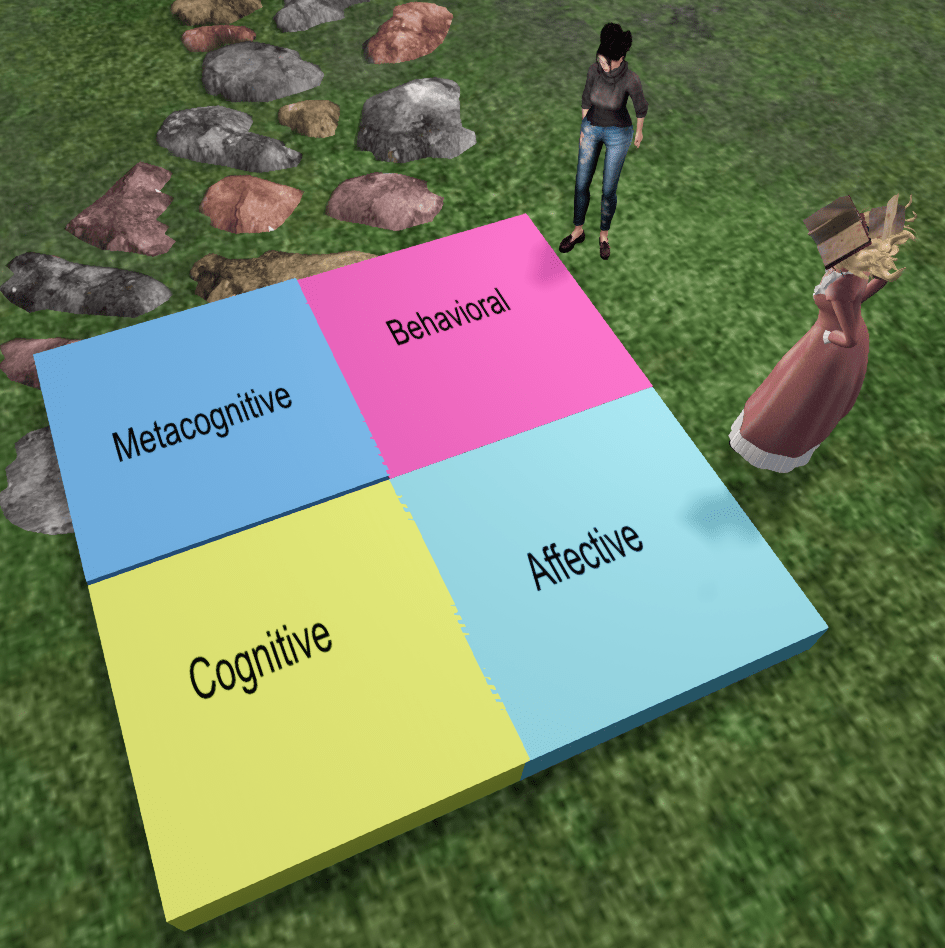
The domains of metaliteracy can be taught in the metaverse and vocabulary can be modified for even very young students. For example, metacognition is “thinking about our thinking” and one might simplify the metacognitive domain to the word THINK. The cognitive domain might be simplified to the word KNOW. The affective domain deals with our emotional intelligence and could be simplified to the word FEEL. Finally, the behavioral domain deals with what students can act upon or simply put, what they DO.
A short video demonstrates these themes, and how they could be taught, by visualizing the four domains on virtual flags.
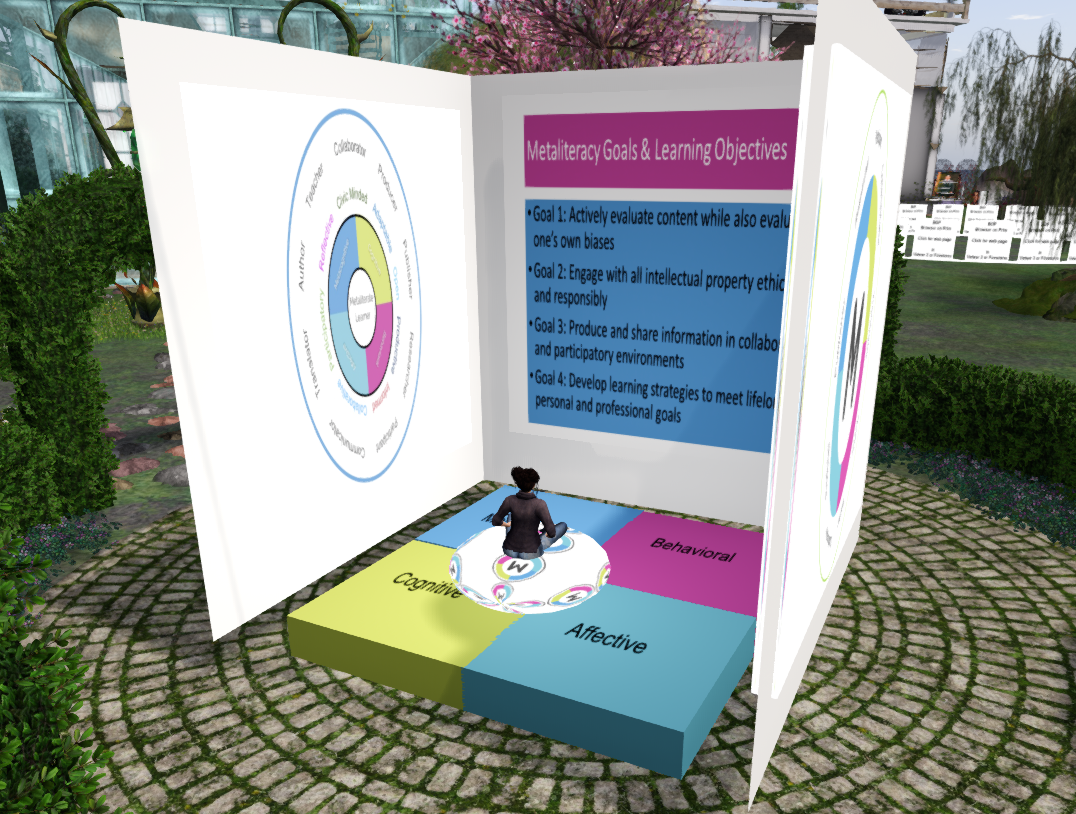
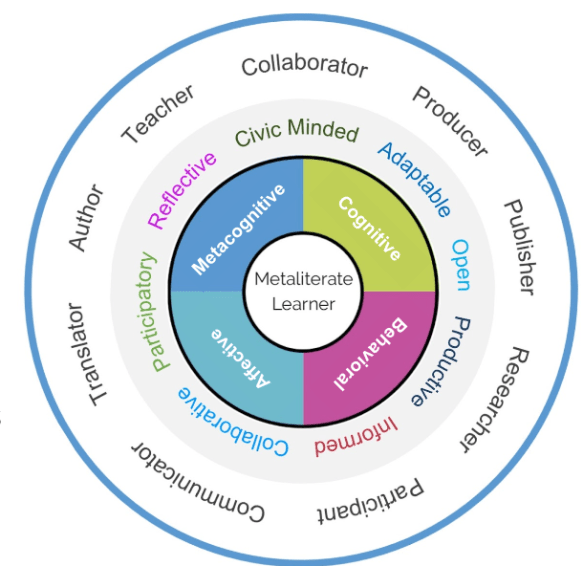
The metaverse is a perfect place to introduce metaliteracy because metaphors can be built in 3D. (Note the 3D model on page 76 in the Winter issue of VEJ). When students, embodied as avatars, can enter a model showing the roles, characteristics, and learning objectives of metaliteracy, they are able to better see how these relate to their own personal learning and their responsibilities for digital citizenship. The learner picture below is sitting on the foundational domains of metaliteracy.
By building a prototype model, one can envision how AI will impact metaliteracy. Soon other 3D builders will have the opportunity to revise the 3D model of AI and Metaliteracy in Second Life. Building in 3D is a great way to dig into the metaliteracy domains, roles, and characteristics of the learner. The picture below depicts AI as a large bubble in which we may navigate in and out of AI applications and still be aware of our own metaliterate roles and characteristics and the domains of our learning process. The learner is sitting on a beanbag that is scripted to allow the individual to move in and out of AI to illustrate that we can learn to control how we use AI and be aware of when AI is gathering information and producing new content.
A video demonstration of this prototype 3D metaliteracy model was provided at the Nonprofit Commons in Second Life and recorded here:
This prototype demonstrates the power of building in 3D and how we can produce and consume content as prosumers—both individually and collaboratively. This is metaliteracy in action. To become a good digital citizen, one must be metaliterate (whether you call it by that name or not!).
We appreciate this guest post from Dr. Valerie Hill, Director of the Community Virtual Library and researcher of changing literacy in digital culture. She has been innovative in applying metaliteracy in the virtual world of Second Life and the metaverse. Dr. Hill’s book, Metamodernism and Changing Literacy: Emerging Research and Opportunities, explores the relationship between metaliteracy and metamodernism.
We are excited to announce the final version of the 2025 Metaliteracy Goals and Learning Objectives. After an open comment period and extensive discussions, we have carefully reviewed the insightful feedback from the community and incorporated valuable suggestions into this finalized version. This update builds upon the 2018 goals and objectives while addressing the evolving nature of metaliteracy, particularly in response to revolutionary developments in artificial intelligence (AI) and the rapidly changing information environment.
Discussing the Role of AI
As we worked through these revisions, we had several intensive meetings in December and January to discuss not only specific updates but also how we conceptualize this version. One key topic of discussion was the role of AI. Although AI is specifically mentioned in the document, our focus extends beyond it to emphasize a broader understanding of metaliteracy. Our overarching goal is to acknowledge AI’s significant influence while ensuring that metaliteracy fosters a comprehensive and adaptable approach to learning in social information environments. Many of the revised objectives inherently address the need for metacognitive reflection and the ethical production of information, which are essential when engaging with AI-driven technologies.
Streamlining the Objectives
Through our collaborative efforts, we have refined this document to make it more actionable and adaptable for today’s educators and learners. This latest version of the Metaliteracy Goals and Learning Objectives streamlines the previous iteration by reducing the number of objectives from 34 to 20, providing greater clarity and focus. It further enhances self-awareness, critical thinking, and adaptability, ensuring that learners are prepared to engage with the complex information environments of today and the future. We made difficult decisions about which objectives to retain, eliminate, or merge, ultimately arriving at a more concise and focused approach. This process reinforced the “meta” perspective that distinguishes metaliteracy from traditional information literacy, aligning the framework with its continued evolution. This latest version underscores the essential ways in which metaliteracy supports continuous reflection, ethical participation in digital environments, and the responsible creation of knowledge.
How We Used AI
It is worth noting that we applied generative AI as a writing assistant to enhance clarity, refine the structure of ideas, and assess how certain objectives align with learning domains which provided valuable insights. Rather than allowing AI to dictate content, we used it as a tool for reflection and refinement, ensuring that our revisions remained true to the principles of metaliteracy that we have been developing for several years. This process serves as a model for how learners can engage with generative AI in a thoughtful, ethical, and collaborative manner—leveraging its strengths while maintaining critical oversight and intellectual ownership of ideas.
Call for Translations
As a next step, we welcome translation assistance to make the 2025 Metaliteracy Goals and Learning Objectives accessible globally. Translations will support a wider group of educators, learners, and researchers to integrate metaliteracy into their work, fostering international collaboration and engagement. If you can help, please leave a comment or contact us directly. Your support in broadening access to metaliteracy is invaluable. We invite you to review the final version of the 2025 Metaliteracy Goals and Learning Objectives and share your thoughts in the comments.
Thanks to the Metaliteracy Community
We want to extend our sincere gratitude to everyone who contributed during the open comment period. Your feedback was instrumental in shaping this final version, and we truly appreciate the thoughtful engagement from the metaliteracy community. Your insights helped refine the goals and objectives, making certain that they are relevant and impactful in educational and professional settings. Thank you for being part of this important process and for your ongoing support of metaliteracy. We look forward to continuing this important conversation with you. We invite you to review the final version of the 2025 Metaliteracy Goals and Learning Objectives and share your thoughts in the comments.
Now that the final version is available, we encourage you to explore the document and consider how these revised goals and objectives can be applied in your own teaching and learning. How do they support your approach to integrating metaliteracy and AI in education? What kinds of assignments or learning activities could be developed based on these insights? We invite you to share how you plan to apply these ideas in your work, teaching, or learning journey!
We look forward to hearing from you and keeping the dialogue going!
We are excited to share the newest draft of the Metaliteracy Goals and Learning Objectives (2025) with you! Through our collaborative work and plenty of our favorite tea, we’ve revised this document based on the progression of metaliteracy. It also addresses the revolutionary developments in artificial intelligence (AI). This update builds on the 2018 version, addressing the needs of educators and learners in rapidly changing information environments. We would love to hear your feedback! Please take a moment to review the draft. Then share your thoughts in the comment box at the end of that page. Do you find the revised goals and objectives useful? Any suggestions for revision? What did we miss? You may also want to add your thoughts concerning others’ suggestions and comments.
The world is evolving rapidly, especially with advancements in artificial intelligence (AI) and the growing concerns around mis- and disinformation. This led us to revisit the original goals and objectives published in 2018. Our aim was to tackle these trends head-on and consider the broader development of the metaliteracy model itself. We wanted a forward-thinking, adaptable approach for educators and learners to thrive in an increasingly complex information environment. This new version prepares learners for the challenges they will face in a world deeply influenced by AI. Metaliteracy’s emphasis on the “learner as producer” is central to the effective and ethical use of new tools and technologies.
As we worked through these revisions, we realized that the 2018 version was out-of -date and overly detailed. We streamlined the document by reducing the number of objectives from 34 to 20, focusing on clarity and purpose. This revision aligns with the evolution of metaliteracy itself and makes the framework more actionable for educators. We believe this new version is more focused and better suited to the needs of today’s learners. It has a sharper focus on critical thinking, self-awareness, and adaptability. We want learners to engage with and critically assess the technologies and influences shaping their world.
We’ve opted for an open comment period instead of a closed survey. This is a transparent process that encourages a collaborative exchange of ideas. We appreciate your thoughts and insights on these revisions, which will help guide the final version of the document.
So now, it’s your turn! We invite you to offer feedback on the draft Metaliteracy Goals and Learning Objectives (2025). What do you think about the revised document? Are there areas that need further refinement? How would these revised goals and objectives support you in teaching with AI? What kinds of assignments would you develop with these new insights? How would you revise existing assignments to apply these changes? The comment period will be open until February 28, 2025. After we analyze all of the feedback, we’ll share the final iteration of the 2025 document via this blog. We greatly appreciate your feedback as we continue to refine and evolve the metaliteracy framework for the future.
Thank you for your ongoing support and for being part of this exciting process! Please leave your comments on the page containing the new draft—let’s continue the conversation!
We welcome this guest post from Gabrielle Lerner, Student Government Association President and a graduate student in the MPA Program at Empire State University!
What is information? Is it the truth or perspective? What are we interpreting, and how do we know? Are we considering a lens or a fragment of something that is before us? I want to see information and feel that it is true—to discern its actuality. Can we feel information, like the vibration of a song? Is the goal for it to resonate and transcend our logical minds, or do we compare its intensity and velocity to standing on a mountain high up in the sky?
These were just some of the questions that stirred my curiosity during my metaliteracy course, an experience that transformed how I view and engage with information.
About three years ago, I had the incredible opportunity to take this course, and it remains one of the most profound educational experiences of my life. The course, Intercultural Perspectives on Information Literacy and Metaliteracy, brought together a diverse team of students from across the globe, including Germany, Bosnia-Herzegovina, Austria, Poland, India, and the United States. Our differences enriched our collaboration, offering a tapestry of perspectives as we navigated complex questions about truth, bias, and the framing of information. I am deeply grateful for the experience and for the chance to work with such a talented and thoughtful group of individuals.
As a group, we focused on the ways information is created, shared, and consumed, using an infographic as our lens. Our discussions delved into the complexities of citing general information, which can transform into something deeply specific with just the click of a button.
One of our most memorable exercises involved using the Metaliteracy wheel to assign roles within the group, ensuring that everyone contributed as a Teacher, Collaborator, Researcher, and Producer. This approach inspired us to be facilitators, speakers, and leaders. Together, we examined a controversial topic—climate change—from a perspective detached from the heated debates over causes or effects. Instead, we honed in on how information about climate change is produced, disseminated, and received.
The virtual landscape we explored was overwhelming at times, a maze of truths and half-truths that made us question what we thought we knew. We sought clarity amid the noise, sifting through scholarly articles, social media posts, and everything in between. We focused on how to identify credible channels, eliminate sensationalism, and help others do the same. We found fire in the footnotes of articles—the hidden truths buried in citations—and realized that even well-meaning authors could unknowingly perpetuate bias.
What truly united us as a group was our shared identity as truth seekers. We questioned assumptions, evaluated impacts, and guided each other through challenging topics. Our discussions were not just about information but also about who we are as learners and communicators. How do we ensure our voices contribute to a clearer understanding rather than adding to the clutter? How do we empower others to do the same?
The course was not only intellectually stimulating but also personally transformative. As we investigated the nuances of information, we, too, changed. Our group—the “metaliterate bunch”—became a microcosm of the literacy goals we sought to understand. We discovered that learning is as much about collaboration and introspection as it is about seeking answers. By the end, we had not only found the “key” to navigating the noise of the information age but also grown as individuals committed to a lifelong pursuit of truth.
Reflecting on this journey, I’m filled with gratitude for the experience and for my teammates, who inspired and challenged me every step of the way. The course taught me that being metaliterate is not just about understanding information; it’s about embracing the complexity of knowledge and striving to make sense of it with humility and curiosity.




 Metaliteracy.org