You may want to walk through the slide show asynchronously to gain new insights about the content presented. All of the interactive components are still available so feel free to jump in and contribute to the following:
The June 27, 2022, Academic Minuteprogram featured Trudi Jacobson, and, of course, metaliteracy. The episode is entitled, Students Reflect on their Roles and Responsibilities as Wikipedia Editors. It is the first in a week of episodes by professors and instructors who teach using the Wiki Education initiative. Although the program airs on a number of National Public Radio (NPR) stations, it is produced here in Albany, NY at WAMC. This makes Trudi’s affiliation, which is listed as North-West University (NWU) in South Africa rather than the University at Albany, seem a bit odd, but in order to appear on the program, one needs to be actively affiliated with an institution of higher learning. Trudi is Distinguished Librarian Emerita at The University at Albany, SUNY and both she and Tom Mackey were appointed Extraordinary Professors at North-West University (NWU) in South Africa, soon after presenting a metaliteracy Prestige Lecture as well as keynotes and workshops there in 2019. As part of their honorary appointments, their latest Prestige Lectures at NWU continue in a series this year and next.
This is the third Academic Minute episode that features metaliteracy. Tom Mackey recorded the first, Metaliterate Leaners, which aired on May 18, 2020. Trudi’s first was Renewable Assisgnments, Wikipedia, and Metaliteracy, from December 15, 2021. As indicated by the name of the series, these are quick listens. You might want to give them a try if you’ve not already heard them. This newest episode includes quotes from two students who made connections between their work as information producers on Wikipedia, metaliteracy and learning.
Feel free to use these short clips as part of your teaching practices related to metaliteracy!
According to Heap’s book review of Metaliteracy in a Connected World:
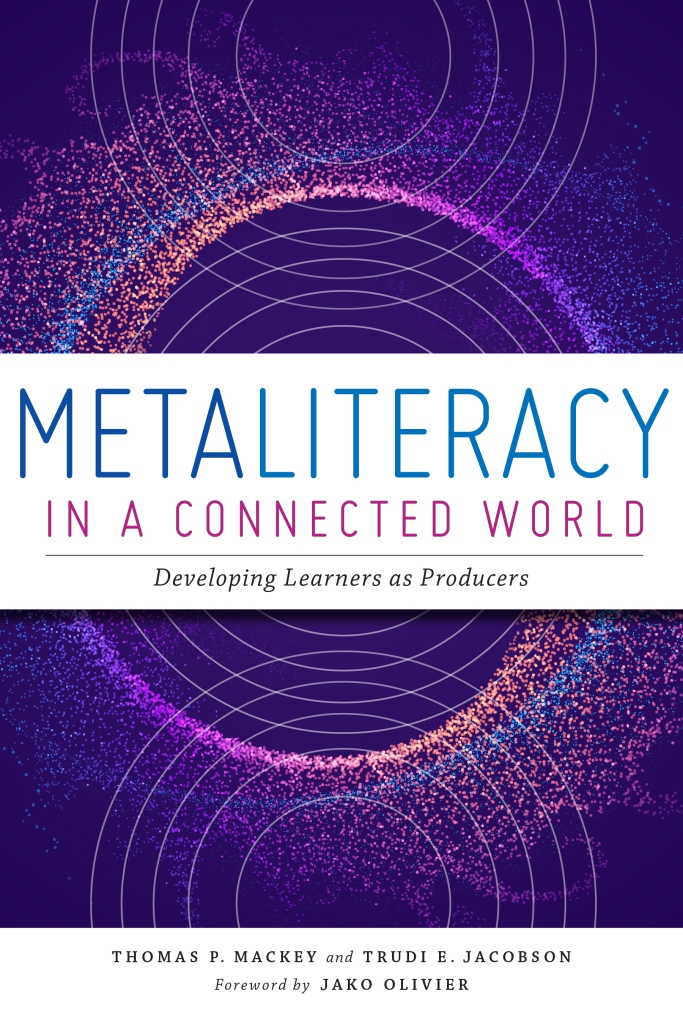
The flow of the text works well to introduce the reader to the concepts surrounding metaliteracy and then proceeds to provide evidence and a variety of examples of metaliteracy in action within Higher Education settings. The reader is supported in their understanding of how application of the metaliteracy framework and concepts could vary depending on the course. The activity section deserves particular appreciation —it provides various examples through which the framework could be applied, a useful scaffolding tool which not many texts offer.
(Heap, 2022, p. 131)
The reviewer provides an analysis of all six of the book’s chapters and argues that “It offers a useful jumping off point for both teachers and librarians in exploring the application of metaliteracy in the classroom” (Heap, 2022, p. 132).
We appreciate this review of our latest metaliteracy book published by ALA Neal-Schuman and look forward to seeing how it is received by authors and practitioners in the field and beyond. If you are aware of other reviews, feel free to send them our way!
Tom and Trudi
HEAP, Jodie R. Book review of Mackey, T., and Jacobson, T. 2022. Metaliteracy in a connected world: Developing learners as producers. Journal of Information Literacy, [S.l.], v. 16, n. 1, p. 131-132, june 2022. ISSN 1750-5968. Available at: <https://ojs.lboro.ac.uk/JIL/article/view/BR-V16-11-1>. Date accessed: 20 june 2022. doi: https://doi.org/10.11645/16.1.3217.
According to the new article co-authored by Dr. Thomas Mackey and Dr. Sheila Aird:
This paper describes the redesign of Digital Storytelling as a Collaborative Online International Learning (COIL) course that was taught in fall 2020 and spring 2021 at SUNY Empire State College. Metaliteracy is integrated into the learning design of this fully online course to enhance the virtual international experience. This pedagogical model encourages metacognitive reflection and the production of digital narratives as individuals and in collaboration with peers.
(Mackey & Aird, 2022)
An earlier version of this paper was presented by Mackey & Aird at the ICDE Virtual Global Conference Week 2021: Upskilling and upscaling for quality Open, Flexible and Distance Learning (OFDL) in October 2021. The paper was then preselected for publication in Open Praxis, the peer-reviewed journal published by the International Council for Open and Distance Education (ICDE). To learn more about this digital storytelling collaboration, explore the Global Digital Stories blog managed by the two authors.
Mackey, T. P., & Aird, S. M. (2022). Integrating Metaliteracy into the Design of a Collaborative Online International Learning (COIL) Course in Digital Storytelling. Open Praxis, 13(4), 397–403. DOI: http://doi.org/10.55982/openpraxis.13.4.442
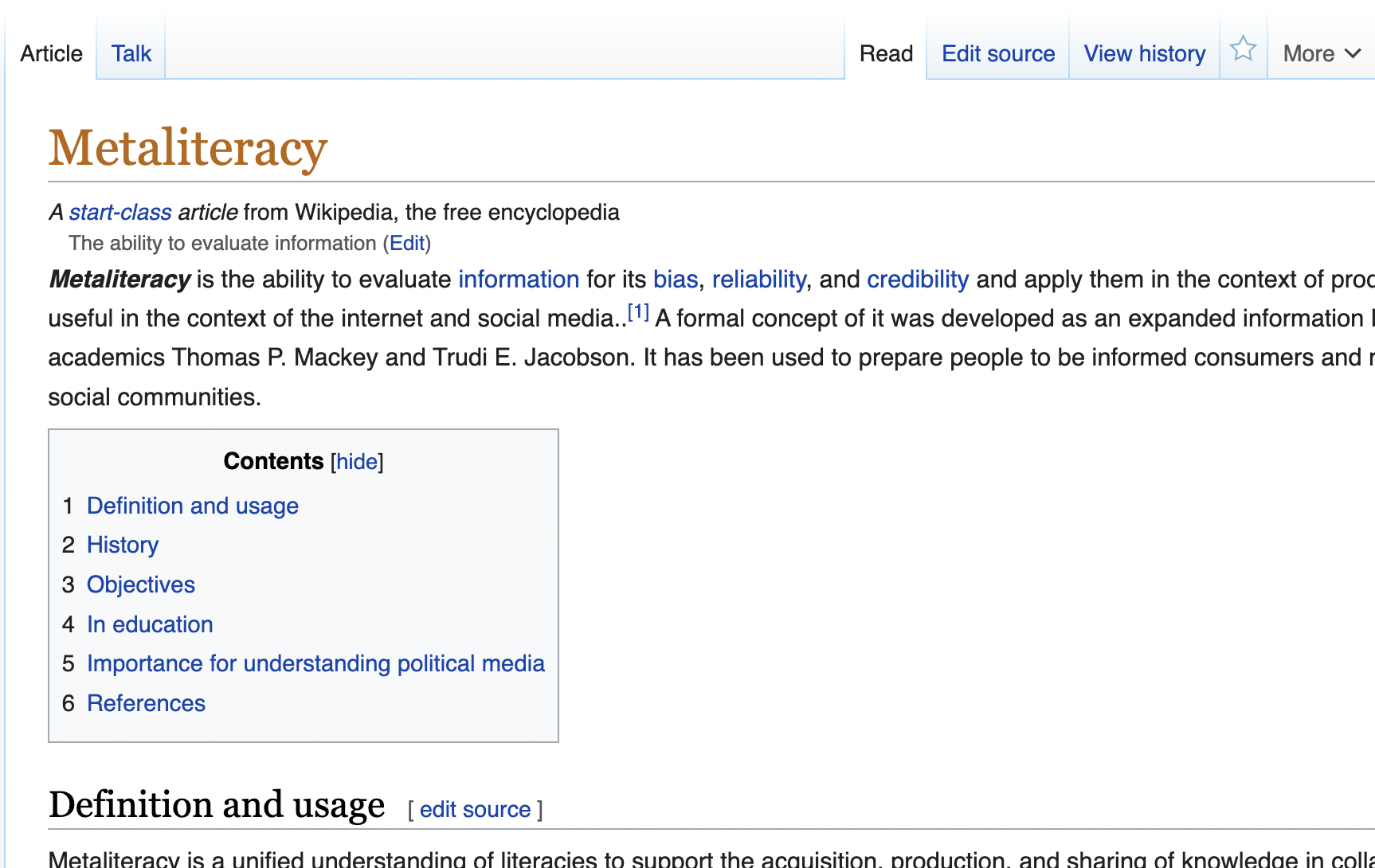
On May 11, 2022, the Metaliteracy article was accepted for publication in the English language version of Wikipedia! It will now be easy for those interested in the framework to find out more about it via one of the most common sources of information in the world.
This move from draft status to published article has been a number of years in the making. Two previous drafts were not approved. However, Gina Barrett of Canada, an experienced Wikipedia editor (Redwidgeon), took on the effort of addressing the issues with the latest draft. These attempts centered on Wikipedia’s notability requirement. As a part of this work, she identified a number of substantive works about metaliteracy beyond those of Tom’s and Trudi’s to be incorporated into the article. She also offered to work with a group of dedicated students from an international course last fall, Intercultural Perspectives on Information Literacy and Metaliteracy (offered by the University of Hildesheim, Germany and several global partners). These students, from the USA, Germany, Bosnia and Herzegovina, and India, had chosen to work on the Wikipedia metaliteracy draft article as their course project. While they had to wait some months to see if their work was ultimately successful on the Wikipedia platform, they now have the satisfaction of knowing that they met their goal of article approval. We would like to thank Feda Kulenovic, Ellen Ballato, Chris Jose, Goutami Rane, Luka Boskovic, and Rabea Schoershusen for their most professional work, as well as the international perspectives they brought to the project.
Just a little bit about the process of adding information to Wikipedia: While it is true that anyone can contribute, that does not mean that everything that is added remains. There are vigilant volunteer editors (contributors to Wikipedia are known as editors) and bots that do clean-up work, both minor and more substantive. As a part of this content checking, articles can be flagged for deletion if particular issues connected with Wikipedia expectations aren’t addressed. Beyond notability, another Wikipedia requirement relates to conflict of interest, meaning that Trudi and Tom are not able to work on the article themselves. For more information about editing on Wikipedia, this guide provides an overview.
Like all Wikipedia articles, the metaliteracy article is subject to revisions and additions. It will be interesting to follow both its Talk and History pages over time. While the article currently appears only in the English language version of Wikipedia, perhaps we will be able to celebrate new or translated metaliteracy articles in additional Wikipedias in the future!
Participants in this event will go through the core components of this holistic framework, including learning domains, learner roles, characteristics, and the reinforcing goals and learning objectives. The instructors will explain the relationship between metaliteracy and the ACRL Framework for Information Literacy for Higher Education. Participants will explore options for learning design that will meet the needs of their students and start a plan for incorporating metaliteracy in their formal or informal teaching. The instructors will provide opportunities to discuss and adapt the metaliteracy goals and learning objectives to multiple disciplines and settings.
Prof. J.A.K. Olivier, UNESCO Chair on Multimodal Learning and OER, Research Unit Self-Directed Learning, North-West University (NWU), South Africa, arranged for the translation of the Metaliteracy Goals and Learning Objectives into eight additional South African languages: isiNdebele, isiXhosa, isiZulu, Sesotho, Sesotho sa Leboa, Siswati, Tshivenda, and Xitsonga.
This substantial expansion of the translated Metaliteracy Goals and Learning Objectives builds upon previous translations in two other official South African languages (the 11th official language is English), Afrikaans and Setswana, as well as French, German, Italian, Portuguese, and Spanish.
Thanks to all of our translators! If you would like to contribute to this metaliteracy global project, just let us know!
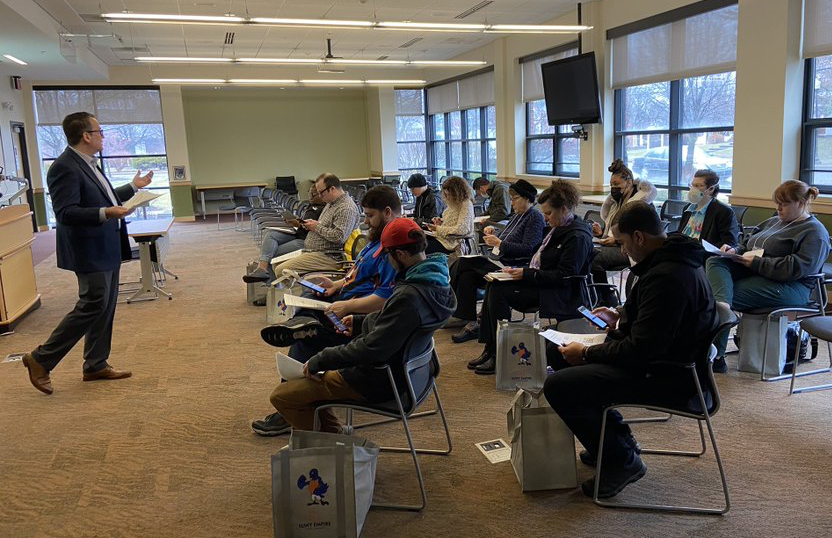
A new metaliteracy workshop was facilitated by Prof. Tom Mackey as a Deliberative Conversation at the SUNY Empire State College Student Academic Conference on April 7, 2022. This was the first in-person student conference at the college since the global pandemic prevented such face-to-face gatherings for two years.
The interactive workshop provided an excellent opportunity to engage with students directly about Developing Metaliteracy to Identify and Resist Misinformation. This most current Deliberative Conversation was organized by Anita DeCianni-Brown, Collegewide Career Development Coordinator at SUNY Empire.
The metaliteracy resources, questions, and techniques applied in this workshop are openly available and transferrable to a wide range of settings. Feel free to facilitate your own Deliberative Conversation at your institution based on this presentation.
Photo credit: Thanks to Anita DeCianni-Brown, Collegewide Career Development Coordinator at SUNY Empire.
If you are interested in implementing an exciting and innovative open pedagogical project in your teaching, you might be interested in attending a panel about the Wiki Education program. This program, available in the US and Canada, provides strong support to both students and instructors for Wikipedia assignments. Having students contribute to Wikipedia in an academic setting enhances the amount of content available through Wikipedia, a boon to those who rely upon this source for information. It also diversifies the editor pool and thus the content as well. The students are able to build upon their subject knowledge and information literacy abilities. Yet moving from a traditional assignment meant for the professor’s eyes only to one openly available can be somewhat intimidating at first. Metaliteracy’s emphasis on the metacognitive and affective learning domains provides scaffolding for students who may grapple with imposter syndrome and fear of visible failure.
The one-hour panel is sponsored by the Faculty Center for Teaching and Learning at Ferris State University and will take place on Monday, April 11 at 3:00 Eastern time. Besides Trudi Jacobson, panel members include Helaine Blumenthal, Senior Program Manager at Wiki Education, Mark Marinkovic, a former student of Trudi’s (pictured above), Naniette Coleman, Executive Director of the Interdisciplinary Research Group on Privacy and Ph.D. candidate in Sociology at UC Berkeley, and Ava Wu, a student of Naniette’s,
The registration page provides more information about the panel. We hope you can join us.
As part of a second Prestige Lecture for North-West University (NWU) in South Africa, Profs. Trudi Jacobson and Tom Mackey presented Open Pedagogy and Metaliteracy to celebrate Open Education Week (OEWEEK 2022). This latest talk is based on a key theme from their new book for ALA Publishing Metaliteracy in a Connected World: Developing Learners as Producers. Trudi and Tom were invited to keynote on this topic as part of their honorary appointments as Extraordinary Professors in the Research Unit Self-Directed Learning, Faculty of Education, North-West University (NWU), South Africa. Thanks to Elsa Mentz, Director of the Research Focus Area Self-Directed Learning and Professor in Computer Science Education and Jako Olivier, UNESCO Chair on Multimodal Learning and OER and Professor in Multimodal Learning at NWU for making this opportunity possible. The entire presentation is now available online via YouTube.