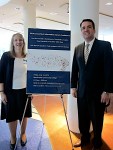
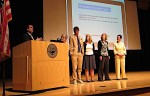
The SUNY wide Conference on Instruction and Technology (CIT 2014) recently published the presentation videos from this year’s event at Cornell University. We developed a presentation with colleagues from the University at Albany and Empire State College based on last year’s Metaliteracy MOOC. This video features Michele Forte, Nicola Allain, Jenna Pitera and Tom Mackey (Trudi Jacobson was presenting a keynote at the Cornell University Library the same week). Here’s the link to the video now available via the CIT2014 site: Metaliteracy in Practice: Strengthening Learning Through a Connectivist MOOC. Tom Mackey was also part of a featured panel presentation about MOOCs with SUNY colleagues from Stony Brook who developed a Coursera MOOC. This was an excellent chance to discuss our connectivist MOOC in comparison with a Coursera MOOC. The video for this panel presentation is also available: Beyond the Front Row Experience: Blending a University Course with a MOOC. The keynote speaker for the conference was Daphe Koller from Coursera: The Online Revolution: Learning without Limits. Toward the end of Daphne Koller’s keynote, look for questions from Betty Hurley and Nicola Allain from Empire State College and Jenna Pitera from the University at Albany.
Category Archives: MOOC
Video of 2014 CT IL Conference Keynote
This is the YouTube video of our metaliteracy keynote at the 2014 Connecticut Information Literacy Conference. All of the presentation videos are available via the conference web site. The metaliteracy keynote slides are also available on slideshare.
Photo Gallery from Recent Metaliteracy Keynote
In June we presented the keynote address at the Connecticut Information Literacy Conference sponsored by the Connecticut Library Association. Thanks to the conference organizers for sending us several pictures from that event! We really enjoyed the opportunity to connect with everyone at the conference. Click on any image to see the full gallery.
- Images from Metaliteracy keynote at the Connecticut Information Literacy Conference
Video Recording of 2014 IL Summit Keynote
Thanks to Troy Swanson Department Chair and Teaching & Learning Librarian at Moraine Valley Community College for posting the video of our keynote Changing Models, Changing Emphases: The Evolution of Information Literacy at the 2014 IL Summit. We enjoyed our time at the summit and appreciate this opportunity to share the video.
When a Small Group Traverses a MOOC Together
[When members of the Metaliteracy Collaborative became aware of the Incredibly Small Face to Face Community at The Ohio State University focused on the Metaliteracy MOOC, we asked Beth Black, Brian Leaf, and Karen Diaz if they might want to write a post for this blog. We are delighted that they were interested.]
Beth:
When I saw the announcement for the Metaliteracy MOOC on the ILI (Information Literacy Instruction) mailing list I had just failed to complete the Forecasting Next Generation Libraries course-ference [http://www.carthage.edu/library-celebration/forecasting/]. I had also just recently read Trudi Jacobson and Tom Mackey’s article Reframing Information Literacy as a Metaliteracy and was intrigued because it seemed to bring together many things that are happening simultaneously in the field. I knew that I needed to participate in the Metaliteracy MOOC but that I had to do something to help me stay engaged with it in the face of so many other demands on my time and attention.
I am exceptionally fortunate to work with a group of colleagues who are passionate learners, educators and librarians. I knew that if we could share the experience of the MOOC, I would learn more and be more likely to finish. So I forwarded the Metaliteracy MOOC announcement to several colleagues, adding “I am interested in this and think it might be good to study this in a group. Anyone interested in participating with me? I think we might be able to meet for lunch regularly during the MOOC to discuss or even watch some of the lectures together.” My invitation was warmly received and five of us initially met (four continued until the end). We determined that we would meet between the MOOC’s scheduled live sessions (approximately every other week) over our lunch hours to discuss what we learned. Now we had scheduled appointments and each other to keep us going.
After our first meeting, Brian Leaf suggested that we join the broader conversation by blogging. He blogged on his personal blog [http://bdleaf.net/] while the rest of us took turns writing for our Information Literacy Toolkit blog [http://library.osu.edu/toolkit/blog/tag/Metaliteracy]. The combination of the regular meetings with colleagues and writing for the blog kept all of us engaged. And best of all, it benefited not just me and the other members of our Incredibly Small Face to Face Community (ISFFC) but others in the MOOC with whom we interacted as well.
Brian:
The major difference between participating in the Metaliteracy MOOC and my other failed attempts at MOOCs has been the ISFFC meetings coordinated by Beth Black. In order to stay on top of our discussions, I relied heavily on the live session chat backchannel, blogs and tweets of other participants. By engaging others in dialogue, I was able to increase the depth of my understanding of Metaliteracy content and concepts. In fact, I find that I am still tweeting ideas and articles using hashtags that came out of particular sessions (i.e. technobiophilia).
While I didn’t always do a good job of recording where particular things came from as I haphazardly copied-and-pasted text, these bits of dialogue can stand alone:
On metacognition –
Jenna
12:46 PM
metacognition would be difficult, and probably important for someone say, on the autism spectrum to achieve. I keep thinking of it in terms of people with Asperger’s, a need for, and difficulty accomplishing metacognition as well as a lower EQ/EI
On what isn’t storytelling –
katharine
12:07 PM
even rocks tell a story
On openness –
There were, of course, many compelling statements that are too numerous to mention; but suffice to say, this format provided an avenue that I preferred given time constraints. And then the opportunity to participate in different ways meant that our contributions to our in-person discussions would be varied. There’s a blog post I’ve since lost track of that discussed how the success of this MOOC might be measured. While I haven’t spent much time thinking about this in particular, I do believe that the fact that our small community stayed engaged to the end speaks volumes because, in the end, it’s about people.
Karen:
For me, the most useful parts of the ISFFC were both the summaries of what happened online that I missed as well as some of the tangents that we took in our discussions. For instance, on the day that the MOOC explored the role of Scholarly Communication in metaliteracy, one member of our group still felt sort of fuzzy on the connection. I had read the ACRL publication Intersections of Scholarly Communication and Information Literacy and attended a session of it at the 2013 ACRL Conference last spring. Weeks before that white paper came out I had already approached our librarian in charge of library publishing about that very issue, and indicated that she needed to not only be developing our publishing program, but also contributing to our information literacy instruction. I had done a lot of thinking and processing of this issue before hand and thus I was able to give a practical and down to earth explanation that I think helped my colleague, but also helped me articulate some of what had been spinning in my head for months.
Another tangent we took on another day was a discussion of teaching strategies. In particular we were talking about holding students accountable to a certain level of understanding, description and application of information literacy concepts in our credit courses. One librarian was shocked when a student questioned why she removed points on an assignment, declaring that her standards of good were not the same as his. This led to a discussion of power differentials in teaching, and questioning of how “harsh” we should be with students in the grading of our classes. One of our colleagues shared a story about watching an HBO series called Masterclass. She indicated that the students in these series were bright, dedicated and talented teens and young adults who “won” the chance to learn from a true master. Most of the masters took a nurturing approach to teaching establishing positive relationships with their students. However, one master yelled at his students when they were wrong. But interestingly, the students in that instance found the correction very helpful and still learned from it.
There were other times we talked about whether the definition of metaliteracy being presented on a given day seemed too far of a stretch. For instance, the technobiophilia concept veered too far for me. It felt like a disorienting conversation and somewhat of a stretch for everyone, although a couple in our group could grasp it better than I did. (I laugh now to see Brian continue to use the hashtag.) Questioning and discussions like this helped me in particular think about where the edges of metaliteracy lie. It also made me wonder when the mix of literacies is helpful and when will we need to separate concepts out again.
It seems to us there is room for ongoing conversation about the topic. The Metaliteracy MOOC began some wide-reaching discussion and gave language to many ideas. Our ISFFC helped us begin some internal conversation using that language.
Metaliteracy Discussed at Westchester Library Association Mid-Winter Conference 2014
Tom Mackey presented on the topic Promoting Access for All with Open and Online Learning at the Westchester Library Association Mid-Winter Conference at The Gateway Center at Westchester Community College. The theme of this year’s conference explored distance education and also featured Linda Braun, youth services Manager for Seattle Public Library, and keynote speaker Joe Nocera, Op-Ed columnist for the New York Times and commentator for NPR’s Weekend Edition. The one-day conference featured Linda Braun’s use of Google Hangouts, Tom Mackey’s discussion about open and online learning, MOOCs, OERs, and Metaliteracy and Joe Nocera’s keynote about digital privacy. This is the complete PowerPoint presentation by Tom Mackey:
Conversations in the Disciplines
Last week we participated in a SUNY-wide “Conversations in the Disciplines” focused on metaliteracy. This is a competitive program that provides funding for a one-day conference to promote interactivity and dialogue. We experienced a full-day of activity that examined many dimensions of metaliteracy and covered a range of issues from K-12 to higher education to open learning. This is the PowerPoint presentation from our morning keynote “Developing Metaliterate Learners: Transforming Literacy across Disciplines.”
Metaliteracy MOOC Talk Plenary
We launched Metaliteracy MOOC on September 4 at the University at Albany with colleagues from SUNY Empire State College and the University Libraries. Our opening plenary was facilitated through Blackboard Collaborate and included Tom Mackey, Trudi Jacobson, Tor Loney, Jenna Hecker, Nicola Marae Allain, and our colleagues from the Metaliteracy Learning Collaborative Michele Forte, Kathleen Stone, Mike Daly, and Mark McBride. We were joined in person by three UAlbany students and online by one of our graduate students from Empire State College. The first MOOC Talk was developed in Prezi and provided an overview of key metaliteracy terms, updates on recent metaliteracy activity, and two figures from the Metaliteracy manuscript recently completed by Tom Mackey and Trudi Jacobson for ALA Books. A recording of our first interactive session via Blackboard Collaborate is available at our Topic 1 page at Metaliteracy MOOC. In the spirit of Open SUNY we coordinated shared press releases that have been published at the Empire State College web site and the UAlbany Web site. The live MOOC Talk session was fascinating for us as we facilitated the talk with several presenters, allowing us to look at metaliteracy from multiple perspectives. We were also inspired by the post-MOOC Talk (that we did not record) because it allowed us to talk through the MOOC format itself and it felt very much like a spontaneous seminar about MOOCs. We have also seen an asynchronous conversation unfold via Twitter at #metaliteracy in response to the talk. We look forward to our upcoming MOOC Talks. On September 18 Char Booth will examine “The Metacognitive Dimension of Metaliteracy,” a key aspect of the metaliteracy model.
Metaliteracy MOOC about to launch!
Registration is now open for a new Metaliteracy MOOC offered by SUNY Empire State College and the University Libraries at the University at Albany. The Massive Open Online Course (MOOC) will launch this Wednesday, September 4. It is based on the metaliteracy framework developed by Dean Tom Mackey from the Center for Distance Learning (CDL) at Empire State College and Distinguished Librarian Trudi E. Jacobson from the University Libraries at UAlbany. Mackey and Jacobson introduced the metaliteracy model, a reinvention of information literacy for open learning and social media environments in their article “Reframing Information Literacy as a Metaliteracy” published in College & Research Libraries. They are currently finishing a book on the topic entitled Metaliteracy: Reinventing Information Literacies to Empower Learners for ALA Books. The Metaliteracy MOOC will be co facilitated by Mackey and Jacobson, as well as Jenna Hecker and Tor Loney from UAlbany, and Nicola Marae Allain and Carol Yeager from Empire State College.
Live webinars presented by scholars from around the world will be featured in Metaliteracy “MOOC Talks” that promote interaction and dialogue about related topics such as metacognition, open learning, visual literacy, news literacy, scientific literacy, transliteracy, global perspectives on literacy, digital storytelling, and STEMx.
Presenters include: Char Booth, Instruction Services Manager & E-Learning Librarian at the Claremont Colleges Library, R. Brian Stone, Associate Professor at The Ohio State University, Alton Grizzle, Programme Officer in Communication and Information at UNESCO, Paul Prinsloo, Education Consultant and Editor of Progressio: South African Journal for Open and Distance Learning Practice at University of South Africa, Rex Smith, Editor of the Albany Times Union, Bryan Alexander, researcher and publisher of Future Trends in Technology and Education at BryanAlexander.org and Senior Fellow at the National Institute for Technology in Liberal Education (NITLE), Sue Thomas, author of Technobiophilia: Nature and Cyberspace, and HP Catalyst Fellows Anthony Maddox, Holly Ludgate, and Samantha Adams Becker.
Several sessions will be co-presented by SUNY colleagues including: John Delano, Distinguished Professor in the Department of Earth and Atmospheric Sciences at the University at Albany, Mark McBride, Director of Library Services, Monroe Community College, Nicola Marae Allain, Faculty Mentor and Academic Area Coordinator for Humanities/Digital Media at CDL, Michele Forte, Faculty Mentor in Community and Human Services at CDL, and Betty Hurley-Dasgupta, Mentor and Academic Area Coordinator in Science Math and Technology at CDL and HP Catalyst Fellow.
In addition to being an entirely free format that is open to participants worldwide, Metaliteracy MOOC will connect courses for credit at the University at Albany with undergraduate and graduate independent studies at Empire State College. At UAlbany, Trudi Jacobson, Tor Loney, and Jenna Hecker will teach with the MOOC as part of UUNL300x (2 credit) and UUNL205x (1 credit). At Empire State College, Tom Mackey and Carol Yeager will co-facilitate undergraduate guided independent studies based on the MOOC. CDL Faculty Mentor and Academic Area Coordinator Nicola Marae Allain will offer a research-based guided independent study entitled “MOOC Metacognitive Analysis” (3 credit) for graduate students in the Master of Arts in Learning and Emerging Technologies (MALET) in the School for Graduate Studies.
Metaliteracy MOOC is designed and co-facilitated by Carol Yeager, who developed the first two MOOCs for Empire State College and the SUNY system with Betty Hurley-Dasgupta, Creativity and Multicultural Communication and VizMath. The new Metaliteracy MOOC was built on the same gRSShopper programming developed by Stephen Downes, one of the originators of the MOOC movement and previous keynote speaker at the CDL Conference. Technical support for the MOOC is provided by Retsam Zhang, Guangdong Province, China.
Meta or MEGA literacy!
Metaliteracy has been featured recently in two new publications. A new UNESCO document entitled Media and Information Literacy for Knowledge Societies (2013) provides a brief definition of metaliteracy and makes it central to the conclusion. According to this new publication:
As an umbrella term, it covers many of the other literacies. It also seems to overlap with new literacies such as multiliteracies and global literacy. It is a metaliteracy. It is transversal in its nature and can be seen as an iceberg concept which is much bigger than what it is seen at first sight. Information literacy can be easily called a megaliteracy which is composed of many other skills and literacies (p. 85).
As a comprehensive and unifying metaliteracy, the idea of a megaliteracy is not needed, since the the meta already encompasses this idea. But this is an intriguing way to look at it and certainly addresses the interconnected nature of emerging literacies. Great to see metaliteracy brought into the conversation.
We also note another new publication from Betty Hurley-Dasgupta, Carol Yeager, and Catherine Bliss from SUNY Empire State College about the first MOOC they offered in the SUNY System entitled Creativity and Multicultural Communication. The authors make several references to metaliteracy in their article cMOOC and Global Learning: An Authentic Alternative in The Journal of Asynchronous Learning Networks (JALN). According to the authors,
Clearly, we need to scaffold the development of metaliteracy skills for learning through cMOOCs. Some scaffolding could be accomplished by incorporating more self-assessment into the MOOC. For future MOOCs, we plan to incorporate shared rubrics to help participants assess their own metaliteracy skills, (Yeager, et.al, 2013, p. 144).
This is an important point that demonstrates the potential impact of a metaliteracy perspective on the cMOOC learning experience, and how learners could gain new insights and knowledge in these open and collaborative spaces. We definitely need metaliteracy rubrics for MOOCs to enhance the experience for independent and collaborative learners.