Metaliteracy Goals and Learning Objectives Now Available in French

We are delighted to announce that the first translation of the Metaliteracy goals and learning objectives is now available. Buts et Objectifs d’apprentissage, the French translation, has kindly been provided by Florent Michelot, a Ph.D. candidate in andragogy at the Université de Montréal. Florent is developing a self-efficacy scale, partly based on metaliteracy principles, and had translated the document in connection with that work.

We would also like to thank Patti Kingsmill at Vanier College, who recognized that this translation would benefit others if accessible on this site, and assisted us with making the connection with Florent.

Merci beaucoup, Florent et Patti!

We continue to seek translations of the goals and learning objectives into other languages. We have a volunteer to translate them into German, but she would welcome collaborating with someone else, if there is interest. And if you are able to help with another language, we would be delighted. With your assistance, information about metaliteracy will become available to larger numbers of learners globally. If you are interested, please contact Trudi Jacobson (tjacobson at albany.edu) or Tom Mackey (Tom.Mackey at esc.edu).

Register Now for Empowering Yourself in a Post-Truth World!

Registration is now open for Empowering Yourself in a Post-Truth World, a new Open edX MOOC developed by colleagues from SUNY Albany and SUNY Empire State College who work together as part of the Metaliteracy Learning Collaborative. This six-week Open edX MOOC starts on March 18, 2019, so register today!  The course examines how to address post-truth challenges through the lens of metaliteracy while exploring ways to rebuild communities of trust. The content of the course is informed by the new book published by Tom Mackey and Trudi Jacobson for ALA-Neal Schuman, Metaliterate Learning for the Post-Truth World. The MOOC is supported by a SUNY Innovative Instruction Technology Grant and is hosted by the University at Buffalo, College of Arts and Sciences Continuing Education.

The instructors for the course include Tom Mackey, Trudi Jacobson, Kelsey O’Brien, Tom Palmer, Lisa Stephens, Christine Fena, Allison Hosier, and Nicola Marae Allain. In addition to the instructors, we worked with a team that included Alena Roddick (Instructional Designer), John Hughes (Videographer), David Dickinson (Videographer), and Christine Paige (Project Manager). Thanks to Jay Stockslader, Director of Continuing Education at the University of Buffalo for supporting our MOOC on Open EdX. Check out the promo video below created by Kelsey O’Brien and register now!

Seeking Translations of the Metaliteracy Goals and Learning Objectives

globe-110775_640

World image from Pixaby.com

One of the metaliterate learner roles is Translator. Translation can be from one format to another, or from one audience to another. We often mean translation beyond that of language. But at the moment, language translation is on our minds.

We would very much like to make the revised April 2018 Metaliteracy Goals and Learning Objectives available to a broader set of readers and scholars. The concept of metaliteracy is global, and many of the works that discuss or are framed by metaliteracy have been published in a number of languages, including Spanish, Chinese, Portuguese, French, and more.

If you are interested in helping with this translation initiative, please contact Trudi Jacobson (tjacobson at albany.edu) and Tom Mackey (tom.mackey at esc.edu). We thank you for considering this request.


Metaliteracy Examined in HigherEdJobs Leadership Publication

HEJ_Logo_2cTrudi Jacobson and Tom Mackey co-authored a feature article entitled Why You Should Fight for Metaliteracy on Your Campus for the HigherEdJobs leadership newsletter. This publication is sent to approximately 40,000 subscribers at the executive level, including presidents, provosts, and deans. The article was written to support all educators interested in applying metaliteracy in a wide range of disciplines and institutional contexts to advance metaliterate learning. As Jacobson and Mackey (2018) argue in this new essay:

Metaliteracy provides a model for thinking and knowing in a social media age that is fraught with misleading and downright false information from a wide range of questionable sources. Metaliterate learners are developed across many academic disciplines through teaching and learning situations that promote self-direction, collaboration, participation, and metacognitive thinking. This approach requires us to work together and innovate, applying the metaliteracy goals and learning objectives, and supporting institutional partnerships among key stakeholders such as faculty, librarians, and instructional designers.

As noted in this essay, collaborative conversations among key stakeholders at the campus level are ideal to advance metaliteracy initiatives. If you have questions about how to get these conversations started or to share innovative programs already in place, feel free to reach out directly to Trudi Jacobson at tjacobson@albany.edu or Tom Mackey at Tom.Mackey@esc.edu.

Tea for Teaching Podcast Features Metaliteracy

Tea1In the latest Tea for Teaching podcast produced by the Center for Excellence in Learning and Teaching (CELT) at the State University of New York at Oswego, Tom Mackey and Trudi Jacobson participate in a conversation about metaliteracy with John Kane, an economist, and Rebecca Mushtare, a graphic designer.  John and Rebecca run the Center and produce the Tea for Teaching series. As part of this podcast, Trudi and Tom define what metaliteracy is, provide illustrative examples of metaliteracy in practice, and explore the connection to the ACRL Framework for Information Literacy for Higher Education. This conversation also goes into detail about the latest SUNY Innovative Instruction Technology Grant (IITG) awarded to the Metaliteracy Learning Collaborative to support a new metaliteracy MOOC Empowering Yourself in a Post-Truth World, currently under development in the Open EdX platform for a March 2019 launch. Tom and Trudi talk about their forthcoming book for ALA Publishing Metaliterate Learning for the Post-Truth World and Trudi provides updates on the Metaliteracy Digital Badging System. As part of the podcast, a full transcript of the discussion is provided, along with related references. Get ready for this Tea for Teaching podcast with your favorite tea and then listen for the latest ideas about metaliteracy that will support your own teaching and learning!

Reconstructing Scientific Literacy through Metaliteracy: Implications for Learning in a Post Truth World

metaliterateLearning_fullsize_RGB

Metaliterate Learning for the Post-Truth World

Allison Brungard and Kristin Klucevsek offer the following preview of their chapter, “Reconstructing Scientific Literacy through Metaliteracy: Implications for Learning in a Post Truth World,” appearing in the forthcoming book, Metaliterate Learning for the Post-Truth World, edited by Thomas Mackey and Trudi Jacobson.

Science now exists in a wide range of digital contexts. Scientific information can be shared through social media platforms such as Facebook, Twitter and Instagram, and user-generated communities such as YouTube, Flickr, Blogger, and Wikipedia. These platforms can help disseminate scientific information to the wider public, but they also can spread misconceptions and distortions. In our post-truth world, this has a strong impact on scientific literacy, with downstream implications for health, politics, and the environment. We also encounter effects of this post-truth world in our classrooms as we work to build stronger literacy skills with our students. The need for learners to critically examine and reflect on what they encounter in these participatory online environments is crucial. To improve scientific literacy, learners must develop the metacognitive processes necessary to discern fact from fiction. As teachers, we must re-examine competencies for scientific literacy in this post-truth, digital world.

In this chapter, we address the challenges of scientific literacy within the larger framework of metaliteracy. With an emphasis on the four domains of metaliterate learning, we align scientific process with metaliteracy competencies to enhance scientific literacy. We explore the impacts of current events and education on scientific literacy, as well as the relationship between social media and personal biases through which scientific facts can be misconstrued. We also focus on strategies for academic librarians and disciplinary faculty to infuse metaliterate objectives in their teaching, curriculum, and research. Reflective and participatory learning can move learners beyond the consumption of information and towards critical thinking, research, and writing. This encourages learners to also be content producers, with the ability to understand the most effective ways to use science in their daily lives

When Stories and Pictures Lie Together — And You Don’t Even Know It.

metaliterateLearning_fullsize_RGBThomas Palmer, M.S., Digital Media Lecturer from the Journalism Program at the University at Albany, SUNY, and Editorial Design Director / News Editor at the Times Union newspaper introduces you to his chapter in Metaliterate Learning in the Post-Truth World: When Stories and Pictures Lie Together — And You Don’t Even Know It.

The photo in the tweet triggers your path to deception in as little as 13 milliseconds. Your brain dedicates about 85% of its processing to make sense of this picture. Your comprehension of its text finally catches up, but you’ll likely believe the false claim merely because the image is present. Confirmation bias settles in. You have just fallen prey within seconds to the intersemiotic contextual misrepresentation of photojournalism — and you weren’t even aware. This targeted disinformation to manipulate you is a success. In this post-truth era, the weaponizing of legitimate photojournalism for political and social propaganda is easy and low tech. However, in this chapter metaliterate learners can develop judgment for identifying and exposing this malpractice to protect themselves and the public.

The relationship between text and image is dynamic and complementary, while also leading to misrepresentations. This chapter analyzes the synergistic association of several visual-textual examples from photojournalism to illustrate how images are easily manipulated and misunderstood.  Metaliteracy is discussed as an empowering pedagogical response to these concerns that supports learners in developing detection and prevention strategies.

Poetic Ethnography and Metaliteracy: Empowering Voices in A Hybrid Theater Arts Course

metaliterateLearning_fullsize_RGB

Metaliterate Learning for the Post-Truth World

Kimmika Williams-Witherspoon, an Associate Professor at Temple University offers the following preview of her chapter: “Poetic Ethnography and Metaliteracy: Empowering Voices in a Hybrid Theater Arts Course’ appearing in the forthcoming book, Metaliterate Learning for the Post-Truth World.

When is a Theater arts course more than a theater arts course? How do we encourage students to “have voice”? In an age when “alternative facts” have become the new norm, how can theater and the theater studies curriculum give students agency to contribute to the discourse? Well… at Temple University, these days, its when faculty consciously use a metaliteracy lens to develop or improve their courses so as to encourage students to not just consume new knowledge but also to produce it and to distribute it through multiple modalities and across multiple platforms.

At Temple University in Philadelphia, the Theater Studies curriculum exemplifies the metacognitive domain of metaliteracy teaching students to effectively consume and produce new information in the form of devised theater productions, displays, press releases, exhibitions, community performances and critiques. One such course that goes a long way to introduce metaliteracy concepts into the theater curriculum is THTR 2008 Poetic Ethnography.

The course, THTR 2008 Poetic Ethnography operates as both ethno-drama and as a theater hybrid that incorporates several tightly structured field site audio and video digital storytelling projects into its 13-week curriculum. These projects encourage students to expand their knowledge base, investigate multiple forms of information gathering methodologies and to develop performative and distributive content across multiple cultural and social platforms.

Through the process of research and new knowledge production, students gain life-long learning skills about how to develop more nuanced, personal narratives that tell a more complete and factual story about communities, individuals and contemporary events. This chapter, then, looks at how Poetic Ethnography teaches students how to develop ethnographic and personal narratives set to poetry about Philadelphia neighborhoods and its people—giving voice to the sometimes voiceless in our communities, while simultaneously learning metaliteracy and metacognitive learning strategies.

Dr. Kimmika L. H. Williams-Witherspoon, Associate Professor

Department of Theater

Temple University
Metaliterate Learning for the Post-Truth World to be Published this Fall!

metaliterateLearning_fullsize_RGB

Metaliterate Learning for the Post-Truth World

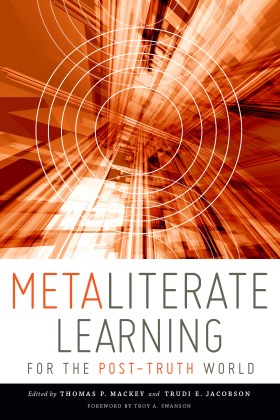
The forthcoming metaliteracy book Metalierate Learning for the Post-Truth World, edited by Thomas Mackey and Trudi Jacobson will be published in spring 2019. Metaliteracy is a pedagogical model for ensuring that learners successfully participate in collaborative information environments, including social media and online communities. Today’s post-truth world requires learners to ethically produce and share information while checking their own biases, and critically evaluating the proliferation of false or misleading information, unfiltered content, and outright denialism of facts. Indeed, it is clearly evident that the competencies, knowledge, and attributes of metaliterate individuals are critical for grappling with the post-truth era. Metaliteracy supports reflective learning through metacognitive thinking, the ethical production of new knowledge, the critical consumption of information, and the responsible sharing of verifiable content across media platforms. Through metaliteracy, learners are envisioned as teachers in collaborative social spaces. This book examines the newest version of the Metaliteracy Goals and Learning Objectives, including the four domains of metaliterate learning. Several chapter authors explore the relationship between metaliteracy and the Association of College and Research Libraries (ACRL) Framework for Information Literacy for Higher Education.

This new metaliteracy book includes a Foreword written by Troy Swanson, MLIS, Ph.D., Department Chair Library Services, Moraine Valley Community College and features persuasive contributions from information literacy instructors, librarians, and disciplinary faculty. All of the chapter authors present effective methods for advancing metaliterate learning in the post-truth world, exploring such relevant topics as:

Theory

  • Strategies for empowering metaliterate learners through the newly developed metaliterate learner characteristics and revised Metaliteracy Goals and Learning Objectives in the framing chapter by Thomas P. Mackey, Ph.D., Professor in the Department of Arts and Media at SUNY Empire State College
  • Documentation as an expanded dimension of the metaliteracy model to reinforce ethical and responsible information practices examined by Marc Kosciejew, M.L.I.S., Ph.D., Faculty of Media and Knowledge Sciences in the Department of Library, Information, and Archive Sciences, University of Malta
  • Inoculation theory as a way to build resistance to influence in the post-truth world theorized by Josh Compton, Ph.D., from the Institute for Writing and Rhetoric at Dartmouth College
  • Scientific literacy enhanced as a holistic learning strategy through metaliteracy examined by Allison B. Brungard, M.L.I.S., from Slippery Rock University and Kristin M. Klucevsek, Ph.D., from Duquesne University
  • The synergistic relationship between text and image in photojournalism analyzed by Thomas Palmer, M.S., Digital Media Lecturer from the University at Albany, SUNY, and Editorial Design Director / News Editor at the Times Union newspaper

Practice

  • The role of LIS professionals in supporting metaliterate learning and the ACRL Framework in a chapter co-authored by Nicole A. Cooke, Ph.D., M.Ed., M.L.S., and Rachel Magee, Ph.D., M.A., from the University of Illinois
  • Teaching students to be wrong through lessons designed with metaliteracy and the ACRL Framework in a freshman seminar developed and taught by Allison Hosier, M.S.I.S., Information Literacy Librarian, at the University at Albany, SUNY
  • Developing metaliterate learners as analytical readers and writers through genre analysis and fictionality in first-year writing instruction as described by Jaclyn Partyka, Ph.D., in the English Department at Temple University.
  • Incorporating Poetic Ethnograpy and digital storytelling based on poetic narratives from neighborhoods in Philadelphia in the closing chapter by Kimmika L. H. Williams-Witherspoon, Ph.D., Associate Professor in the Department of Theater at Temple University

Metaliteracy is an empowering pedagogical model for preparing learners to be ethical and responsible participants in today’s divisive information environment. This new book showcases several teaching and learning theories and practices that have already proven effective and are certain to inspire new ideas. Metaliterate Learning for the Post-Truth World builds on the two previous metaliteracy books Metaliteracy in Practice (2016) and Metaliteracy: Reinventing Information Literacy to Empower Learners (2014).

Comments Welcomed on Revised Metaliteracy Goals and Learning Objectives

The original set of four goals and accompanying learning objectives were developed in 2014 by members of the Metaliteracy Learning Collaborative with valuable input by others, as indicated in the Additional Contributors section of the Goals and Learning Objectives page. Over the course of the last several years, there have been significant changes in our information environment and with social media in particular, and in the ways that people interact with them. We felt that it was time to review the goals and learning objectives in depth. What followed were changes both substantive and minor, as well as some reorganization.

We invite you to review and comment on these changes through the Reply feature at the bottom of Goals and Learning Objectives page. We also welcome suggestions. Our goal is to finalize the revision by September 15. Thank you.