Third Academic Minute Program about Metaliteracy

The June 27, 2022, Academic Minute program featured Trudi Jacobson, and, of course, metaliteracy. The episode is entitled, Students Reflect on their Roles and Responsibilities as Wikipedia Editors. It is the first in a week of episodes by professors and instructors who teach using the Wiki Education initiative. Although the program airs on a number of National Public Radio (NPR) stations, it is produced here in Albany, NY at WAMC. This makes Trudi’s affiliation, which is listed as North-West University (NWU) in South Africa rather than the University at Albany, seem a bit odd, but in order to appear on the program, one needs to be actively affiliated with an institution of higher learning. Trudi is Distinguished Librarian Emerita at The University at Albany, SUNY and both she and Tom Mackey were appointed Extraordinary Professors at North-West University (NWU) in South Africa, soon after presenting a metaliteracy Prestige Lecture as well as keynotes and workshops there in 2019. As part of their honorary appointments, their latest Prestige Lectures at NWU continue in a series this year and next.

This is the third Academic Minute episode that features metaliteracy. Tom Mackey recorded the first, Metaliterate Leaners, which aired on May 18, 2020. Trudi’s first was Renewable Assisgnments, Wikipedia, and Metaliteracy, from December 15, 2021. As indicated by the name of the series, these are quick listens. You might want to give them a try if you’ve not already heard them. This newest episode includes quotes from two students who made connections between their work as information producers on Wikipedia, metaliteracy and learning.

Feel free to use these short clips as part of your teaching practices related to metaliteracy!

-Trudi
New Metaliteracy Book Reviewed in the Latest Journal of Information Literacy

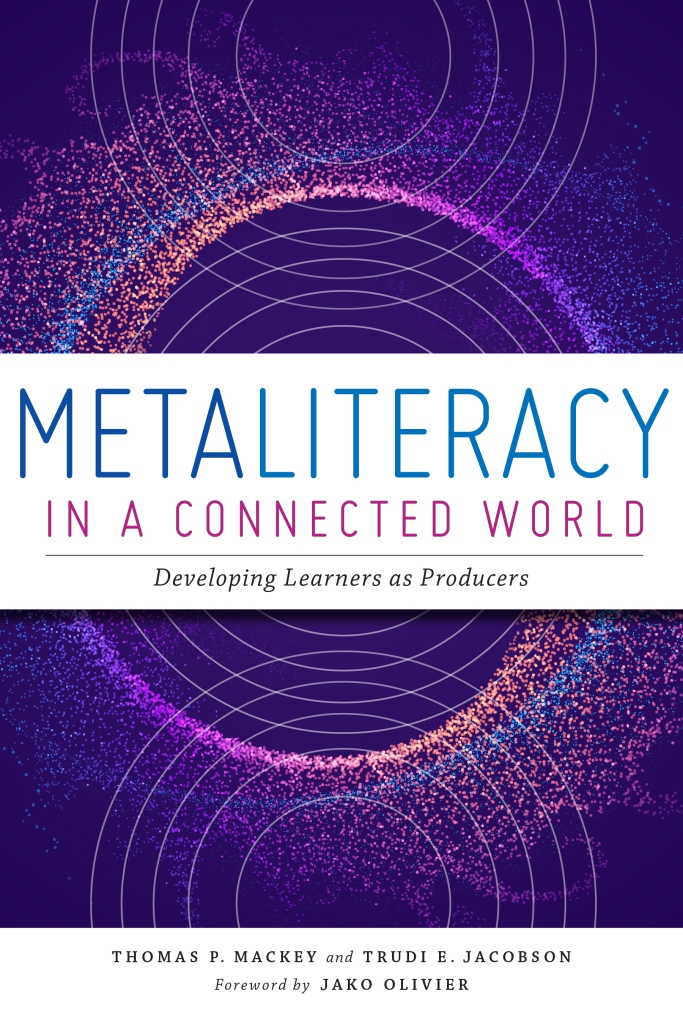
Now that Metaliteracy in a Connected World: Developing Learners as Producers has been published, what do the critics think? We were thrilled to read this review of our new book written by Jodie R Heap from Staffordshire University in the latest issue of Journal of Information Literacy, one of the premiere journals in the field!

According to Heap’s book review of Metaliteracy in a Connected World:

The flow of the text works well to introduce the reader to the concepts surrounding metaliteracy and then proceeds to provide evidence and a variety of examples of metaliteracy in action within Higher Education settings. The reader is supported in their understanding of how application of the metaliteracy framework and concepts could vary depending on the course. The activity section deserves particular appreciation —it provides various examples through which the framework could be applied, a useful scaffolding tool which not many texts offer.

(Heap, 2022, p. 131)

The reviewer provides an analysis of all six of the book’s chapters and argues that “It offers a useful jumping off point for both teachers and librarians in exploring the application of metaliteracy in the classroom” (Heap, 2022, p. 132).

We appreciate this review of our latest metaliteracy book published by ALA Neal-Schuman and look forward to seeing how it is received by authors and practitioners in the field and beyond. If you are aware of other reviews, feel free to send them our way!

Tom and Trudi

HEAP, Jodie R. Book review of Mackey, T., and Jacobson, T. 2022. Metaliteracy in a connected world: Developing learners as producers. Journal of Information Literacy, [S.l.], v. 16, n. 1, p. 131-132, june 2022. ISSN 1750-5968. Available at: <https://ojs.lboro.ac.uk/JIL/article/view/BR-V16-11-1>. Date accessed: 20 june 2022. doi: https://doi.org/10.11645/16.1.3217.

American Library Association (ALA) eLearning Solutions Features Metaliteracy Webinar

Registration is now open for an interactive webinar about metaliteracy offered by the American Library Association (ALA) eLearning Solutions continuing education program. Trudi Jacobson and Tom Mackey will facilitate this live event entitled Teaching with Metaliteracy: Developing Learners as Producers on July 14, 2022 at 1:30 pm CDT (2:30pm EST). Participation in this 90-minute webinar will lead to a certificate of completion.

According to the description for this workshop:

Participants in this event will go through the core components of this holistic framework, including learning domains, learner roles, characteristics, and the reinforcing goals and learning objectives. The instructors will explain the relationship between metaliteracy and the ACRL Framework for Information Literacy for Higher Education. Participants will explore options for learning design that will meet the needs of their students and start a plan for incorporating metaliteracy in their formal or informal teaching. The instructors will provide opportunities to discuss and adapt the metaliteracy goals and learning objectives to multiple disciplines and settings.

(Webinar Description)

The webinar is based on Tom and Trudi’s latest book for ALA Neal-Schuman, Metaliteracy in a Connected World: Developing Learners as Producers, and will illuminate ideas from the text.

We look forward to seeing you at this next metaliteracy virtual event! If you have any questions in advance, be sure to let us know!

Trudi and Tom

Metaliteracy Explored in Deliberative Conversation about Identifying and Resisting Misinformation

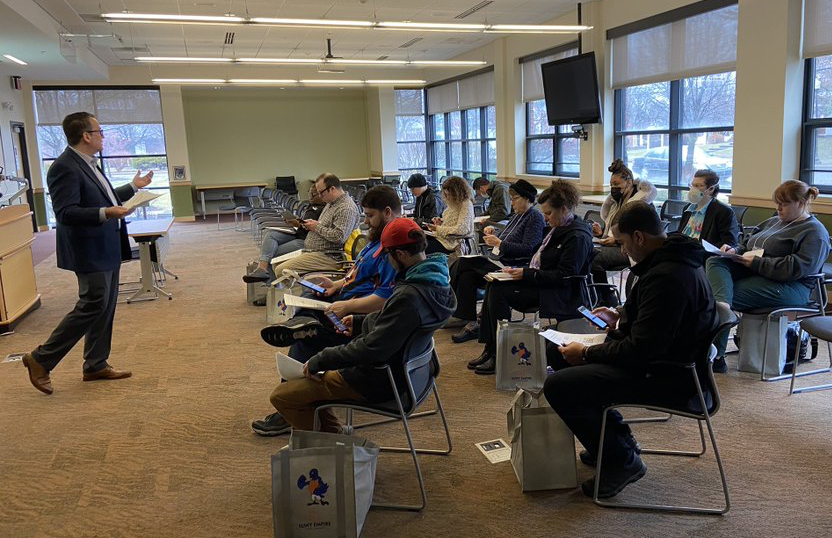
Picture of Tom Mackey presenting at Deliberative Conversation. Photograph take by Anita Brown.

A new metaliteracy workshop was facilitated by Prof. Tom Mackey as a Deliberative Conversation at the SUNY Empire State College Student Academic Conference on April 7, 2022. This was the first in-person student conference at the college since the global pandemic prevented such face-to-face gatherings for two years.

The interactive workshop provided an excellent opportunity to engage with students directly about Developing Metaliteracy to Identify and Resist Misinformation. This most current Deliberative Conversation was organized by Anita DeCianni-Brown, Collegewide Career Development Coordinator at SUNY Empire.

Photo of Tom Mackey and Students at Deliberative Conversation.

For additional background about the development of Deliberative Conversations at SUNY Empire State College, explore the paper by Principal Investigator (PI) Dr. Rhianna C. Rogers and co-PIs (including Anita Brown) for the Rockefeller Institute entitled The Value of Deliberative Conversation in Participatory Action Research A Student Commentary on the Buffalo Project – Academic Year 2017-18 (Murawski, et. al., 2020).

The metaliteracy resources, questions, and techniques applied in this workshop are openly available and transferrable to a wide range of settings. Feel free to facilitate your own Deliberative Conversation at your institution based on this presentation.

Photo credit: Thanks to Anita DeCianni-Brown, Collegewide Career Development Coordinator at SUNY Empire.

Metaliteracy Featured in ALA Neal-Schuman Interview

A new metaliteracy interview with Tom Mackey and Trudi Jacobson is featured in the ALAstore blog to coincide with the publication of their book Metaliteracy in a Connected World: Developing Learners as Producers. Rob Christopher, Marketing Coordinator at ALA Editions | ALA Neal-Schuman conducted the interview and asked questions related to the origins of the metaliteracy framework, the timeliness of metaliteracy, the “learner as producer” dimension of the model, and the relationship of a “growth mindset” to lifelong learning. Here’s one excerpt from the interview that addresses the importance of a “growth mindset” and the development of a metaliteracy mindset:

If you have a fixed mindset, you are much less likely to delve into new areas that require time and energy to succeed. Your lifelong learning would not be able to develop in creative and inventive ways. But with a growth mindset, the world’s your oyster! You just need to make a commitment and follow through on it when you are serious about learning or accomplishing something new. And you have to realize that there will be stumbles along the way–it is inevitable. Making mistakes is such an important part of the learning process, and the value of these experiences can be drawn out through the metacognitive dimension of metaliteracy.

(https://www.alastore.ala.org/MJconnectinterview)
Metaliteracy in a Connected World: Developing Learners as Producers (2022)