Exploring Metaliteracy and AI at ICIL 2024 Africa Conference

The 3rd international Conference on Information Literacy (ICIL – Africa 2024) took place at Bibliotheca Alexandrina in Egypt. It featured a virtual presentation by Prof. Tom Mackey from Empire State University. The topic of Tom’s talk was Artificial Intelligence and the Future of Literacy. This presentation explored the revolutionary changes in generative artificial intelligence (AI). It highlighted the groundbreaking potential of information literacy, AI literacy, and especially metaliteracy to transform learning. This talk explored the core theme of the conference “Information Literacy Revolution: Get Ready.” It also looked ahead to the future of literacy in a world of generative AI. Metaliteracy serves as a comprehensive pedagogical framework that prepares meditative learners as individual and collaborative producers of digital information. It also prepares them as effective communicators and participants in rapidly-evolving information environments.

Tom’s presentation examined several key themes:

  • AI offers considerable potential for supporting artistic creativity and learning
  • AI challenges our understanding of originality and the original production of information
  • The problem of mis- and dis-information is exacerbated through AI
  • Metaliteracy offers a holistic model for effectively engaging learners with AI technologies
  • The metaliteracy goals and learning objectives reinforce the application of metaliteracy in practice

Metaliteracy emerged from information literacy and developed into a comprehensive model with several core components. It aligns with emerging AI Literacy models while focusing on learning in wide-ranging information environments. This approach provides a holistic and open framework to prepare learners as ethical producers of generative content.

We want to know how you engage with metaliteracy in your teaching and learning with AI. To share your techniques for applying AI and metaliteracy, please contact Tom Mackey or Trudi Jacobson directly. We welcome your ideas about a guest blog post!

Metaliteracy’s Place in the Development of an Artist

Trudi Jacobson

Color and texture. They beguile me. Lure me. Tease me. Color and texture can enhance or detract. I weave. Weaving can be all about color and texture in the emerging cloth. Done well, it sizzles and shimmers. Otherwise, you might have a veritable reproduction of mud.

Art embraces color and texture. I collected art-themed postage stamps when I was young, arranged them by artist, and did research into each artist. I still have that collection. I visited museums with my mother when young, then on my own, with friends or my husband. I was entranced by much of what I saw. I took a college art history course in London, visiting the National Gallery to see the works we studied in person. I wanted to know why there seemed to be so few women artists. In my quest, I received a study grant to travel to England to learn more about Lady Elizabeth Butler.

But art was for others to produce, me to admire. I couldn’t even draw a realistic stick figure. I never considered aspiring to try to create art myself. Until I did.

I started with a popular book Learn to Paint in Acrylics with 50 Small Paintings by Mark Daniel Nelson and some 6” x 6” canvases. I began reproducing images from the book. Some were better, some worse. Each one of them, even if mediocre, excited me. Maybe, just maybe, I could do this. Of course, it would take time and practice. Did I have the courage to go forward, though? One can’t claim beginner status forever–eventually one has to take responsibility for one’s progress, or lack of progress.

Where does metaliteracy fit into all of this? Its impact was subtle but substantive. I only started to think about this when Tom suggested I consider writing a blog post on this topic. When I was taking my first tentative forays in painting, I was heavily involved with shaping and sharing metaliteracy. Tom and I recognized and developed the metaliterate learner roles. At the time, Dr. Sally Friedman, a professor of political science and friend, was very interested in engaging her students with metaliteracy concepts. She asked them to consider their strengths and goals in connection with the metaliterate learner roles. Which role would they each like to become more comfortable with by the end of the course? We developed similar learning activities for our first global Coursera MOOC Metaliteracy: Empowering Yourself in a Connected World.

I realized I should be asking myself the same question. I’d always produced content, but mostly as an author dealing with the written word. But could I be brave and follow the path of a producer of art? Would the affective components of learning something so new and discomforting to me steer me away from this pursuit? Might I engage the metacognitive component to sort myself out?

It seemed I could. I sought online and in-person learning opportunities to help with my steep learning curve. I had to consider the metaliterate learner characteristics that would help me on my journey. The participatory characteristic is vital, closely aligned with being adaptable, reflective, collaborative, and civic-minded. These attributes were all critical when I was invited to join a group of women who met weekly to practice art and support one another’s efforts. At first, I felt like a fraud, masquerading as an artist but really just an artist wannabe. But I continued to participate. I brought my medium of choice at the time, watercolor. But when a group member suggested I try pastels and lent me the materials, I had to grapple with a medium that threw me back to being a beginner all over again. I focused on adaptability, reflecting that this established artist had her reasons for encouraging me to take this step in my learning process. As it turned out, she steered my artistic efforts in a crucial way. I love the immediacy and vibrant color of pastels.

As for the collaborative characteristic, group members work together to mount exhibits several times a year at local public libraries. Showing one’s work can be a bit scary, but the support of the group members makes it much easier. And civic-minded? I developed and maintain a website for the group as another means of sharing our work with a wide community. 

In the interest of length, I’ve just skimmed the surface of metaliteracy’s impact on me as a learner creating art. But perhaps it might prompt reflection on your part as you consider metaliteracy’s role in something new you are learning. 

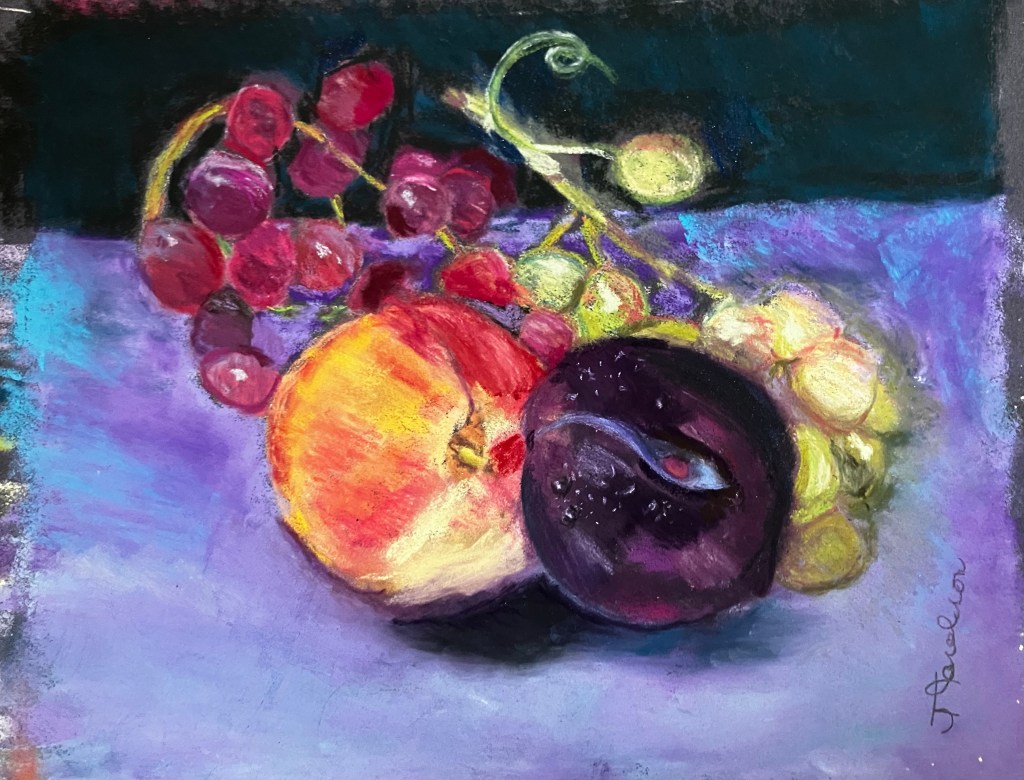
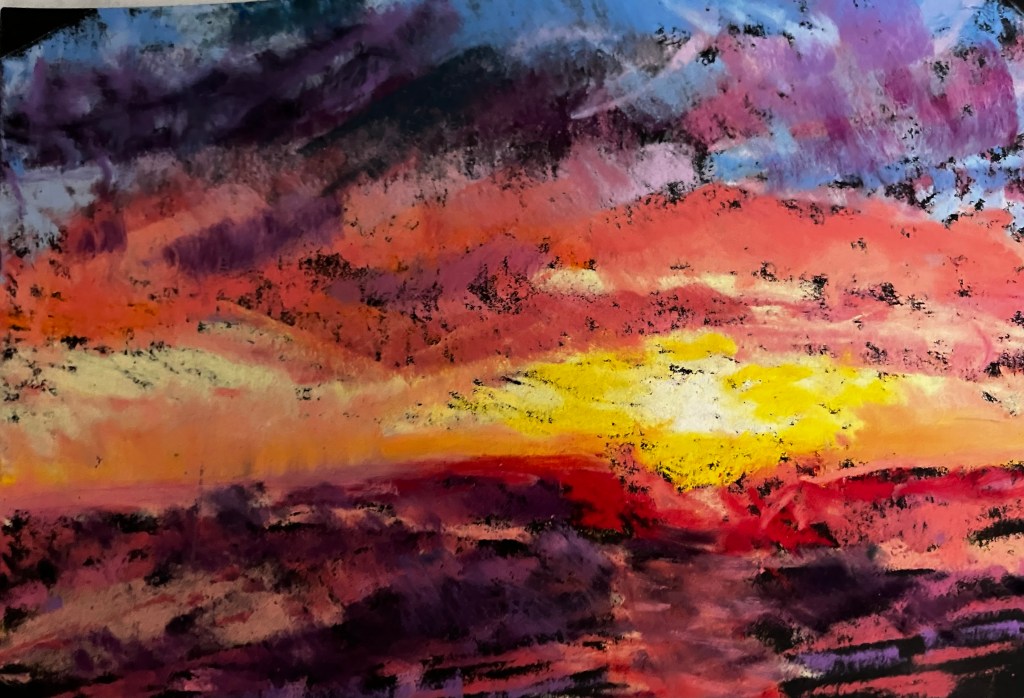
Let me share some works that document my continuing evolution as a painter. Other than the first two which are very early works, I am particularly happy with these paintings that just a few years ago I would never, ever have thought I could produce! And if you are engaged on your own development as an artist of any type, I highly recommend Art & Fear: Observations on the Perils (and Rewards) of Artmaking by David Bayles and Ted Orland.

Designing Interactive Pedagogies of Play Through Metaliteracy

Trudi Jacobson and Tom Mackey co-authored the chapter Designing Interactive Pedagogies of Play Through Metaliteracy for a new book edited by Marietjie Havenga, Jako Olivier, and Byron J Bunt. The open access volume entitled Problem-based Learning and Pedagogies of Play: Active Approaches Towards Self-Directed Learning is published by AOSIS Scholarly Books. As noted in the synopsis: “The focus of this book is original research regarding the implementation of problem-based learning and pedagogies of play as active approaches to foster self-directed learning” (https://books.aosis.co.za/index.php/ob/catalog/book/409).

According to the abstract for Trudi and Tom’s chapter:

This chapter explores interactive pedagogies of play (PoPs) through the theory and practice of metaliteracy. As a holistic pedagogical framework for developing reflective and self-directed learners in collaborative social environments, metaliteracy supports individuals to become active knowledge producers. The structure of the metaliteracy model includes interrelated roles, domains and characteristics that reinforce the scaffolding of play- and problem-based learning in multimodal contexts. The core components of metaliteracy are applied in practice through a set of flexible and adaptable goals and learning objectives. Through this analysis of metaliteracy concerning PoPs, we will describe interactive meaning-making in pedagogical situations involving collaborative problem-based learning (PBL) in four courses at both foundational and advanced levels of the college experience.

https://doi.org/10.4102/aosis.2023.BK409.

We are thrilled to be a part of this exciting new open access book with such excellent editors and authors. It was a great experience to apply metaliteracy to this new context of pedagogies of play. The examples we provide from our own teaching in the Writing and Critical Inquiry course at The University at Albany and in the Digital Media Arts courses at Empire State University demonstrate how applicable these ideas are to a wide range of pedagogical contexts. Let us know what you think about this new application of the metaliteracy model and feel free to try it out in your own teaching!

-Trudi and Tom

Jacobson, TE & Mackey, TP 2023, ‘Designing interactive pedagogies of play through
metaliteracy’, in M Havenga, J Olivier & BJ Bunt (eds.), Problem-based learning and pedagogies of play: Active approaches towards Self-Directed Learning, NWU Self-Directed Learning Series, vol. 11, AOSIS Books, Cape Town, pp. 43–70. https://doi.org/10.4102/aosis.2023.BK409.03

Third Academic Minute Program about Metaliteracy

The June 27, 2022, Academic Minute program featured Trudi Jacobson, and, of course, metaliteracy. The episode is entitled, Students Reflect on their Roles and Responsibilities as Wikipedia Editors. It is the first in a week of episodes by professors and instructors who teach using the Wiki Education initiative. Although the program airs on a number of National Public Radio (NPR) stations, it is produced here in Albany, NY at WAMC. This makes Trudi’s affiliation, which is listed as North-West University (NWU) in South Africa rather than the University at Albany, seem a bit odd, but in order to appear on the program, one needs to be actively affiliated with an institution of higher learning. Trudi is Distinguished Librarian Emerita at The University at Albany, SUNY and both she and Tom Mackey were appointed Extraordinary Professors at North-West University (NWU) in South Africa, soon after presenting a metaliteracy Prestige Lecture as well as keynotes and workshops there in 2019. As part of their honorary appointments, their latest Prestige Lectures at NWU continue in a series this year and next.

This is the third Academic Minute episode that features metaliteracy. Tom Mackey recorded the first, Metaliterate Leaners, which aired on May 18, 2020. Trudi’s first was Renewable Assisgnments, Wikipedia, and Metaliteracy, from December 15, 2021. As indicated by the name of the series, these are quick listens. You might want to give them a try if you’ve not already heard them. This newest episode includes quotes from two students who made connections between their work as information producers on Wikipedia, metaliteracy and learning.

Feel free to use these short clips as part of your teaching practices related to metaliteracy!

-Trudi

Metaliteracy Presentations at SUNY Virtual Conference on Instruction & Technology (CIT)

This year’s SUNY Virtual Conference on Instruction & Technology (CIT) 2021 featured two metaliteracy presentations. Prof. Trudi Jacobson presented Scaffolding Student Learning: The Role of Metaliteracy in Open Pedagogy. Trudi’s presentation examines the relationship between the core concepts of open pedagogy and metaliteracy with a focus on student creations that resulted from this approach.

In a second metaliteracy presentation, Prof. Tom Mackey collaborated with Prof. Sheila Marie Aird on Collaborating to Teach Global Digital Storytelling Online. Tom and Sheila’s presentation explores how they applied metaliteracy to the design of a Digital Storytelling course they co-teach at SUNY Empire State College as a fully online international experience. Their slideshow is available via their Global Digital Stories blog.

The Roles of Metaliteracy and Wikipedia Editing in Overcoming Imposter Syndrome

“Anyone could make edits, and anyone could challenge those edits…This helped me feel less like an outsider trying to fit into a conversation and more like one of a million voices that were working together towards a shared goal of information creation and consumption.”

It is not only illuminating, but also vital to hear from learners about the impact of their encounters with metaliteracy. Asking them to write reflective pieces is one way to find out how components of metaliteracy may have had an effect on their learning. A recent Wiki Edu blog post by Corrin Baker, a graduating senior at The University at Albany, provides such insight. Corrin expanded a wonderfully written course reflection for this post about a course taught by Prof. Trudi Jacobson.

In describing metaliteracy’s producer role, Ms. Baker wrote:

The shared roles of producer and consumer were present in every step of the course. I was fully engaged in locating and evaluating sources, and then finding ways to make that information both understandable and accessible. I felt a great sense of responsibility to the audience and to the authors whose work I was using. I was also far more aware of diversity in a global audience, especially as I found myself struggling to find non-male authors to cite. 

The course, which lasts just seven weeks, is challenging for students, but aims to have a lasting effect on their understanding of information and their roles in producing and sharing it. Corrin’s reflection testifies to the incredible impact that the blend of metaliteracy, information literacy, and the wonderful Wiki Education program can have.

Read the full post here: Overcoming imposter syndrome by editing Wikipedia

Wiki. edu logo by David Peters of EXBROOK for Wiki Education Foundation – Wiki Education Foundation, Public Domain, https://commons.wikimedia.org/w/index.php?curid=33179189

Metaliteracy in Action in Non-Disposable Assignments: Creating a Website by First Year Students for First Year Students

Trudi Jacobson, Distinguished Librarian at the University at Albany, SUNY taught a first year experience (FYE) course this fall, one which concentrated on introducing students to topics such as selecting a major, time planning, study skills, financial literacy, and of course metaliteracy. Students worked through the SUNY OER Services’ iSucceed College Success course which includes a robust metaliteracy module (another version of Lumen Learning’s College Success doesn’t contain the metaliteracy module). In order to give students an opportunity to put what they were learning into practice, Trudi asked them to work on creating helpful content for other first-year students. This information would be added to a website that can be shared with other first year students. Groups of three students tackled an FAQ and a number of zines providing tips for this particular population. Extra credit assignments yielded two more helpful resources, one in audio and one in video format. Five examples of a course infographic project were also added to the site. A student took photos for the header for each page. Students not only had become information producers, but also teachers as well.

The site is being promoted through social media, and soon will be shared with other instructors in the program as well as students in the University at Albany’s Writing and Critical Inquiry Program (another first-year course). Most of the advice on the site is not specific to UAlbany, so please feel free to share it with others who might be interested. Take a look!

Metaliteracy and Maker Literacy

We are delighted to share this guest post by Sarah Nagle, Creation and Innovation Services Librarian at Miami University, Oxford Ohio. Sarah explores the maker movement, its tenuous fit with the ACRL Framework for Information Literacy, and what she defines as a strong alignment with metaliteracy.

Metaliteracy as a Bridge Between Maker Literacy and the ACRL Framework

Sarah Nagle, Creation and Innovation Services Librarian

The popularity of makerspaces has soared across the world since the onset of the Maker Movement in the mid-2000s. Makerspaces are collaborative working and learning spaces that often include technology such as 3D printers, sewing machines, laser cutters, and other equipment. While community and public library makerspaces led the charge in the early years of the maker movement, maker-centered learning has blossomed in the realm of education, becoming a popular learning tool in K-12 schools, and more recently in higher education. Often, university makerspaces live in the campus library. University libraries can provide broad access to communal, collaborative spaces for the campus community, making them an ideal location for makerspaces. Maker-centered learning has a strong multidisciplinary, collaborative aspect, and makerspaces traditionally put value on the open sharing of things and ideas, something that is deeply embedded in the spirit of libraries.

As makerspaces have grown in popularity in education, some important projects have arisen to study the benefits and outcomes of maker-centered learning. Agency by Design (AbD) (Clapp et al., 2017) is a multi-year research project that has studied maker-centered learning. Although the project focused mainly on K-12 education, many of the findings can apply to maker-centered learning for any age level. AbD developed a Framework for Maker-Centered Learning, which focuses on maker empowerment and design sensitivity. A prominent framework for maker-centered learning in higher education is the Maker Literacies Project (Wallace, et al., 2018), an IMLS-funded initiative started at the University of Texas Arlington, has developed a list of maker competencies for higher education, in addition to providing a wide range of examples of makerspace course integrations. A common thread for maker-centered learning frameworks is the development of a maker mindset, which places emphasis on empowerment, failure positivity, and critical thinking. Often absent from maker-centered learning frameworks is a strong emphasis on the acquisition of specific skills. In other words, even though students are learning specific tools, technologies, and software, the enduring value that they receive from maker-centered learning experiences is primarily related to mindset development.

The question of how maker-centered learning connects to information literacy instruction remains largely unanswered. Since moving from public to academic library makerspaces in 2018, I have grappled with how to bridge maker-centered learning with my library’s information literacy instructional mission, which focuses heavily on the ACRL Framework for Information Literacy. Attempting to map maker literacies to the ACRL Framework can be a difficult task; there are many similarities, but there are also many outcomes of maker-centered learning that don’t fit perfectly within the six frames. Then I began reading about metaliteracy and discovered that the concept provides an excellent overarching model for connecting experiential learning competencies like maker literacy to the ACRL Framework.

Metaliteracy places emphasis on learners as active, collaborative, and introspective creators. This perspective on information literacy broadens the scope of library instruction and makes room for new and innovative literacies, such as maker literacy. Below are some of the important ways that metaliteracy encompasses the outcomes of maker-centered learning.

  • Shift from consumer to creator – Goal 3 of the 2018 Metaliteracy Goals and Learning Objectives includes students’ ability to view themselves as producers of information. An important outcome of maker-centered learning focuses on this shift as well. Rooted in the ideals of the maker movement, the shift from consumer to creator fundamentally changes students’ outlook and connects closely with the theme of empowerment. Students are no longer blindly consuming information and things, but rather looking critically at all aspects of the designed world around them, with a confidence in their ability to analyze, tinker with, and design new objects.
  • Empowerment – Learner empowerment is mentioned in the metaliteracy documentation as an outcome of metacognition and metaliterate learning. Empowerment is also a key component of maker-centered learning frameworks. The ultimate outcome of the AbD Framework for Maker-Centered Learning is Maker Empowerment. This is defined as “A sensitivity to the designed dimension of objects and systems, along with the inclination and capacity to shape one’s world through building, tinkering, re/designing, or hacking” (Agency by Design, n.d.). In other words, maker-centered learning helps students critically evaluate the world around them, understand how things work, and gain confidence in their own ability to fix, improve upon, and create things.
  • Civic mindedness – One characteristic of metaliterate learners is their tendency to be civic minded. Civic mindedness is also a byproduct of maker-centered learning. When students experience empowerment through maker-centered learning, this empowerment begins to extend beyond themselves, often resulting in students’ commitment to use their newfound agency to make a difference in the world at large. A hallmark of the maker movement is the propensity of makers to use their skills to give back to their communities. A recent example is the maker community’s response to shortages of PPE and medical devices during the COVID-19 pandemic. When stories began circulating of PPE shortages, makers worldwide immediately stepped up in huge ways to design, develop, and manufacture face masks, shields, and even parts for medical devices such as ventilators. AbD identifies “Community Making” as one of the primary benefits of maker-centered learning, defining it as, “Finding opportunities to make things that are meaningful to one’s community and taking ownership of that process of making, either independently or with others” (Clapp et al., 2017, p. 41).
  • Metacognition – Metacognition is an integral component of metaliteracy, as one of the four domains of metaliterate learning. Although the current literature and frameworks on maker literacy do not explicitly address metacognition in maker-centered learning, the concept is certainly interconnected with the maker learning process. The maker mindset involves critical evaluation of one’s own beliefs and outlooks. In all of my makerspace instruction sessions, I start by introducing students to the maker mindset, which gives students the opportunity to understand and evaluate their own shift in thinking as they develop themselves as makers. Additionally, Wallace et al. (2018) discuss how maker learning activities were more effective when faculty members included self-reflection in the assignment. They describe how the addition of journaling or other self-reflective components to maker assignments increased student growth. This metacognitive step also contributes to maker empowerment, because when students understand the elements of mindset development, they have the ability to control their own learning.

As more academic libraries implement makerspaces, academic library maker educators may face pressure to demonstrate how maker literacy fits with the ACRL Framework. Metaliteracy not only expands students’ expertise of information literacy to include rapidly changing digital environments, it also has the potential to be the bridge that connects newly forming innovative literacies, including maker literacy, to the ACRL Framework. By embracing mindset development rather than skill acquisition, information literacy instruction has the potential to help students develop lifelong practices and viewpoints that will continue to serve them long after they graduate.

References

Agency by Design. (n.d.). The Framework for Maker-Centered Learning. http://www.agencybydesign.org/explore-the-framework

Clapp, E. P., Ross, J., Ryan, J. O., & Tishman, S. (2017). Maker-centered learning: empowering young people to shape their worlds. San Francisco, CA: Jossey-Bass.

Wallace, M., Trkay, G., Peery, K., Chivers, M, Radniecki, T. (2018, August 3-5). Maker Competencies and the Undergraduate Curriculum. Paper presented at the 2018 International Symposium on Academic Makerspaces, Stanford, CA. Retrieved from https://rc.library.uta.edu/uta-ir/handle/10106/27518

Sarah Nagle is Creation and Innovation Services Librarian at Miami University in Ohio, where she supports transdisciplinary projects and course integrations relating to a variety of maker and innovation topics. Sarah’s scholarly interests include inclusivity in the maker movement and how maker-centered learning can enhance learning both in informal environments and higher education.