Unknown's avatar

About metaliteracy1

The Metaliteracy Learning Collaborative includes Trudi Jacobson, Tom Mackey, and Kelsey O'Brien..

Workshop on Teaching and Mentoring with Metaliteracy

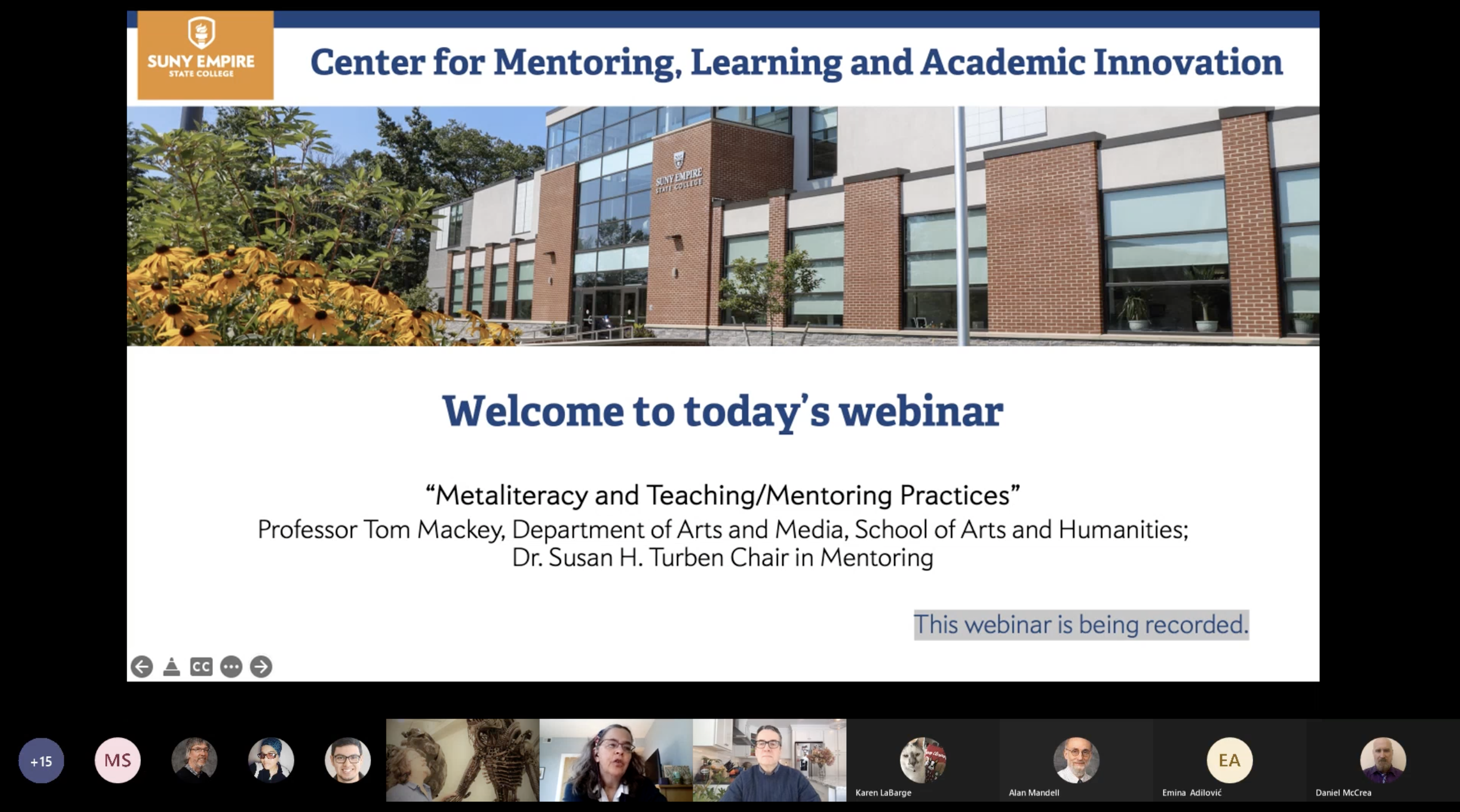
A new metaliteracy workshop by Prof. Tom Mackey was presented online for the Center for Mentoring, Learning, and Academic Innovation (CMLAI) at SUNY Empire State College. Tom conducted this interactive workshop as part of his appointment this year as Dr. Susan H. Turben Chair in Mentoring. The presentation, entitled “Metaliteracy in Teaching/Mentoring Practice,” was recorded and is available via SUNY Empire’s LEARNscape platform. The session provides a theoretical overview of the metaliteracy model and explores ways to integrate metaliteracy roles and objectives into learning activities. Specific examples of metaliteracy in practice are provided from courses that Tom teaches, including Digital Storytelling, Ethics of Digital Art & Design, and Educational Planning. Participants of the workshop learned about the theory and practice of metaliteracy and considered learning activities to apply in their own teaching. The themes and techniques discussed in the workshop are transferrable to a wide range of settings.

Recorded Session: Metaliteracy and Teaching/Mentoring Practice

Connecting Metaliteracy, Open Pedagogy, and Wikipedia Editing

Trudi Jacobson has written a post for the WikiEdu blog under the title above. In it, she very briefly explores these elements as they are explained in the new book she wrote with Tom Mackey, Metaliteracy in a Connected World: Developing Learners as Producers (ALA/Neal-Schuman, 2022). She mentions that in chapter 3, the authors show how ”metaliteracy provides a comprehensive scaffolding and framework for the learning, and indeed the teaching, that takes place in open pedagogical environments” (p. 85). Chapter 4 includes course-based case studies, one of which is centered on the educational Wikipedia editing program offered by Wiki Education.

Image credits: JfhughesusCC BY-SA 4.0, via Wikimedia Commons; Illustrated by Jasmina El Bouamraoui and Karabo Poppy Moletsane, CC0, via Wikimedia Commons

Metaliteracy Featured in Two Prestige Lectures at the Invitation of Northwest University (NWU) in South Africa

Profs. Trudi Jacobson and Tom Mackey have been invited to present two Prestige lectures as part of their honorary appointments as Extraordinary Professors in the Research Unit Self-Directed Learning, Faculty of Education, North-West University, South Africa, These virtual events explore themes from their new book for ALA Publishing Metaliteracy in a Connected World: Developing Learners as Producers and are available to everyone.

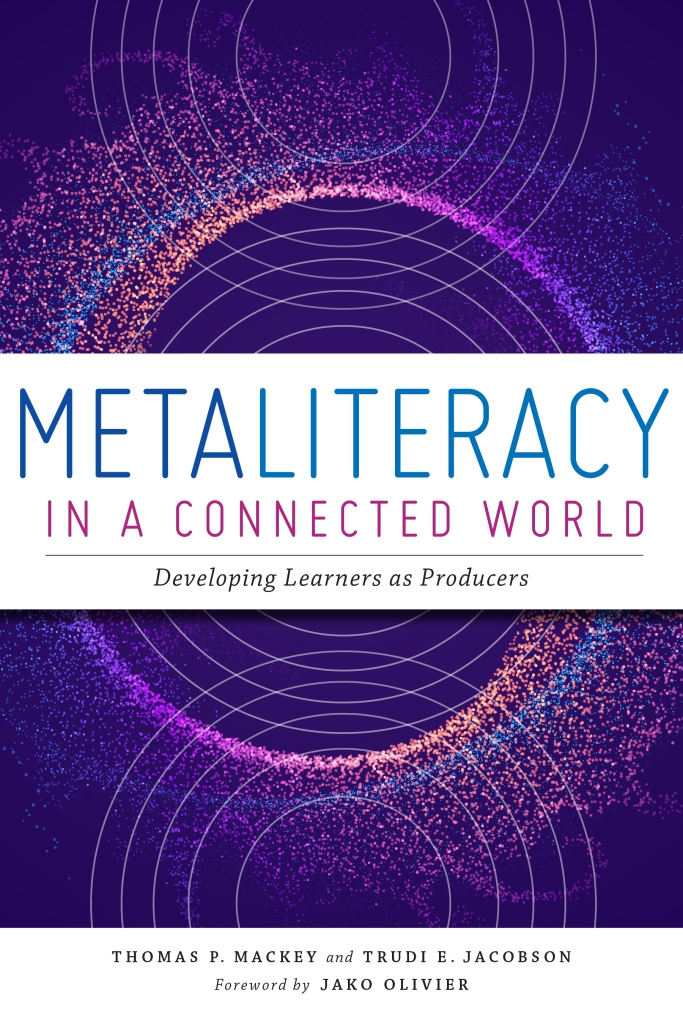
Picture of the cover for the book Metaliteracy in a Connected World: Developing Learners as Producers

Register for either or both lectures at the links below:

Prestige Lecture 1: Metaliteracy and Its Role in Self-Directed Learning (SDL) with Profs. Tom Mackey and Trudi Jacobson

Friday 11 February 2022 8:00AM-9:00AM (Eastern time). Register here:
https://us02web.zoom.us/webinar/register/WN_mj8jdegwSpCTJRnbqPuXtA

This first lecture will trace the origins of the metaliteracy framework in relation to changing conceptions of information literacy and revolutionary changes in the social information environment. We will explore the evolution of metaliteracy as a distinct model with core components that include a focus on learning domains, active learner roles, associated characteristics, and reinforcing goals and learning objectives. 

Prestige Lecture 2: Open Pedagogy and Metaliteracy with Profs. Trudi Jacobson and Tom Mackey

Tuesday 8 March 2022 8:00AM-9:00AM (Eastern time). Register here:
https://us02web.zoom.us/webinar/register/WN_X5X1rwdRQ02n2DpjdSqNGw

The use of open pedagogy provides students with the opportunity to engage deeply in their own learning, but the responsibilities involved may be unfamiliar and stressful. The metaliteracy framework provides scaffolding that encourages student success. This lecture will delve into how metaliteracy and open pedagogy can work hand-in-hand.

Join us for both lectures exploring the metaliteracy framework and its application in pedagogical situations.

In 2019, Tom and Trudi presented a Prestige Lecture in person at NWU in South Africa at the invitation of Jako Olivier, UNESCO Chair on Multimodal Learning and OER and Professor in Multimodal Learning about Exploring the Foundation of Metaliteracy in Theory and Practice.

We hope to see you at the newest lecture series available online! Be sure to register today!

Tom and Trudi  

Metaliteracy in a Connected World Book Published by ALA Publishing!

The new book co-authored by Thomas P. Mackey and Trudi E. Jacobson entitled Metaliteracy in a Connected World: Developing Learners as Producers has been published by ALA Neal Schuman! The idea of learner as producer is foundational to the metaliteracy framework and is explored in depth in this new publication.

The book’s Foreword is written by Jako Olivier, UNESCO Chair on Multimodal Learning, and OER Professor in Multimodal Learning, North-West University, South Africa.

According to the press release from ALA Publishing, the new metaliteracy book “offers an overview of the development of the metaliterate producer through metaliteracy’s goals, learning objectives, learning domains, active learner roles, and associated characteristics” and “explores the ways in which metaliteracy provides scaffolding for open pedagogical settings, encouraging students to understand and embrace their active roles,” among other highlights.

The new book examines metaliteracy in relation to such timely and relevant themes as self-directed learning, multimodality, open pedagogy, digital citizenship, and developing a growth mindset. Metaliteracy in a Connected World is organized into six related chapters:

Chapter 1: Metaliteracy for Empowering Learners as Producers

Chapter 2: Engaging Metaliterate Producers through Multimodal Learning

Chapter 3: Metaliteracy and Open Pedagogy

Chapter 4: Developing Metaliterate Producers Using Open Pedagogy

Chapter 5: Designing an Online Metaliteracy Course to Engage Informed Producers

Chapter 6: Developing Productive Metaliterate Citizens with Growth Mindsets

This is the fourth book about metaliteracy and presents a fully realized model that has developed considerably since we first introduced the concept in 2011. We look forward to your feedback and welcome the opportunity to engage with audiences about the themes examined in each chapter!

Tom and Trudi

Connecting Metaliteracy and the ACRL Framework for Information Literacy

Visualizations, whether figures, graphs, or charts, can convey meaning and explore connections in a vivid manner, A recent book edited by Jannette L. Finch, Envisioning the Framework: A Graphic Guide to Information Literacy (ACRL, 2021) contains chapters that provide a variety of visualizations of the ACRL Frameworik for Information Literacy for Higher Education (ACRL 2105) One of the chapters, Visualizing the Convergence of Metaliteracy and the Information Literacy Framework is written by Trudi Jacobson, Tom Mackey, and Kelsey O’Brien. The chapter delves into specifics that help to show how metaliteracy influenced the Framework. It includes this visualization that allows readers to see at a glance where metaliteracy’s characteristics and the Framework’s dispositions align.

Metaliteracy Discussed on The Academic Minute—Again!

Trudi Jacobson is featured on a segment for NPR’s The Academic Minute that was first presented on December 15, 2021: Renewable Assignments, Wikipedia, and Metaliteracy.

In this new segment, Trudi discusses the value of renewable assignments, i.e., assignments in which students create content that is useful to others, not meant simply for their professors’ eyes alone. Such assignments help individuals to become metaliterate learners and responsible digital citizens. Her example involves editing content in Wikipedia and the important scaffolding that metaliteracy can provide. If you get a chance, listen (or read it, the text is provided). The Academic Minute is produced for NPR by our local WAMC public radio station.

This is the second time metaliteracy has been featured on the program. Tom Mackey’s segment, Metaliterate Learners, aired on May 18, 2020.

Metaliteracy Essay Published in SUNY Empire’s All About Mentoring 50th Anniversary Edition

A new metaliteracy essay by Tom Mackey entitled “Translating a Blended Cyprus Residency Study in the Digital Arts to Online” is featured in the latest edition of All About Mentoring (Issue 55 Autumn 2021, pp. 37-42) published by SUNY Empire State College.

The article explores how metaliteracy informed the design of a course entitled Ethics of Digital Art and Design for the international Cyprus Residency offered in the summer of 2019 (see class photo). The development of the residency study as an online course for the Digital Arts curriculum at SUNY Empire State College is explored as well.

A discussion of Linkr Education and how it is incorporated in the online version is provided. Metaliterate learners develop professional profiles and produce multimedia publications about course themes in the Linkr Education learning environment.

The application of metaliteracy in both learning experiences is central to the course description, learning outcomes, and learning activities. The relationship between each course is examined and practical insights are provided about how to embed metaliteracy into learning design in multimodal settings.

Metaliteracy Keynote at Information Literacy and Democracy Conference 2021

Metaliteracy was featured as part of the Information Literacy and Democracy Conference (IDESA 2021) supported by the Faculty of Political Sciences, University of Sarajevo. Trudi Jacobson and Tom Mackey presented Developing Metaliterate Learners to Advance Democratic Ideals as the keynote for the event. A recording of the entire conference is available via YouTube and the metaliteracy presentation starts at 4:47:00.

The conference also featured  Emir Vajzović and Mario Hibert from the University of Sarajevo, and Thomas Mandl from the University of Hildesheim in Germany. In addition, Joachim Griesbaum and Theresia Woltermann from the University of Hildesheim, Institute of Information Science and Language presented on the Intercultural Perspectives on Information Literacy and Metaliteracy course that Tom and Trudi have also been involved with. The conference included special guest Dr. Alton Grizzle, Program Specialist – Section for Media and Information Literacy and Media Development; Communication and Information Sector, UNESCO, Paris, France, who presented “Media and Information Literate Citizens: Thinking Critically, Think Wisely.”

We look forward to any feedback you have about our keynote!

Tom and Trudi

Metaliteracy, Self-Directed Learning, and Assessment

Trudi Jacobson, Tom Mackey and Jako Olivier (UNESCO Chair on Multi-Modal Learning and Open Educational Resources, and Professor at North-West University) co-authored a chapter in a recent open-access volume, Learning Through Assessment: An Approach Towards Self-Directed Learning. The book was edited by Elsa Mentz and Anitia Lubbe, and is a part of the NWU Self-directed Learning Series.

Cover for Learning through assessment: An approach towards self-directed learning
Learning Through Assessment (2021)

The chapter by Trudi, Tom and Jako is entitled “Aligning Metaliteracy with Self-directed Learning to Expand Assessment Opportunities,”

The chapter’s abstract:

Metaliteracy is a holistic model that emphasises information-related knowledge attainment whilst challenging individuals to take charge of their learning strategies and goals. It prepares learners to become informed consumers and responsible producers of information. Metacognition is a core concept in metaliteracy, just as it is in self-directed learning (SDL) and in methods of assessment appropriate to SDL, such as Assessment as Learning (AaL) and Assessment for Learning (AfL). This congruence provides clear avenues for using metaliteracy’s framework in ways that support SDL. The first part of the chapter explores metaliteracy and its connections with SDL and assessment. The remainder of the chapter provides two examples of how the intersection of metaliteracy, SDL and assessment might be addressed in practice. These case studies provide additional and practical connections that might suggest applications in other settings. The first section explores a comprehensive metaliteracy digital badging system that is designed to advance SDL, with a focus on how the self-directed unit from this system was adapted for use in an open textbook. The final section of the chapter provides an example of how an online undergraduate course intertwines metaliteracy, information literacyand editing on Wikipedia, exemplifying principles of SDL and providingexamples of AaL and AfL. (p. 72)

We look forward to furthering our investigations into the connections between metaliteracy and self-directed learning.

Information Has Value: Engaging Students as Wikipedia Editors

Trudi and Jackson Grey, a student in her fall 2021 Information Literacy in the Humanities and Fine Arts course, presented at the virtual 2021 WikiConference North America in October. This course uses a combination of the Wiki Education program, metaliteracy, and frames from the ACRL Information Literacy Framework for Higher Education to encourage students to see themselves as ethical and responsible information producers.

The Wiki Education program provides excellent training for novice Wikipedia editors, but a conceptual understanding of the value of information, as well as scaffolding to recognize themselves as information producers, can provide a rich underpinning for this new set of skills, a background that will help them to see the value of their contributions, and encourage them to continue as metaliterate Wikipedia editors.

Jackson, a senior at the University at Albany majoring in philosophy, provided a student’s viewpoint in such a learning situation where It is possible to share growing knowledge in a field of study. He also explored the differing values of information, inherent vs. as a means to an end, and the disconnect between the availability of information and its importance.

The presentation is available on YouTube as part of a day of programs. It starts at 6:05, and this link is set to start at that point.