AI and Metaliteracy to be Featured at ECIL 2025 in Bamberg, Germany

Two international panels on AI and Metaliteracy have been accepted for presentation at the 2025 European Conference on Information Literacy (ECIL). The aim and scope of this year’s conference are focused on Information Literacy in an AI-driven World. It will take place September 22–25 at the University of Bamberg in Germany.

The two metaliteracy panels are featured as part of the full conference agenda and include:

Panel Presentation: Humans in the Loop: Advancing Metaliteracy for Generative AI Learning Environments

This international panel on Tuesday, Sept. 23 2025 will explore the transformative potential of metaliteracy as a holistic framework for addressing the global challenges and opportunities presented by artificial intelligence (AI). The panelists will present descriptive case studies from around the world that demonstrate actionable strategies for empowering learners as humans in the loop through metaliteracy.

Panelists:

  • Thomas P. Mackey, Empire State University, USA
  • Brenda Van Wyk, University of Pretoria, South Africa
  • Megan Eberhardt-Alstot, Pepperdine Graduate School of Education and Psychology, USA
  • Kristine N. Stewart, Zayed University, United Arab Emirates
  • Kristen Schuster, University of Southampton, UK
  • Matt Moyo, North-West University, South Africa

Paper Presentation: Combining Information Literacy and Metaliteracy to Advance Transnational Group Learning about AI. Learning Process and Learning Outcomes, Results from a Case Study

The global panel on Thursday, September 25, 2025, will present findings from a co-authored transnational case study on learning about AI. The paper combines insights from information literacy and metaliteracy to highlight collaborative learning processes and outcomes across cultures. Panelists will discuss collaborative teaching and learning in the global virtual exchange Intercultural Perspectives on Information Literacy and Metaliteracy (IPILM).

Authors:

  • Joachim Griesbaum, University of Hildesheim, Germany
  • Stefan Dreisiebner, Carinthia University of Applied Sciences, Austria
  • Emina Adilović, University of Sarajevo, Bosnia and Herzegovina
  • Justyna Berniak-Woźny, SWPS University Kraków, Poland
  • Subarna Bhattacharya, Kalinga Institute of Industrial Technology, India
  • Jini Jacob, Symbiosis College of Arts & Commerce, India
  • Thomas P. Mackey, Empire State University, SUNY, USA
  • Tessy Thadathil, Symbiosis College of Arts & Commerce, India

These two sessions underscore the growing importance of metaliteracy in addressing the opportunities and challenges of AI in global education. They also highlight the collaborative work of international scholars who are shaping future directions for learning in the age of generative AI.

(AI-generated image “AI and Metaliteracy” created using ChatGPT)

Seekers of Truth in a Digital World

What is information? Is it the truth or perspective? What are we interpreting, and how do we know? Are we considering a lens or a fragment of something that is before us? I want to see information and feel that it is true—to discern its actuality. Can we feel information, like the vibration of a song? Is the goal for it to resonate and transcend our logical minds, or do we compare its intensity and velocity to standing on a mountain high up in the sky?

These were just some of the questions that stirred my curiosity during my metaliteracy course, an experience that transformed how I view and engage with information.

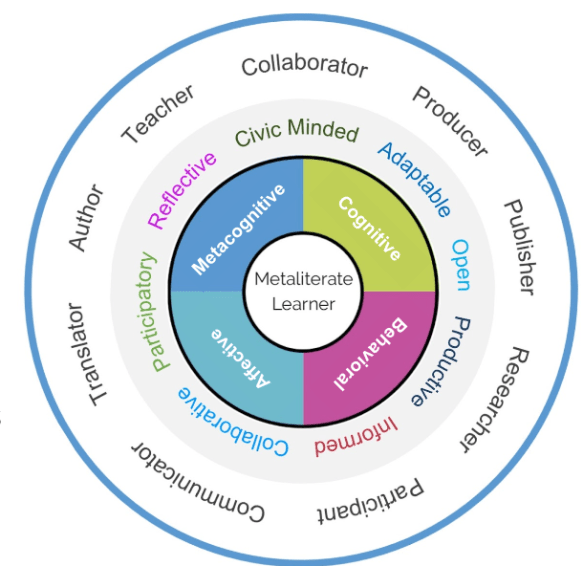
One of our most memorable exercises involved using the Metaliteracy wheel to assign roles within the group, ensuring that everyone contributed as a Teacher, Collaborator, Researcher, and Producer. This approach inspired us to be facilitators, speakers, and leaders. Together, we examined a controversial topic—climate change—from a perspective detached from the heated debates over causes or effects. Instead, we honed in on how information about climate change is produced, disseminated, and received.

Digital Storytelling and Metaliteracy Explored in New Book!

The new book edited by Dr. Sheila Marie Aird and Dr. Thomas P. Mackey Teaching Digital Storytelling: Inspiring Voices Through Online Narratives has been published by Rowman & Littlefield. The editors worked with an exceptional team of authors from SUNY schools, Temple University, and universities in South Africa to share their narratives about teaching with digital storytelling through the lens of information literacy and metaliteracy. The new book features a Foreword written by futurist and digital storytelling pioneer Dr. Bryan Alexander. This is the newest book to be included in Trudi Jacobson’s Innovations in Information Literacy Series at Rowman & Littlefield.

This book project emerged from the collaborative teaching by the Drs. Aird and Mackey to design a fully online course in Digital Storytelling to unite Empire State University students studying in Prague, Czech Republic and the United States. This course fully integrates the metaliteracy framework and features learning objects available at the metaliteracy.org blog. The editors wrote the framing chapter about this case study Metaliteracy and Global Digital Storytelling: Building Shared Learning Communities.

As noted in the book overview and description:

This book presents the stories of educators who through digital storytelling inspire students from diverse communities to construct their empowering digital narratives. Educators from a wide range of disciplines present innovative case studies of teaching digital storytelling through the lens of personal narratives, metaliteracy, and information literacy. They describe how teaching students to tell their personal digital stories prepares them as learners who are reflective while playing active learner roles such as producer, publisher, and collaborator. 

https://rowman.com/ISBN/9781538172919/Teaching-Digital-Storytelling-Inspiring-Voices-through-Online-Narratives

We invite you to explore this new book and tell us about your own digital storytelling adventures!

-Sheila and Tom

Collaborative Metaliteracy Article Published in Communications in Information Literacy (CIL)

The international project team that has been developing and teaching an innovative global course just published a peer-reviewed article entitled Teaching Internationally, Learning Collaboratively: Intercultural Perspectives on Information Literacy and Metaliteracy (IPILM) in Communications in Information Literacy (CIL). This teaching and research team includes Joachim Griesbaum, Stefan Dreisiebner, Tom Mackey, Trudi Jacobson, Tessy Thadathil, Subarna Bhattacharya and Emina Adilović.

According to the abstract for this new article:

Intercultural Perspectives on Information Literacy and Metaliteracy (IPILM) is a discourse- oriented learning environment that engages students from diverse cultural backgrounds to participate in collaborative knowledge construction. The objective is to evolve a thematic approach to course design that includes elements of open pedagogy, information literacy, and metaliteracy. IPILM invites participation from educators and learners from around the world and has witnessed an increase in participating countries. This paper describes the concept of IPILM and demonstrates the implementation of this approach in practice.

The next iteration of the IPILM concept will take place this summer and involve the exploration of artificial intelligence (AI) from an intercultural perspective and through the lens of information literacy and metaliteracy. The latest updates about the IPILM Project are available online: https://ipil.blog.uni-hildesheim.de/.

Griesbaum, J., Dreisiebner, S., Mackey, T. P., Jacobson, T. E., Thadathil, T., Bhattacharya, S., & Adilović, E. (2023). Teaching Internationally, Learning Collaboratively: Intercultural Perspectives on Information Literacy and Metaliteracy (IPILM). Communications in Information Literacy, 17 (1), 260–278. https://doi.org/10.15760/comminfolit.2023.17.1.4