A guest blog post by Dr Valerie Hill
The metaverse is rapidly expanding and even young children are immersed in worlds like Minecraft and Roblox. Adult learners have utilized Second Life as a learning space for building in 3D for years now. Educators and librarians must utilize these evolving information landscapes for teaching and learning. The metaverse is ideal for embedding metaliteracy and is a real, albeit virtual, place where critical thinking is needed. To that end, the Winter 2025 issue of the Virtual Education Journal has focused on metaliteracy.
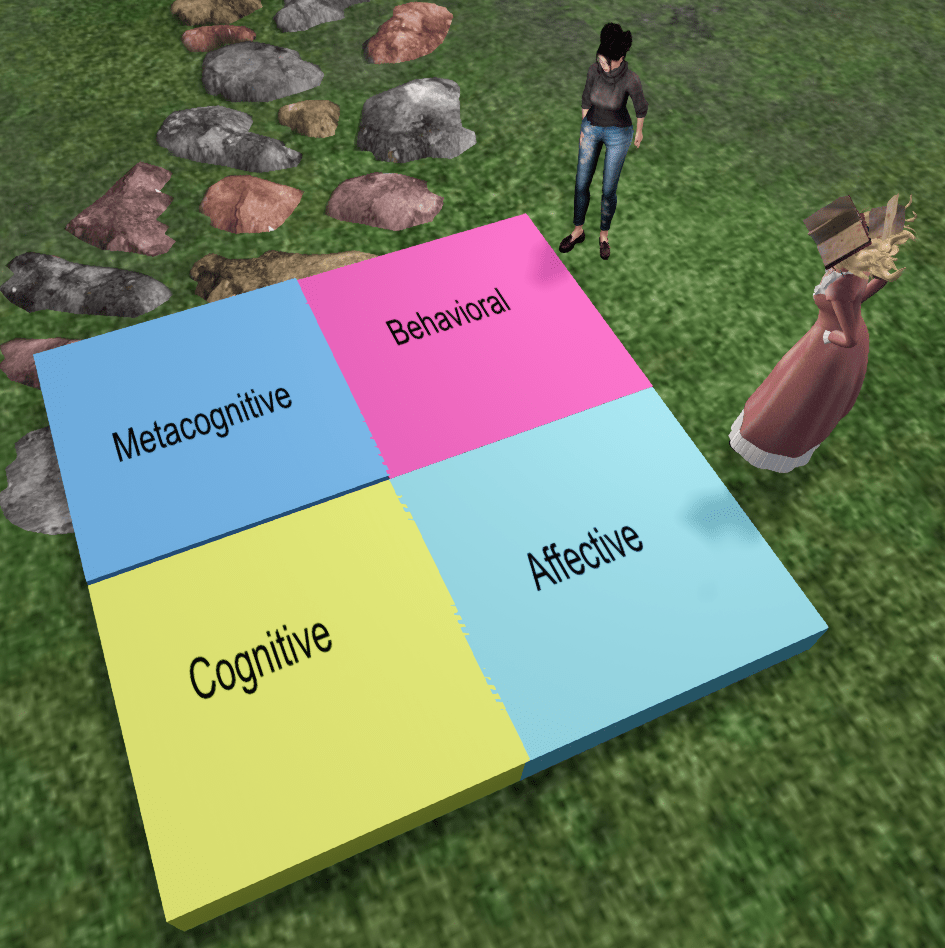
The domains of metaliteracy can be taught in the metaverse and vocabulary can be modified for even very young students. For example, metacognition is “thinking about our thinking” and one might simplify the metacognitive domain to the word THINK. The cognitive domain might be simplified to the word KNOW. The affective domain deals with our emotional intelligence and could be simplified to the word FEEL. Finally, the behavioral domain deals with what students can act upon or simply put, what they DO.
A short video demonstrates these themes, and how they could be taught, by visualizing the four domains on virtual flags.
The metaverse is a perfect place to introduce metaliteracy because metaphors can be built in 3D. (Note the 3D model on page 76 in the Winter issue of VEJ). When students, embodied as avatars, can enter a model showing the roles, characteristics, and learning objectives of metaliteracy, they are able to better see how these relate to their own personal learning and their responsibilities for digital citizenship. The learner picture below is sitting on the foundational domains of metaliteracy.
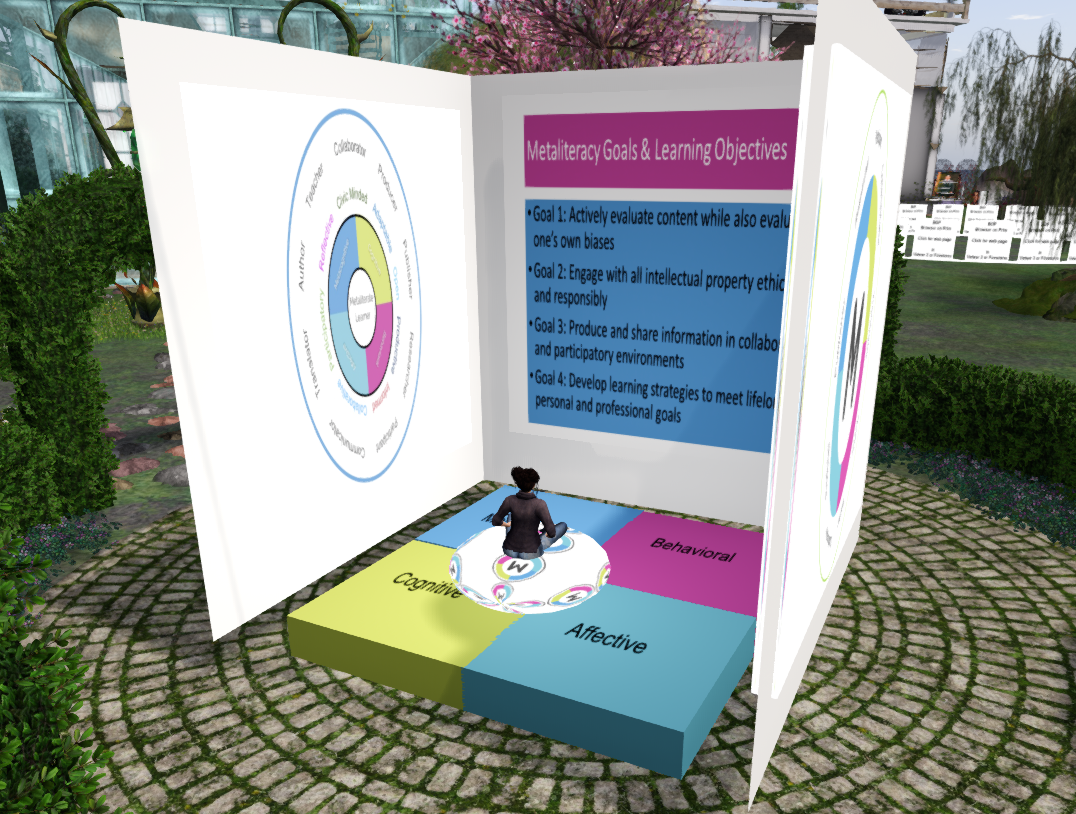
By building a prototype model, one can envision how AI will impact metaliteracy. Soon other 3D builders will have the opportunity to revise the 3D model of AI and Metaliteracy in Second Life. Building in 3D is a great way to dig into the metaliteracy domains, roles, and characteristics of the learner. The picture below depicts AI as a large bubble in which we may navigate in and out of AI applications and still be aware of our own metaliterate roles and characteristics and the domains of our learning process. The learner is sitting on a beanbag that is scripted to allow the individual to move in and out of AI to illustrate that we can learn to control how we use AI and be aware of when AI is gathering information and producing new content.
A video demonstration of this prototype 3D metaliteracy model was provided at the Nonprofit Commons in Second Life and recorded here:
This prototype demonstrates the power of building in 3D and how we can produce and consume content as prosumers—both individually and collaboratively. This is metaliteracy in action. To become a good digital citizen, one must be metaliterate (whether you call it by that name or not!).

We appreciate this guest post from Dr. Valerie Hill, Director of the Community Virtual Library and researcher of changing literacy in digital culture. She has been innovative in applying metaliteracy in the virtual world of Second Life and the metaverse. Dr. Hill’s book, Metamodernism and Changing Literacy: Emerging Research and Opportunities, explores the relationship between metaliteracy and metamodernism.
 Metaliteracy.org