Metaliteracy in Practice Book Published!

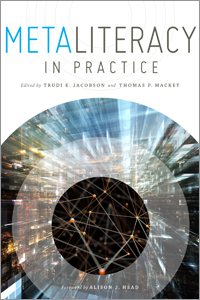
MackeyMIP_300We are thrilled that our new edited book Metaliteracy in Practice (right) was published this week by ALA Neal-Schuman! This book is the follow up to our co-authored book Metaliteracy: Reinventing Information Literacy to Empower Learners (2014).  The new book features 9 chapters from faculty and librarians who have been applying metaliteracy in their teaching practices.  We really enjoyed the chance to work with such outstanding chapter authors on this project, representing a variety of institutions, including: Keene State College, Washington College, University of South Africa, SUNY College at Brockport, and the University of Scranton. The authors explore metaliteracy practices related to social media pedagogy, the politics of information, nursing education, open and collaborative learning, student empowerment, and learner agency.  In addition, ACRL’s Framework for Information Literacy for Higher Education is examined in relation to metaliteracy in several of the chapters.  The book’s Foreword was written by Alison J. Head, Ph.D., Executive Director, Project Information Literacy (PIL), Principal Research Scientist, The Information School, University of Washington, and Faculty Associate, Berkman Center for Internet & Society, Harvard University. We appreciate all of the support we received from everyone at ALA Neal-Schuman and we must say that we absolutely love the cover!  -Trudi and Tom

Metaliteracy in Practice: Sneak Peak #3

Barbara J. D’Angelo and Barry M. Maid of Arizona State University give you a glimpse into their chapter in the forthcoming book.

Metaliteracy Learning of RN to BSN Students: A Fusion of Disciplinary Values and Discourses

Library and Information Science and Writing Studies share a long-standing collaborative partnership in higher education. The connection often is articulated or manifested in first year composition courses, particularly the second semester composition course focused on research (commonly known as English 102 or Composition II). However, research and communication, including written communication, also are important to disciplinary discourses. Nurses, in particular, exist within sophisticated information environments in which work takes place in interdisciplinary teams ranging from medical personnel, pharmacists, home health care workers, social workers, patients, and more. For undergraduate nursing education, the importance of research and communication practices can be seen in two of nursing’s disciplinary documents related to undergraduate education: The Essentials of Baccalaureate Education for Professional Nursing Practice and in Core Competencies for Interprofessional Collaboration.

In this chapter we report on the development of a discipline-specific writing and research course, Writing for Healthcare Management, for nursing majors in the online RN-BSN degree program at Arizona State University. The course focuses on developing students’ professional writing and information abilities in a way that reflects concepts underpinning metaliteracy. The course facilitates critical thinking and collaborative practices needed for both the consumption and production of knowledge. The chapter describes the development of the course and assignments, and how metaliteracy aligns with disciplinary writing outcomes. In addition, the results of a small scale study that analyzed student work is presented to show how the course meets metaliteracy goals and learning objectives. The chapter contributes an example of a “meta” approach to course design and a model of a contextual approach to fusing multiple “literacies” and “outcomes or objectives” through valuing shared responsibility and accountability for student achievement and transfer of knowledge. While this chapter concentrates on a course in one discipline, nursing, the methods used are transferable to research and communication courses in other disciplines.


Can’t seem to stop those ads following you around? Why not become ‘metaliterate’?

The Conversation, an online news and opinion site that describes its content as having “academic rigor, journalistic flair,” has met Metaliteracy! First, a bit about The Conversation, for those who may not be familiar with it.

“The Conversation is a collaboration between editors and academics to provide informed news analysis and commentary that’s free to read and republish.”

They describe their mission:

“Access to independent, high-quality, authenticated, explanatory journalism underpins a functioning democracy. Our aim is to allow for better understanding of current affairs and complex issues. And hopefully allow for a better quality of public discourse and conversations.”

They began in Australia, and now have UK, US, and African editions as well.

We were intrigued by the model followed by The Conversation, with the opportunity to share metaliteracy more broadly, and in an open environment. We worked with the outstanding Education Editor, Kalpana Jain, to turn our ideas for a piece into Can’t seem to stop those ads following you around? Why not become ‘metaliterate’?, published on August 7 in the US and Australian editions. Rather than recapping the contents here, we encourage you to take a look at the article, and also the site.  If you fit their criteria for being an author, you might also want to share your expertise with readers of The Conversation!

Metaliteracy Presentation at COIL Conference in NYC

Three members of the Metaliteracy Learning Collaborative presented at the 7th SUNY COIL Conference in New York City in March 2015. Tom Mackey, Michele Forte, and Kathleen Stone presented: Empowering Yourself in a Connected World: Designing an Open SUNY Coursera Course for a Global Audience.  This presentation examined our initial observations of the collaboratively developed and facilitated Coursera MOOC Empowering Yourself in a Connected World with a particular emphasis on the global reach of this learning environment. If you attended the conference or just discovered the presentation now, let us know what you think with a reply to this posting!

Metaliteracy eCourse offered by ALA in January 2015

Trudi Jacobson and Tom Mackey will co-facilitate a new eCourse for ALA starting on January 5, 2015.  This 4-week course entitled Metaliteracy: Reinventing Information Literacy to Empower Learners is based on their new co-authored book about Metaliteracy.  Detailed information about the eCourse, including learning objectives and the course outline, is also available via the ALA Press Release.  This asynchronous course will feature optional weekly sessions via synchronous web conferencing with both authors.  The course includes video introductions recorded by Trudi and Tom at the TV Studio at SUNY Empire State College: Metaliteracy eCourse Introductory Video

Second SUNY Innovative Instruction Technology Grant Supports Metaliteracy

A team from Empire State College, SUNY and the University at Albany was awarded a Tier 3 SUNY Innovative Instruction Technology Grant (IITG) for 2014-2015. This $60,000 grant, Designing Innovative Online Learning: Integrating a Coursera MOOC with Open SUNY Badging, is funding several initiatives focused on metaliteracy and badging.

As described in the grant proposal, “This project merges two innovative and flexible learning models: a metaliteracy Coursera MOOC open to all SUNY students, and its integration with competency-based badging. This unified approach to learning appeals to students and employers alike, and serves as a robust model to advance Open SUNY.” In addition, the funding will provide the means to develop a community of support for SUNY faculty interested in developing Open SUNY badging initiatives.

The team, led by Trudi Jacobson, Distinguished Librarian at the University at Albany, and Tom Mackey, Interim Vice Provost for Academic Programs at Empire State College, is building upon strengths developed from their 2012-2013 IITG-funded projects. They and members of the Metaliteracy Collaborative developed a connectivist MOOC that was offered in the fall of 2013, and they have created a very rich digital badging system based on the metaliteracy learning objectives.

Additional members of the grant team are Kelsey O’Brien (project director), Jenna Hecker, and Allison Hosier from the University at Albany, and Michele Forte, Kathleen Stone, Amy McQuigge, and Dana Longley from Empire State College.Three graduate students at the University at Albany’s School of Education,, Andrea Beukema, Brandon West, and Carmita Sanchez-Fong, will assist. Samuel Abramovich from the University at Buffalo’s Department of Learning and Instruction will oversee a MOOC-related research study.

Speaking of MOOCs, the team will offer not just one MOOC during spring 2015, but rather two! This came about because Coursera is currently unable to offer the functionality the team needed to integrate the badges with the MOOC. However, due to their high profile in the MOOC arena, and their selection as the platform of choice for SUNY, the team is adapting its original intentions in order to proceed with the planned course.The Coursera MOOC will feature a longer (10-week) learning opportunity that utilizes the high-end videos common to many of the company’s offerings, and will address a range of the metaliteracy learning objectives. Kathleen Stone is overseeing the Coursera component of the grant. This MOOC will begin in February 2015.

The Canvas MOOC will vary in several ways.  It will be shorter, probably 5 weeks, and will start in March. It will focus on one of the four main areas of metaliteracy, Digital Citizen. Those who enroll in this MOOC will be working their way through a shareable badge, one that they can display via Credly.There is great interest in determining what impact the badging will have on student motivation, and what can be learned comparing the two different platforms and courses.

More details about the MOOCs and other grant-funded projects will be posted soon.
 

Call for Chapter Proposals for Metaliteracy in Practice

We are soliciting chapter proposals for a book entitled Metaliteracy in Practice, to be published in late 2015 or early 2016 by the American Library Association. We would like to include chapters written by academic librarians, disciplinary faculty, administrators, instructional designers, and scholars of emerging literacies about successful educational initiatives and instruction that involve metaliteracy. The editors are particularly interested in ideas that are easily transferable, and that include strong components of student metacognition and empowerment. The book will include innovative case studies from different academic institutions in the U.S. and internationally. Given the relationship between metaliteracy and emerging technologies, we look forward to receiving proposals on a range of cutting edge endeavors surrounding social media and digital learning. We are also interested in the application of the expanded Metaliteracy Learning objectives featured in our current book Metaliteracy: Reinventing Information Literacy to Empower Learners and available here on the Metaliteracy.org blog.

Metaliteracy, which reframes and reinvents traditional conceptions of information literacy, has become increasingly well known since its introduction in Reframing Information Literacy as a Metaliteracy in January 2011 in College & Research Libraries. In fall 2013, a connectivist MOOC on the topic was offered and a Coursera MOOC, which fully integrates with a metaliteracy badging initiative, will be offered in spring 2015. In 2014, Metaliteracy: Reinventing Information to Empower Learners was published by ALA Neal-Schuman, which expanded the model in both theory and practice and featured two chapters that examined specific case studies. This new compendium, Metaliteracy in Practice, will complement the first metaliteracy book with chapters from a wide range of institutional and instructional design settings to meet the needs of librarians and other educators who would like to examine a wide array of practical examples focused on student success and empowerment.

The ongoing ACRL process of developing the new information literacy framework has generated lively debates in the field about a number of the its proposed components, including metaliteracy, demonstrating the timeliness of a volume that is based on innovative case studies from the field.

For accepted chapters, please consider using the following sections and overall organizing structure, if this is appropriate for your content:

Introduction
Related Literature
Institutional or other Associated Context
Disciplinary/Programmatic/Other Perspective
Metaliteracy Case Study
Application of Metaliteracy Learning Objectives
Contribution/Innovation
Assessment of the Instruction/Endeavor
Conclusion

This book will be co-edited by Trudi E. Jacobson, Head of the Information Literacy Department at the University at Albany, and Thomas P. Mackey, Dean of the Center for Distance Learning, SUNY Empire State College.

Please send 1-2 page proposals to Trudi at tjacobson@albany.edu no later than November 3, 2014. We will make our decisions by late November. First drafts of the completed chapters (20-25 pages) will be due on February 16, 2015. Final drafts will be due by April 17, 2015.

If you have any questions about proposal ideas or about the book, please contact Trudi.

NMC (New Media Consortium) Horizon Report 2014 for Higher Education and Metaliteracy

The NMC Horizon Report 2014 Higher Education Edition has been released, focusing on higher education technology adoption. In this document, they identify 

  • Key trends accelerating higher education technology adoption
  • Significant challenges impeding higher education technology adoption
  • Important developments in educational technology for higher education

Each category includes 6 items, divided into short-, mid-, and longer term time frames. As an example, the key trends that they identify in accelerating higher education technology adoption are:

     One to two years

          the growing ubiquity of social media

          integration of online, hybrid, and collaborative learning

     Three to five years

          rise of data driven learning and assessment

          shift from students as consumers to students as creators

     Five or more years

          agile approaches to change

          evolution of online learning

There are striking connections in this list to metaliteracy. Metaliterate learners will be prepared for, and able to succeed in, situations that develop as a part of these trends. 

The section on important developments in educational technology also includes issues that relate very strikingly to the metaliteracy badging system that is under development, including the flipped classroom (I’ve been using a number of the quests and challenges as outside work for my courses, and this strategy has radically changed both student reception and understanding of the material, and my ability to teach beyond basic concepts) and games and gamification. 


Developing Metaliterate Learners: A Rousing SUNY Conversation in the Disciplines

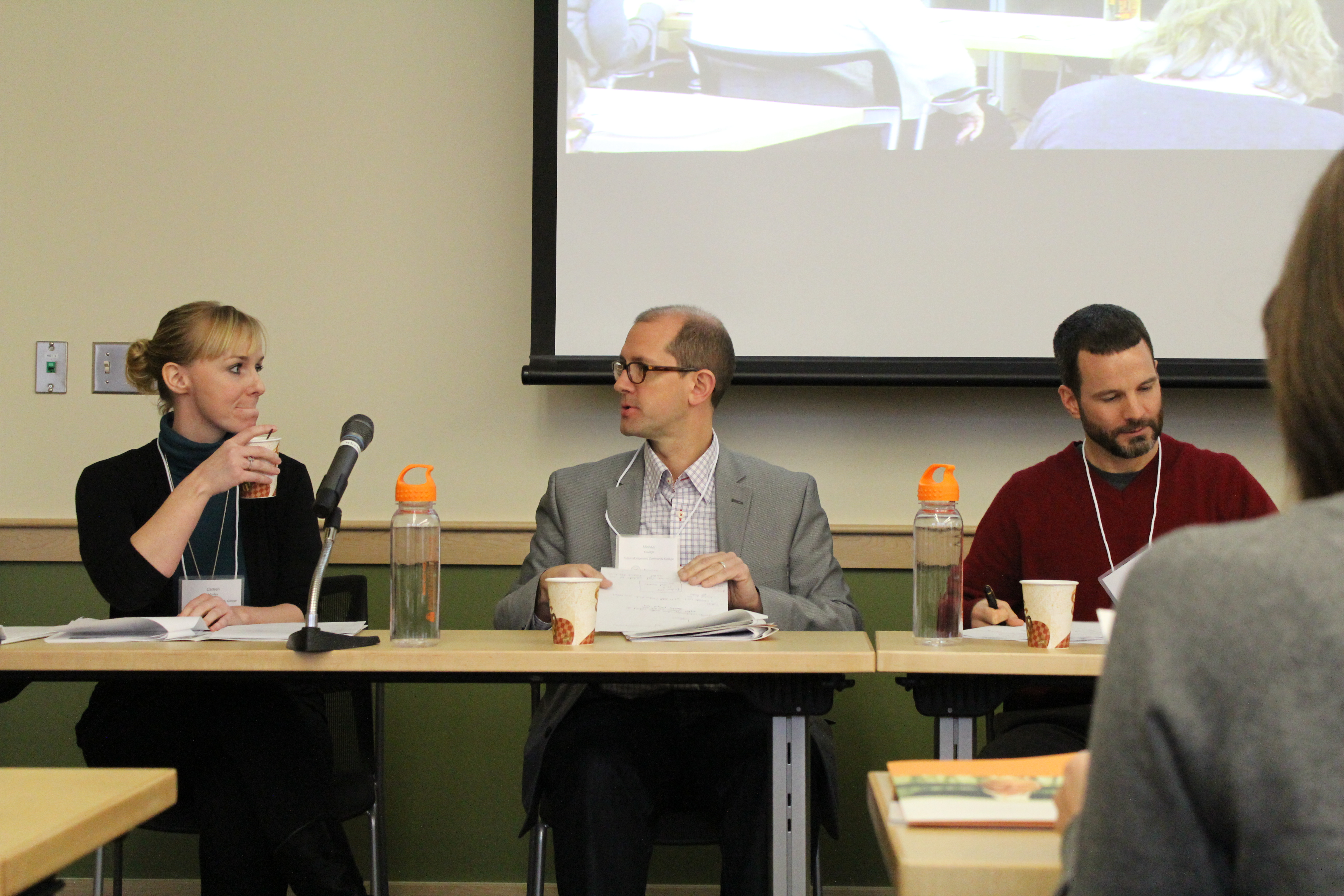
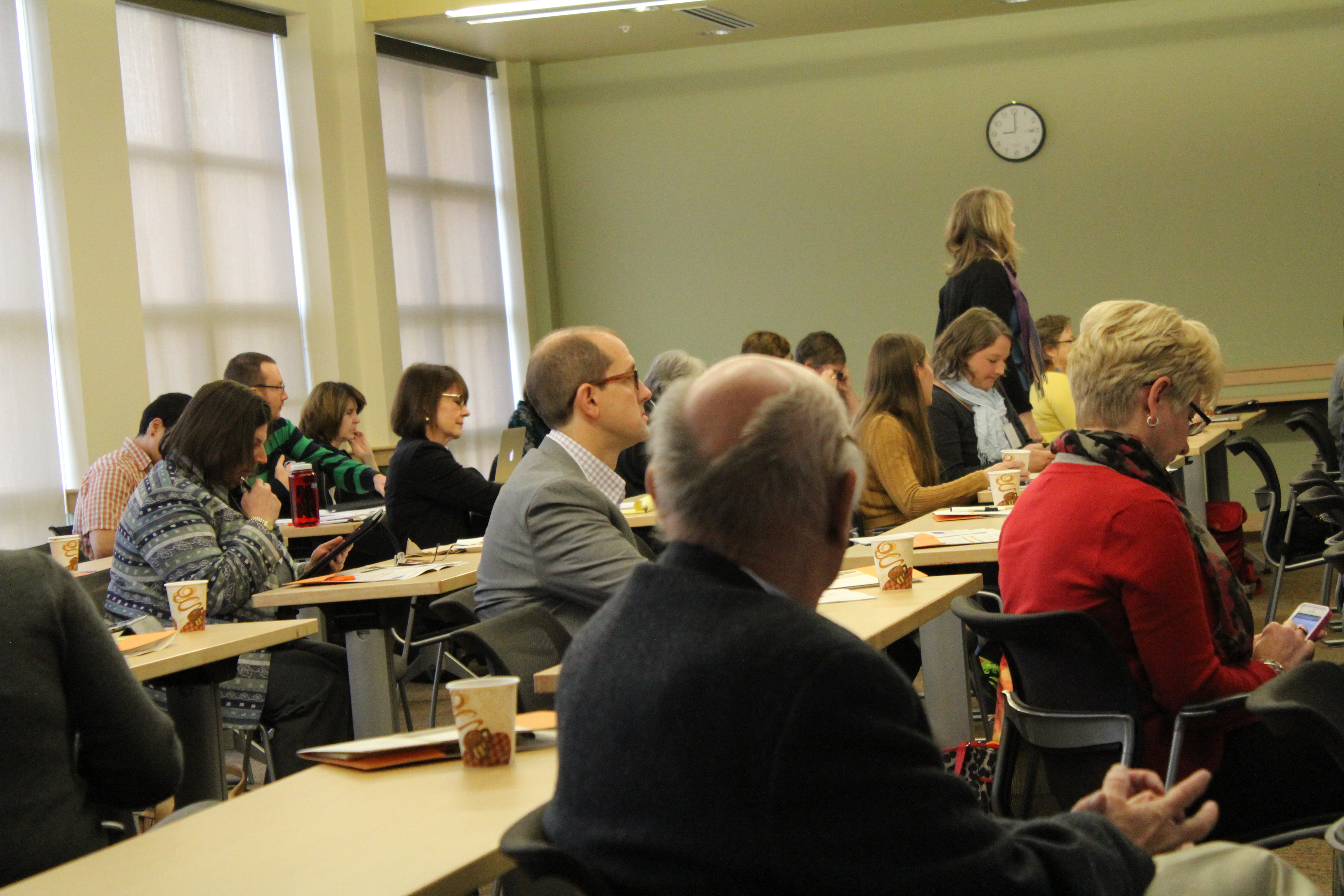
The December 17 and January 12 posts here on this blog discuss and link to materials from an event held on Friday, December 13,  when approximately 50 librarians, faculty members, instructional technologists, and others gathered together for a SUNY grant-funded Conversation in the Disciplines. It was entitled Developing Metaliterate Learners: Transforming Literacy Across Disciplines. There were lots of “aha” moments. One that really struck a chord was a comment by Rick Fogarty, Associate Professor of History, on the morning panel.  He mentioned that the Greek meaning of “meta” is “after,” although it is used in a somewhat different manner today. He pointed out that metaliteracy is what comes after literacy, which gives us much to mull over. These pictures perhaps convey the energy of the event. (Thank you to Ashley Smolinski and Kelsey Moak, event photographers.)

Photo by Ashley Smolinskli

Irina Holden, Deborah Bernnard, Tor Loney

IMG_4889

Tom Mackey and Trudi Jacobson

IMG_4909

Carleen Huxley, Mike Youngs, Rick Fogarty

Attendees at the Conversation in the Disciplines

Attendees at the Conversation in the Disciplines

IMG_4922Michele Forte introducing the afternoon reaction panel: Tor Loney, Ashley Smolinksi, Karen Mahar, and Paige Jaeger

Randy Hensley, afternoon keynote speaker

Randy Hensley, afternoon keynote speaker

Metaliteracy Presentation Videos Now Available via ESC-TV

As part of our SUNY wide Conversations in the Disciplines event hosted at Empire State College, we recorded the keynote presentations and panels. These videos are now available via ESC-TV and include the morning keynote presentation by Tom Mackey and Trudi Jacobson, entitled Developing Metaliterate Learners: Transforming Literacy Across Disciplines.  We also feature the morning Reaction Panel with Richard Fogarty, Carleen Huxley, and Michael Youngs.  The afternoon sessions are also available, including the keynote presentation by Randy B. Hensley and Reaction Panel: Brian Morgan, Paige Jaeger, Tor Loney, Karen Mahar, Dave Brown, and Ashley Smolinski.  All of the videos are available at Metaliteracy Conference 2013.