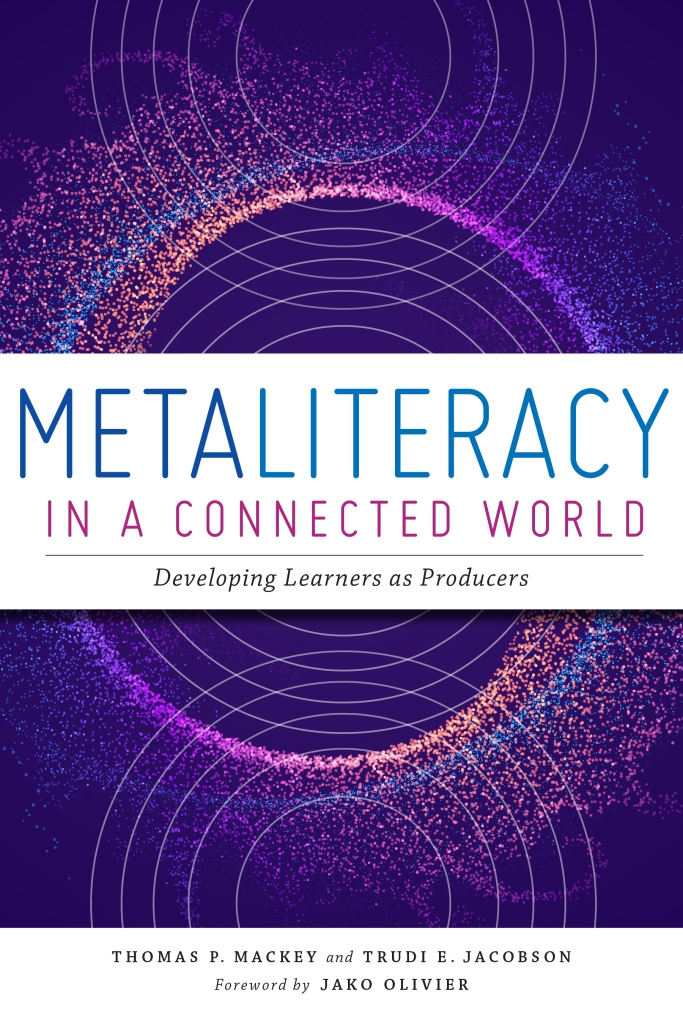
The new book co-authored by Thomas P. Mackey and Trudi E. Jacobson entitled Metaliteracy in a Connected World: Developing Learners as Producers has been published by ALA Neal Schuman! The idea of learner as producer is foundational to the metaliteracy framework and is explored in depth in this new publication.
The book’s Foreword is written by Jako Olivier, UNESCO Chair on Multimodal Learning, and OER Professor in Multimodal Learning, North-West University, South Africa.
According to the press release from ALA Publishing, the new metaliteracy book “offers an overview of the development of the metaliterate producer through metaliteracy’s goals, learning objectives, learning domains, active learner roles, and associated characteristics” and “explores the ways in which metaliteracy provides scaffolding for open pedagogical settings, encouraging students to understand and embrace their active roles,” among other highlights.
The new book examines metaliteracy in relation to such timely and relevant themes as self-directed learning, multimodality, open pedagogy, digital citizenship, and developing a growth mindset. Metaliteracy in a Connected World is organized into six related chapters:
Chapter 1: Metaliteracy for Empowering Learners as Producers
Chapter 2: Engaging Metaliterate Producers through Multimodal Learning
Chapter 3: Metaliteracy and Open Pedagogy
Chapter 4: Developing Metaliterate Producers Using Open Pedagogy
Chapter 5: Designing an Online Metaliteracy Course to Engage Informed Producers
Chapter 6: Developing Productive Metaliterate Citizens with Growth Mindsets
This is the fourth book about metaliteracy and presents a fully realized model that has developed considerably since we first introduced the concept in 2011. We look forward to your feedback and welcome the opportunity to engage with audiences about the themes examined in each chapter!
In this new segment, Trudi discusses the value of renewable assignments, i.e., assignments in which students create content that is useful to others, not meant simply for their professors’ eyes alone. Such assignments help individuals to become metaliterate learners and responsible digital citizens. Her example involves editing content in Wikipedia and the important scaffolding that metaliteracy can provide. If you get a chance, listen (or read it, the text is provided). The Academic Minute is produced for NPR by our local WAMC public radio station.
This is the second time metaliteracy has been featured on the program. Tom Mackey’s segment, Metaliterate Learners, aired on May 18, 2020.
Trudi and Jackson Grey, a student in her fall 2021 Information Literacy in the Humanities and Fine Arts course, presented at the virtual 2021 WikiConference North America in October. This course uses a combination of the Wiki Education program, metaliteracy, and frames from the ACRL Information Literacy Framework for Higher Education to encourage students to see themselves as ethical and responsible information producers.
The Wiki Education program provides excellent training for novice Wikipedia editors, but a conceptual understanding of the value of information, as well as scaffolding to recognize themselves as information producers, can provide a rich underpinning for this new set of skills, a background that will help them to see the value of their contributions, and encourage them to continue as metaliterate Wikipedia editors.
Jackson, a senior at the University at Albany majoring in philosophy, provided a student’s viewpoint in such a learning situation where It is possible to share growing knowledge in a field of study. He also explored the differing values of information, inherent vs. as a means to an end, and the disconnect between the availability of information and its importance.
The presentation is available on YouTube as part of a day of programs. It starts at 6:05, and this link is set to start at that point.
In a second metaliteracy presentation, Prof. Tom Mackey collaborated with Prof. Sheila Marie Aird on Collaborating to Teach Global Digital Storytelling Online. Tom and Sheila’s presentation explores how they applied metaliteracy to the design of a Digital Storytelling course they co-teach at SUNY Empire State College as a fully online international experience. Their slideshow is available via their Global Digital Stories blog.
“Anyone could make edits, and anyone could challenge those edits…This helped me feel less like an outsider trying to fit into a conversation and more like one of a million voices that were working together towards a shared goal of information creation and consumption.”
It is not only illuminating, but also vital to hear from learners about the impact of their encounters with metaliteracy. Asking them to write reflective pieces is one way to find out how components of metaliteracy may have had an effect on their learning. A recent Wiki Edu blog post by Corrin Baker, a graduating senior at The University at Albany, provides such insight. Corrin expanded a wonderfully written course reflection for this post about a course taught by Prof. Trudi Jacobson.
In describing metaliteracy’s producer role, Ms. Baker wrote:
The shared roles of producer and consumer were present in every step of the course. I was fully engaged in locating and evaluating sources, and then finding ways to make that information both understandable and accessible. I felt a great sense of responsibility to the audience and to the authors whose work I was using. I was also far more aware of diversity in a global audience, especially as I found myself struggling to find non-male authors to cite.
The course, which lasts just seven weeks, is challenging for students, but aims to have a lasting effect on their understanding of information and their roles in producing and sharing it. Corrin’s reflection testifies to the incredible impact that the blend of metaliteracy, information literacy, and the wonderful Wiki Education program can have.
The new metaliteracy book written by Tom Mackey and Trudi Jacobson will be published by ALA/Neal Schuman in summer 2021!
The fourth metaliteracy book in a series is entitled Metaliteracy in a Connected World: Developing Learners as Producers and will focus specifically on the metaliterate learner as informed and ethical producer of information in collaborative social settings. The Foreword to this book will be written by Jako Olivier, UNESCO Chair on Multimodal Learning, and OER Professor in Multimodal Learning, North-West University, South Africa.
In this newest book in their series, the authors carefully examine the central role of learners as producers of information, a foundational idea for the metaliteracy framework and one that’s more important than ever in our current media and information environment. They emphasize the active role today’s learners play as individual and collaborative metaliterate producers of information in various forms, including writing, digital stories, digital artifacts, and multimedia productions. The authors explore a range of connected social settings from online courses to social media to open learning environments.
We are excited to announce the forthcoming publication of our next book and will provide updates via Metaliteracy.org as we get closer to the publication date so stay tuned!
SUNY Online has just published their schedule of events for 2021’s Open Education Week.There are a number of presentations from Monday, March 1 to Friday March 5, several of which fit in well with the very metaliterate idea of learner as producer.
On Tuesday, March 2 at 10:00 ET, Trudi will be presenting “Enhancing Student Engagement Through Scaffolded Non-Disposable Assignments,” in which metaliteracy will be playing a starring role! At least one of her current students plans to participate, providing his views as a counterpoint.
Perhaps you will be able to attend one or more of the sessions. The registration link is available on the schedule of events page.
There are a number of components in Wikipedia that align with the Framework, suggesting that an analysis of Wikipedia might serve as a contained but rich case study of how the Framework can serve as a construct whose utility extends beyond individuals’ information literacy understanding and progress. Individual frames shed light on this resource, and metaliteracy, which influenced the Framework, highlights additional elements of Wikipedia, particularly as an immersive teaching tool.
This descriptive analysis of the Empowering Yourself in a Post-Truth World MOOC shows how metaliteracy is embedded in the course to prepare learners as informed consumers and ethical producers of information. Participants gain insights about their affective responses to information by reflecting on their preconceptions and conducting research to create a digital artifact. The course-specific learning outcomes in each module are based on the metaliteracy goals and learning objectives and associated components such as the learner roles, learning domains, and characteristics.
(Mackey, p. 357)
We welcome your feedback about these new metaliteracy articles and look forward to being in dialogue with you in 2021!
Trudi Jacobson, Distinguished Librarian at the University at Albany, SUNY taught a first year experience (FYE) course this fall, one which concentrated on introducing students to topics such as selecting a major, time planning, study skills, financial literacy, and of course metaliteracy. Students worked through the SUNY OER Services’ iSucceed College Success course which includes a robust metaliteracy module (another version of Lumen Learning’s College Success doesn’t contain the metaliteracy module). In order to give students an opportunity to put what they were learning into practice, Trudi asked them to work on creating helpful content for other first-year students. This information would be added to a website that can be shared with other first year students. Groups of three students tackled an FAQ and a number of zines providing tips for this particular population. Extra credit assignments yielded two more helpful resources, one in audio and one in video format. Five examples of a course infographic project were also added to the site. A student took photos for the header for each page. Students not only had become information producers, but also teachers as well.
The site is being promoted through social media, and soon will be shared with other instructors in the program as well as students in the University at Albany’s Writing and Critical Inquiry Program (another first-year course). Most of the advice on the site is not specific to UAlbany, so please feel free to share it with others who might be interested. Take a look!
This guest blog post is by Dr. Valerie Hill, Director of the Community Virtual Library (a library in virtual learning environments) and researcher of changing literacy in digital culture. Valerie believes metaliteracy aligns well to our philosophical era which many are beginning to call “metamodernism”.
Her recent book, Metamodernism and Changing Literacy: Emerging Research and Opportunities, focuses on metaliteracy for all age groups through an exploration of our metamodern moment. In the Foreword to this book, Thomas Mackey states, “Hill provides a fascinating exploration of metamodernism through the perspective of metaliteracy. This intersection between both theories is vital to our understanding of the relationship between digital culture and literacy.”
Certainly, over the past few months instructors and learners have been challenged by the need to plunge into virtual learning environments (like it or not!) due to Covid 19. Many educators have scrambled to learn new tech tools connecting to students through ZOOM and other apps. Obviously, lecturing online through a web camera has obstacles and limitations as there is little chance for interactive hands-on learning without a “shared space”. Entering virtual platforms for learning requires metaliteracy and the ability to reflect on information in multiple formats as we participate in digital spaces both consuming and producing information. We are surrounded by evidence that metaliteracy is essential, realizing that literacy is no longer defined as the ability to read and write. Options for online learning continue to evolve and a look at our philosophical era in relation to literacy helps us understand how deep learning can occur today and in the future.
The End of Postmodernism
Metaliteracy, as defined by Mackey and Jacobson (2014), is a term developed to better understand the need for digital citizens to reflect on their own literacy in globally networked culture through four domains: behavioral, cognitive, affective, and metacognitive. The ongoing process of learning through these domains takes place again and again over time. This need for metaliteracy was a perfect match to the changing era of postmodernism and the rise of networked culture; however, it is even more critical as we move beyond postmodernism. Several new concepts are emerging, such as: post-postmodernism, post-millennialism, trans-postmodernism, and the term used in this writing, metamodernism.
One of the hallmarks of postmodernism was deconstructionism and the tearing down of grand narratives and established belief systems. Postmodernism emphasized irony, engendered an abundance of dystopian literary works, and promoted a sense of the “death of history”. Metamodernism, in contrast, allows room for hope. Vermeulen and van den Akker (2010, p. 2) suggest, “History, it seems, is moving rapidly beyond its all too hastily proclaimed end.” Understanding changes in literacy may be better understood by exploring metamodernism and embracing metaliteracy.
Metaliteracy in Virtual Spaces
Literacy, we all know, has been revolutionized by digital culture bringing opportunities to access, create and curate content through a plethora of apps and digital platforms. Rapidly expanding digital tools have disrupted education, leading to the need for new nomenclature and a new look at literacy. As information landscapes continue to evolve, metaliteracy addresses goals and learning objectives for digital citizens which include 1) Evaluation of content and bias; 2) Advocating respect for intellectual property; 3) Producing and sharing through collaboration; and 4) Adapting to change through lifelong personal and professional goals.
While innovative learning spaces can be new and exciting, the metamodern individual seeks a balance of innovation with respect for history and tradition. Much can be gained by studying the past and reflecting on the learning journey of those who lived before us. These oscillations between the past and the present, between the physical and the virtual (or digital), and between numerous opposing concepts (the concrete and the abstract) surround us in our metamodern world and impact literacy as we juggle and swing between them in our minds. This juggling between modes of literacy and thinking influences our behavior, our knowledge and understanding, our feelings toward information, and our reflection on how we learn (notice the four domains of metaliteracy).
Choosing the best learning environment is challenging for educators and for learners as online classroom management platforms compete to provide educational applications and virtual spaces (even VR headsets) continue to rapidly expand. Many online spaces offer little interaction beyond observation through a webcam or interactive chat. Evaluating the criteria necessary for specific learning objectives is critical and a shared sense of place and presence can be of tremendous value.
3D virtual environments may play a greater role in simulating a shared learning experience using avatars, a simulated space across distance with the ability to learn in collaboration in a persistent environment (a space that remains over time rather than a one-time disposable experience). Research has documented the potential for high quality educational simulations for over fifteen years. Virtual worlds, such as Second Life or Kitely, offer learners tools to build alone or in collaboration with others. These virtual learning spaces require metaliteracy as users employ various new skills such as embedding online media, coding and scripting, using voice or text, collaborative building, applying the laws of physics, or back channeling through other platforms to communicate.
Learners in a 3D Virtual Environment (Second Life) 2020
Great potential for learning and creating in virtual environments is evident; yet, so too is the need for a balance between the virtual world and the physical world. Metamodernism calls for a balance of both worlds and an appreciation of both. The process of becoming metaliterate is lifelong and the metamodern individual must be aware of the personal responsibilities we each hold as digital citizens. As XR (Extended Reality), VR (Virtual Reality), AR (Augmented Reality) and MR (Mixed Reality) continue to evolve, metaliteracy will become essential to education and daily life. Certainly, the unprecedented shutdowns caused by Covid 19 have brought a new appreciation of our physical world and our social interactions. A deep appreciation for the physical world alongside multiple “realities” is a metamodern concept.
Metaliteracy for all Age Groups in Digital Culture
From infancy through old age, we are all called upon to become digital citizens in today’s globally connected culture. Tiny tots see digital devices around them from birth and elderly people are often expected to utilize digital modes of communication from email and online shopping to texting and social media. Much of our online interaction takes place through social media and networked communities. “Metaliteracy promotes critical thinking and collaboration in a digital age, providing a comprehensive framework to effectively participate in social media and online communities” (Mackey and Jacobson, 2011, p. 62).
Becoming metaliterate is a process that begins at birth with the modeling of literacy (print books preferred for infants and toddlers!) imperative to development. Parents, children, educators, students, and lifelong learners are challenged to develop a personal awareness of metaliteracy and to “apply metaliterate learning as a lifelong value and practice” (Metaliteracy Goal 4:9) (Jacobson, et. al., 2019).
References
Hill, V. J. (2020). Metamodernism and Changing Literacy: Emerging Research and Opportunities. Hershey, PA: IGI Global.