Metaliteracy Recording from LIT Virtual Conference Now Online

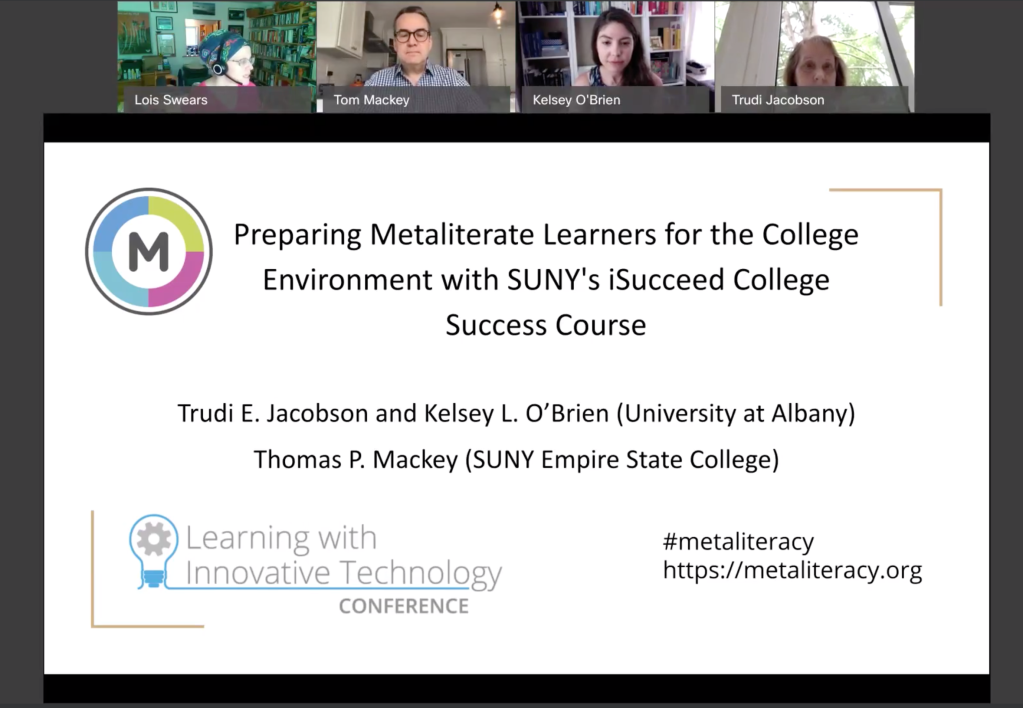
Image of Webex recording of metaliteracy presentation.

The Webex recording of the metaliteracy presentation at the Learning with Innovative Technology (LIT) Conference Virtual Conference is now available online. The session recording entitled Preparing Metaliterate Learners for the College Environment with SUNY’s iSucceed College Success Course by Trudi Jacobson, Kelsey O’Brien and Tom Mackey examines the metaliteracy module designed for the Lumen Learning iSucceed College Success course.

This fully open and flexible resource was developed for SUNY OER Services and is adaptable to both K-12 and higher education settings.The presentation explores the current learning environment, including the challenges of the COVID-19 pandemic, provides an overview of the iSucceed College Success Course, and takes a deep dive into the metaliteracy module based on the metaliteracy framework. Several suggestions for adapting the metaliteracy module to your setting are discussed. This talk also refers to openly available resources for teaching with metaliteracy, including videos, interactive learning objects, and specific segments from the iSucceed module.

All of the slides from the presentation Preparing Metaliterate Learners for the College Environment with SUNY’s iSucceed College Success Course are available as well. The LIT conference web site at SUNY Empire State College includes this presentation, along with all of the recorded presentations from this event.

Metaliteracy Presentation at LIT Virtual Conference

The Learning with Innovative Technology (LIT) Conference at SUNY Empire State College will include a presentation by Trudi Jacobson, Kelsey O’Brien and Tom Mackey about the development of a metaliteracy module for the Lumen Learning iSucceed College Success course. The presentation, entitled Preparing Metaliterate Learners for the College Environment with SUNY’s iSucceed College Success Course, will take place at this virtual conference on Friday, July 10 2020 at 9:15am EDT (UTC -4).

Students entering or preparing for college typically find themselves in a very different environment from high school. They must make more decisions on their own, from organizing their time to making health-related choices. How they engage with information must also change based on the demands of the college experience. Becoming producers of information in both academic and quotidian settings that are often collaborative and online requires a shift in mindset that can benefit students throughout their lives. COVID-related circumstances may cause many more students to live at home while starting college, requiring them to take on new responsibilities and self-regulation strategies without the typical face-to-face support from instructors and peers. 

SUNY OER Services has adapted Lumen’s “College Success” online course to include two new modules in its “iSucceed” version, one of which focuses on metaliteracy. This course is available not only to SUNY students but also, in a modified form, to anyone interested in applying the metaliteracy model to lifelong learning. This session will provide a brief overview of the iSucceed College Success course and then focus on how the metaliteracy course module can be used to introduce students to the importance of this information and learning framework. As educators transition to fully online, blended, and remote learning in response to the COVID-19 crisis, this new metaliteracy resource provides adaptable content for both K-12 and college settings. The metaliteracy module guides students through this process as they learn the definition of the term, examine metaliterate learner roles, goals, and characteristics, and explore how to become a metaliterate digital citizen. This flexible, interactive unit includes videos, assignments, and self-check quizzes that are adaptable to a range of disciplines and educational settings.

Metaliteracy Presentation at the Information Literacy & Democracy Conference

Tom Mackey and Trudi Jacobson will present Advancing democratic dialogue by applying metaliteracy in teaching praxis at the Information Literacy & Democracy Virtual Conference June 19-20. The video presentation is available in advance of the conference and their live session will take place on June 19 at 11:30 am Eastern Savings Time (5.30 p.m Central European Summer Time – CEST). To join the live session, register for free by sending an e-mail to infodem (at) uni-hildesheim.de. All of the conference presentations are available via the Information Literacy & Democracy conference web site and YouTube. The Information Literacy and Democracy (IDE) project is supported by the Ministry of Science and Culture of Lower Saxony, Germany.

Tom and Trudi’s presentation explores metaliteracy as a pedagogical model to develop a metaliteracy mindset for effectively consuming, producing, and sharing information. This comprehensive framework promotes democratic dialogue with learners to uphold democracy in a post-truth world of misinformation and disinformation. This presentation describes the four components of metaliteracy and offers ideas for advancing democratic dialogue with learners.

Metaliteracy Keynote Features Open Resources for Teaching and Learning at a Distance

Tom and Trudi at Virtual Keynote

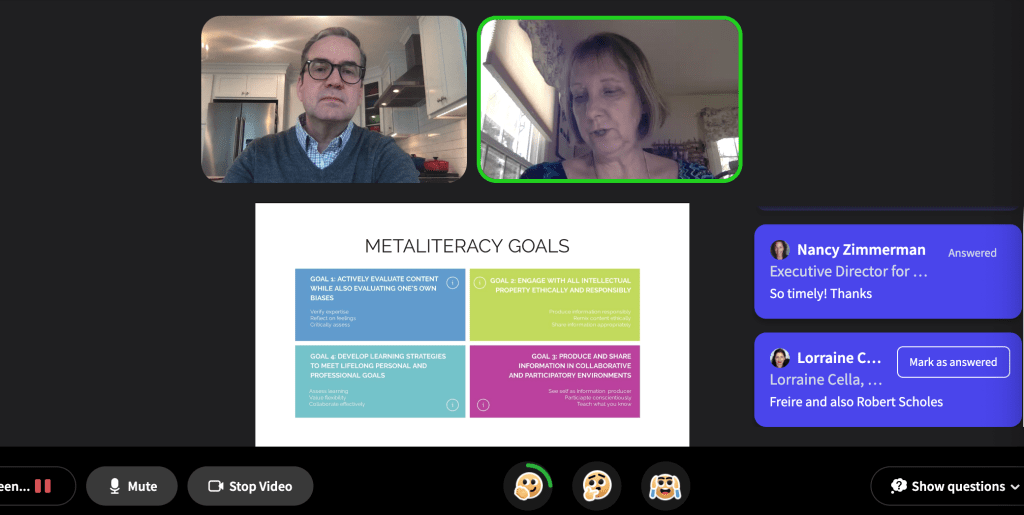
Trudi Jacobson and Tom Mackey keynoted on Teaching Metaliteracy as a Vital Literacy for Today’s Digital World at the Edge consortium’s Annual Teaching with Technology Showcase: Excellence in Action on April 24. This conference was transitioned to a virtual format as a result of the COVID-19 crisis and the presentation includes open resources that are available to faculty and librarians who have transitioned to online and remote teaching during this crisis. The keynote also features adaptable reflective questions about the information we consume, produce, and share at a time when accurate and reliable information is more important than ever. Trudi and Tom were invited to keynote by Nancy Zimmerman, Executive Director for EdgeEvents and Print Communications. Edge is the regional technology partner for colleges and universities in New Jersey. If you have any questions about the slides or would like to continue the conversation let us know!

Metaliteracy Resources for Online or Remote Teaching & Learning

As educators respond to the COVID-19 crisis and transition to online and remote learning, or expand what they are doing at a distance, consider several metaliteracy resources that are adaptable for these purposes. We’ve seen an increase in the use of our MOOCs during these unprecedented times and would like to highlight those resources and other OER that were designed for teaching and learning with metaliteracy:

iSucceed College Success – SUNY OER Services recently launched this expanded College Success course with a new metaliteracy module to prepare students for the college environment. The Metaliteracy Module is adaptable to K-12 and college environments and provides open content, learning objects, videos, and assignments that are adaptable to your educational setting.

Metaliteracy: Empowering Yourself in a Connected World – This was our first Coursera MOOC that introduces metaliteracy and was recently revised with updated content and streamlined to a four-module format.

Empowering Yourself in a Post-Truth World – This Coursera MOOC addresses the challenges of the post-truth world and is especially relevant now that accurate and reliable information is paramount during this global pandemic.

Metaliteracy Digital Badging – All of the content developed for our Metaliteracy Digital Badging system is openly available to apply online and through remote learning.

Metaliteracy Learning Goals and Objectives – This resource is at the heart of metaliteracy and has undergone revisions to address post-truth issues while expanding to include several new translations to address the international interest in metalieracy.

Metaliterate Learner Roles – This diagram features the essential metaliterate learner roles and associated questions that spark reflection and online discussion in multiple disciplines.

Metaliteracy and Your Role as a Metaliterate Learner – This resource also features the learner roles and the four domains of metaliteracy and features reflective questions written and shared by Professor Sally Friedman, University at Albany.

Metaliterate Learner Characteristics – This interactive learning object highlights the characteristics that individuals strive toward as they develop as metaliterate learners.

Metaliterate Learner Characteristics Aligned with the ACRL Framework Dispositions – This open model is ideal for faculty and librarians teaching information literacy with the ACRL Framework while incorporating key elements of metaliteracy.

Metaliteracy YouTube Channel– All of the videos we’ve created for our MOOC projects are openly available in one location via the Metaliteracy Learning Collaborative YouTube Channel.

Additional resources are available through this blog and if you would like to share any open metaliteracy resources that you have developed be sure to let us know.

Take care and be well during this challenging time.

Tom, Trudi, and Kelsey
Knowing Metaliteracy: A reflective digital story of my metaliteracy journey

We thank Mehreen Tahir, Information Commons Librarian at Forman Christian College, for providing this guest posting about Knowing Metaliteracy: A reflective digital story of my metaliteracy journey. Mehreen developed this final project as part of her participation in our Coursera MOOC, Metaliteracy: Empowering Yourself in a Connected World. We invite you to do the same!

Greetings Everyone,

I am excited to share that I have successfully completed the Coursera online course Metaliteracy: Empowering Yourself in a Connected World by The State University of New York (SUNY). Metaliteracy has always been my area of interest and thanks to the instructors Tom Mackey and Trudi Jacobson for developing this course with their colleagues at SUNY. This MOOC experience was an amazing learning opportunity for me to explore the concept of metaliteracy, its various learner roles, Creative Commons licensing, creating digital stories, and much more. 

My digital story is basically a reflective journey of my understanding of the different metaliteracy learner roles and the way I identified them during this course. It helped me in recognizing the roles I have been silently playing in my activities online through different social media platforms, such as Facebook and Instagram on a daily basis, but also urged me to build a creative thinking mechanism to incorporate these roles in the future as well. I feel like developing a sense of being a responsible digital citizen, reflecting upon my own experiences while navigating through these 21st century social media environments. Hoping to learn and explore more in this area.

Thanks,

Mehreen Tahir

New Book about the ACRL Framework Includes Metaliteracy

The new book edited by Heidi Julien, Melissa Gross, and Don Latham The Information Literacy Framework: Case Studies of Successful Implementation, features a Foreword written by Trudi E. Jacobson and a metaliteracy chapter authored by Tom Mackey. Trudi’s perspective as co-chair of the Association of College and Research Libraries (ACRL) task force that developed the ACRL Framework for Information Literacy for Higher Education, informed her Foreword for the book. Trudi noted that: “The chapter authors and editors of this volume have done a great service for librarians and other educators who wold like to expand their understanding of the potential impact and use of the Framework and add to their repertoire of ways for integrating it into their work” (p. xi).

The ACRL Framework was influenced by aspects of metaliteracy and in his chapter entitled “Exploring Metaliterate Learning through the Frames of Information Literacy,” Tom Mackey investigates both models as complementary. In particular, he examines the final project assignment in the metaliteracy MOOC Empowering Yourself in a Post-Truth World as an example of metaliterate learning from the perspective of the six frames of the ACRL Framework. He also argues that “The metacognitive aspect of metaliteracy has been a driver for these projects and suggests the need for further development of this approach in information literacy as well” (p. 217).

This new book, published by Rowman & Littlefield, includes 18 different case studies from librarians and faculty members who have experience applying the ACRL Framework in practice. Take a look at the range of the chapters–you are certain to find some pertinent to your interests!

Metaliteracy Post-Truth MOOC is Popular and Recommended

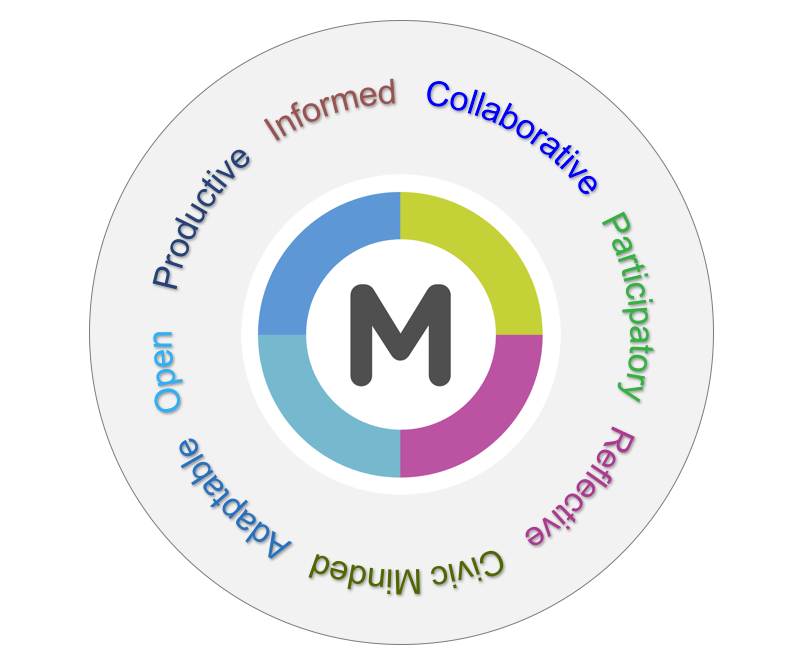
Characteristics of the Metaliterate Learner (Mackey & Jacobson, 2019)

According to Class Central, the Coursera version of our most recent metaliteracy MOOC Empowering Yourself in a Post-Truth World is one of 2019’s Most Popular Online Courses. The founder and CEO of Class Central, Dhawal Shah noted that his site aggregates MOOCs and collects course enrollment data from MOOC providers as well as data from learners at Class Central to arrive at the list of most popular online courses.

In another recent mention of our Metaliteracy MOOC, Jessica Stillman Contributor at Inc.com recommended Empowering Yourself in a Post-Truth World in her latest article “20 Online Courses That Will Make You More Successful in 2020.” According to Stillman, she selected “classes in everything from exercise to data analysis that will help you be more motivated, productive and successful this year.” Our MOOC was mentioned along with classes from around the world about such topics as Statistics, Artificial Intelligence (AI), Design, Writing and Public Speaking, Critical Thinking, and Ethical Hacking. We join Jessica Stillman in wishing everyone a productive and successful 2020!

Open Pedagogy and Metaliteracy Topic of ICIL Keynote

bC19g0oxRyOYV6LZ+rTnmw

Trudi Jacobson keynoting at ICIL in South Africa

Trudi Jacobson gave the last international keynote address at the International Conference on Information Literacy (ICIL) at North-West University (NWU) in Vanderbijlpark, South Africa on September 26. Her topic was Creating Shareable Knowledge: Exploring the Synergy between Metaliteracy and Open Pedagogy. She spoke about the components of open educational practices, including open educational resources, open pedagogies, open learning, open sharing of teaching ideas, and open technologies. She then asked participants to put themselves in the role of a student and to consider what might be different about their learning experience if open played a role. (Their responses are here, please feel free to consider the question and add your own ideas.)

Trudi delved into how metaliteracy can both scaffold and add to student learning in open pedagogical settings, using Caroline Sinkinson’s open pedagogy model to make connections. Trudi concluded by exploring the connections in two case studies. One, which was analyzed in-depth, is an information literacy/metaliteracy course in which students contribute to Wikipedia. The second, discussed more briefly, is a political science course in which metaliteracy OER play a large role and encourage elements of open pedagogy. If interested in this latter course, look for an article next year in the International Journal of Open Educational Resources that explores this professor/librarian collaboration in more depth.

Applying Metaliteracy in Teaching and Learning Practices Session at ICIL, South Africa

nehNGVV0RGy+w5uwom2FIA

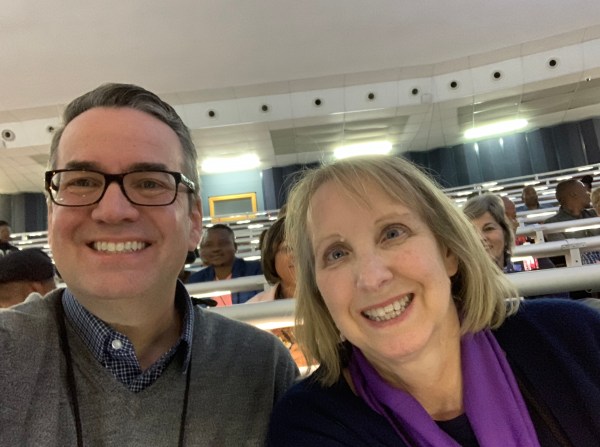
Tom Mackey and Trudi Jacobson

Tom Mackey’s and Trudi Jacobson’s last, and rather unexpected, joint presentation while they were in South Africa was a session on September 25 at the International Conference on Information Literacy (ICIL) at North-West University (NWU) in Vanderbijlpark, South Africa. They were invited to give this presentation by Dr. Jako Olivier when another presenter’s session fell through. The presentation, Applying Metaliteracy in Teaching and Learning Practices, was very well attended, particularly for a last minute addition to the schedule. Trudi and Tom explored changing literacy types, the value of metaliteracy in an environment of competing and overlapping literacies, core components of metaliteracy, and the open educational resources available to embed in disciplinary courses. This last part of the presentation focused on the metaliterate learner badges and the metaliteracy MOOCs (massive open online courses), although other resources were also described.