by Gabrielle Lerner
We welcome this guest post from Gabrielle Lerner, Student Government Association President and a graduate student in the MPA Program at Empire State University!
What is information? Is it the truth or perspective? What are we interpreting, and how do we know? Are we considering a lens or a fragment of something that is before us? I want to see information and feel that it is true—to discern its actuality. Can we feel information, like the vibration of a song? Is the goal for it to resonate and transcend our logical minds, or do we compare its intensity and velocity to standing on a mountain high up in the sky?

These were just some of the questions that stirred my curiosity during my metaliteracy course, an experience that transformed how I view and engage with information.
About three years ago, I had the incredible opportunity to take this course, and it remains one of the most profound educational experiences of my life. The course, Intercultural Perspectives on Information Literacy and Metaliteracy, brought together a diverse team of students from across the globe, including Germany, Bosnia-Herzegovina, Austria, Poland, India, and the United States. Our differences enriched our collaboration, offering a tapestry of perspectives as we navigated complex questions about truth, bias, and the framing of information. I am deeply grateful for the experience and for the chance to work with such a talented and thoughtful group of individuals.
As a group, we focused on the ways information is created, shared, and consumed, using an infographic as our lens. Our discussions delved into the complexities of citing general information, which can transform into something deeply specific with just the click of a button.
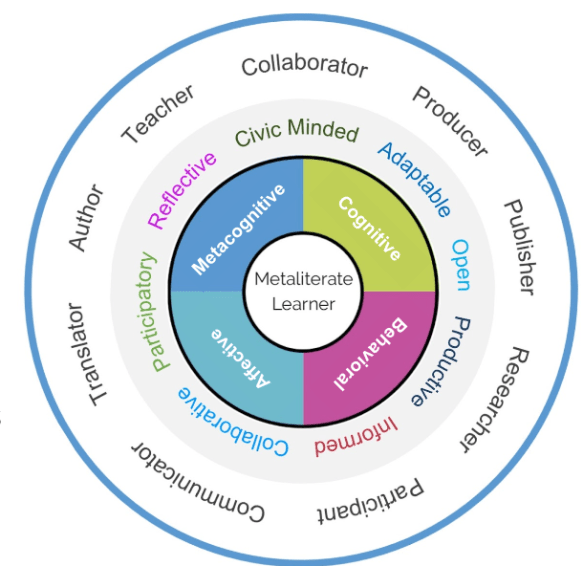
One of our most memorable exercises involved using the Metaliteracy wheel to assign roles within the group, ensuring that everyone contributed as a Teacher, Collaborator, Researcher, and Producer. This approach inspired us to be facilitators, speakers, and leaders. Together, we examined a controversial topic—climate change—from a perspective detached from the heated debates over causes or effects. Instead, we honed in on how information about climate change is produced, disseminated, and received.
The virtual landscape we explored was overwhelming at times, a maze of truths and half-truths that made us question what we thought we knew. We sought clarity amid the noise, sifting through scholarly articles, social media posts, and everything in between. We focused on how to identify credible channels, eliminate sensationalism, and help others do the same. We found fire in the footnotes of articles—the hidden truths buried in citations—and realized that even well-meaning authors could unknowingly perpetuate bias.
What truly united us as a group was our shared identity as truth seekers. We questioned assumptions, evaluated impacts, and guided each other through challenging topics. Our discussions were not just about information but also about who we are as learners and communicators. How do we ensure our voices contribute to a clearer understanding rather than adding to the clutter? How do we empower others to do the same?
The course was not only intellectually stimulating but also personally transformative. As we investigated the nuances of information, we, too, changed. Our group—the “metaliterate bunch”—became a microcosm of the literacy goals we sought to understand. We discovered that learning is as much about collaboration and introspection as it is about seeking answers. By the end, we had not only found the “key” to navigating the noise of the information age but also grown as individuals committed to a lifelong pursuit of truth.
Reflecting on this journey, I’m filled with gratitude for the experience and for my teammates, who inspired and challenged me every step of the way. The course taught me that being metaliterate is not just about understanding information; it’s about embracing the complexity of knowledge and striving to make sense of it with humility and curiosity.
 Metaliteracy.org